Why Fluticasone Propionate Leads the Intranasal Corticosteroid Category
Corticosteroid nasal sprays have been the clinical standard for allergic rhinitis treatment for over three decades — but not all of them are equivalent. Among the available intranasal corticosteroids, fluticasone propionate occupies a distinct position based on three pharmacological characteristics that collectively explain its widespread prescriber preference.
The first is receptor binding affinity. Fluticasone propionate has the highest glucocorticoid receptor binding affinity of any commercially available intranasal steroid — approximately 500 times greater than hydrocortisone and significantly higher than budesonide or beclomethasone. This translates into potent local anti-inflammatory action at lower deposited doses, reducing mucosal oedema, suppressing mast cell degranulation, blocking histamine and leukotriene release, and reducing eosinophil infiltration across the nasal epithelium with each actuation.
The second is systemic safety. Despite its potency at the receptor level, fluticasone propionate achieves near-zero systemic bioavailability when administered intranasally — approximately 1% or less reaches systemic circulation after nasal absorption and first-pass hepatic metabolism. This separation of local efficacy from systemic exposure is precisely what allows daily use over extended periods without the HPA-axis suppression, growth effects in children, or bone density concerns associated with systemic corticosteroids.
The third is its action on both the early and late phases of the allergic response. Many antihistamines address only the immediate histamine-mediated phase of allergic rhinitis. Fluticasone propionate suppresses both the early-phase mast cell response and the late-phase eosinophilic inflammatory cascade — providing 24-hour symptom control that antihistamines cannot replicate for nasal congestion, which is predominantly a late-phase phenomenon.
For pharmaceutical brands and ENT medicine companies evaluating a fluticasone nasal spray manufacturer in India, these pharmacological credentials represent a product with strong evidence, established prescriber confidence, and consistent long-term market demand.
Fluticasone Propionate Nasal Spray Uses — Conditions Across ENT and Allergy Practice
The fluticasone propionate nasal spray uses in clinical practice extend well beyond seasonal hay fever — covering a range of upper respiratory and ENT conditions where mucosal corticosteroid therapy is evidence-based.
Allergic Rhinitis — Seasonal and PerennialSeasonal allergic rhinitis triggered by pollen, grasses, and moulds — and perennial allergic rhinitis from year-round exposure to dust mites, pet dander, and cockroach allergens — are both primary indications for fluticasone nasal spray for allergies. Once-daily dosing of 100mcg (two sprays per nostril) provides 24-hour control of all four cardinal symptoms: sneezing, rhinorrhoea, nasal congestion, and nasal pruritus. For perennial rhinitis patients who require continuous long-term use, fluticasone propionate's minimal systemic absorption profile makes it the safest choice for sustained therapy.
Hay FeverHay fever — seasonal allergic rhinitis from airborne pollen — drives enormous prescription volumes for corticosteroid nasal spray during spring and monsoon seasons across India. Unlike oral antihistamines that relieve itching and sneezing but leave nasal congestion uncontrolled, fluticasone addresses the full symptom complex. Patients initiated on treatment 1–2 weeks before the anticipated pollen season achieve better seasonal control than those who start treatment reactively.
Nasal PolypsNasal polyps treatment spray with fluticasone propionate is evidence-based and guideline-supported. Intranasal corticosteroids reduce polyp size by suppressing the eosinophilic inflammatory process that drives their growth — particularly in patients with concomitant asthma or aspirin sensitivity. While larger polyps may require surgical intervention, fluticasone spray reduces post-surgical recurrence and manages smaller polyps conservatively, avoiding repeat procedures.
Chronic SinusitisIn chronic rhinosinusitis — where persistent mucosal inflammation blocks sinus drainage and perpetuates the infection cycle — sinusitis nasal spray India prescriptions incorporating fluticasone reduce mucosal swelling, improve sinus ostial patency, and decrease the inflammatory burden that prolongs sinusitis episodes.
Dust Allergy and Year-Round Nasal SymptomsNasal spray for dust allergy India demand is driven by India's high indoor dust mite allergen burden, construction dust, and pollution particulates. Patients with non-seasonal perennial symptoms benefit from maintenance fluticasone therapy that keeps nasal mucosal inflammation below the threshold of symptomatic response, reducing the frequency and severity of acute episodes.
Non-Allergic Rhinitis with Eosinophilia (NARES)Even in patients without documented IgE-mediated allergy, fluticasone propionate's eosinophil-suppressing action makes it effective for NARES — a condition characterised by persistent rhinorrhoea and congestion driven by eosinophilic mucosal inflammation rather than allergen-specific sensitisation.
Third Party & Contract Manufacturing — Fluticasone Propionate Nasal Spray
Demand for nasal spray for allergic rhinitis India is growing year-on-year — driven by rising allergen sensitisation rates, expanding ENT specialist density in Tier 2 cities, and increasing physician preference for intranasal corticosteroids over first-generation sedating antihistamines. Brands with a reliable, quality-assured manufacturing partner for fluticasone nasal spray hold a consistent supply advantage across both seasonal peaks and year-round perennial rhinitis prescribing.
Delwis Healthcare is a WHO-GMP certified third party pharmaceutical manufacturer and CMO partner for fluticasone propionate nasal spray — offering complete outsourced manufacturing for ENT brands, anti-allergic pharmaceutical companies, and export distributors.
Third Party Manufacturing — Your brand label on GMP-manufactured product. We handle API procurement, formulation, aseptic filling into metered-dose nasal spray bottles, crimping, carton packaging, and labeling under your registered brand name.
Contract Manufacturing (CMO) — End-to-end development and manufacturing from API qualification and formulation development through spray characterisation validation, stability studies, and commercial batch production with CDSCO-compliant documentation for your target market.
Private Label Manufacturing — Custom brand name, bottle label design, carton artwork, and patient instruction leaflet tailored to your ENT or anti-allergic product range positioning.
Bulk Supply — Consistent commercial batch volumes for institutional hospital formularies, government ENT department procurement, and export distributors with full batch COA and regulatory documentation.
Nasal Spray Manufacturing Capability — What Metered-Dose Nasal Spray Production Demands
Manufacturing a metered-dose nasal spray is technically distinct from liquid filling or tablet production. Dose consistency per actuation, particle size distribution of the spray plume, preservative system stability, and pump mechanism validation are all critical quality parameters that separate pharmaceutical-grade nasal spray from sub-standard generic alternatives.
Delwis Healthcare's WHO-GMP, ISO 9001, and ISO 14001 certified facility in Ahmedabad is equipped for this complexity:
- Controlled-environment aseptic processing suites for nasal spray filling — preventing microbial contamination of the aqueous suspension during production
- Calibrated metered-dose pump filling and crimping lines validated for consistent actuated volume per spray
- Particle size analysis capability confirming spray plume droplet distribution within the nasal deposition range
- Spray content uniformity testing across bottle life — first dose, mid-bottle, and last dose — confirming 50mcg/spray delivery throughout the 100-dose pack
- Viscosity and pH monitoring at validated in-process checkpoints ensuring formulation consistency batch-to-batch
- Electronic batch records and QMS documentation for every production run aligned with WHO-GMP audit requirements
Quality Testing — Batch Release Standards for Fluticasone Propionate Nasal Spray
Every batch of fluticasone propionate nasal spray IP manufactured at Delwis Healthcare clears a validated multi-stage quality control programme before release:
- HPLC Assay — Fluticasone propionate content quantified against certified reference standard per batch
- Spray Content Uniformity — Actuated dose per spray confirmed at beginning, middle, and end of bottle life
- Particle Size Distribution — Droplet size analysis confirming therapeutic nasal deposition range
- Pump Delivery Volume — Volumetric output per actuation verified within validated specification
- pH and Osmolarity — Confirmed within nasal mucosa-compatible range for patient tolerability
- Microbial Limit Testing — Preservative system efficacy and microbiological safety compliance per IP/BP pharmacopoeial standards
- Stability Studies — Real-time and accelerated ICH-compliant data supporting 24-month shelf life across the validated storage condition range
Why ENT Brands Choose Delwis Healthcare for Fluticasone Nasal Spray Manufacturing
Pharmaceutical companies and ENT product brands partner with Delwis Healthcare for fluticasone nasal spray contract manufacturing because of capabilities specific to nasal spray production that general tablet manufacturers cannot offer:
- WHO-GMP & ISO 9001/14001 Certified — Regulatory credentials accepted for CDSCO domestic approvals and international market submissions
- Metered-Dose Nasal Spray Expertise — Validated pump filling, crimping, and spray characterisation for consistent 50mcg/actuation across the full 100-dose bottle
- Aseptic Processing — Controlled-environment filling suites preventing contamination in the aqueous nasal suspension
- Spray Uniformity Validation — Full bottle-life content uniformity testing confirming dose consistency from first to last actuation
- ENT Product Portfolio Focus — Dedicated manufacturing experience across intranasal corticosteroids and ENT spray formulations
- Flexible MOQ — Pilot validation batches through large commercial runs scaled to seasonal demand cycles
- Full CMO Support — Formulation development, spray characterisation, stability data, and regulatory dossier preparation
- Competitive Manufacturing Cost — Cost-efficient nasal spray production from Ahmedabad without compromising critical dose consistency quality parameters
Fluticasone Propionate Nasal Spray — Questions from Prescribers, Patients & Manufacturing Buyers
Q1: What is fluticasone propionate nasal spray used for?
Fluticasone propionate nasal spray is used for allergic rhinitis (both seasonal and perennial), hay fever from pollen allergy, nasal polyps, chronic sinusitis, dust allergy with persistent nasal symptoms, and non-allergic rhinitis with eosinophilia. It relieves nasal congestion, sneezing, rhinorrhoea, and nasal itching by suppressing the underlying mucosal inflammatory process rather than merely blocking histamine receptors.
Q2: How does fluticasone nasal spray work?
Fluticasone propionate is a potent glucocorticoid that binds to corticosteroid receptors in nasal mucosal cells with exceptionally high affinity. This triggers gene-level suppression of pro-inflammatory cytokines, reduces mast cell and eosinophil activity, decreases mucosal oedema, and blocks both the early histamine-mediated and late eosinophilic phases of the allergic response — providing comprehensive, 24-hour nasal symptom control from a single daily dose.
Q3: Is fluticasone nasal spray a steroid and is it safe for daily use?
Yes, fluticasone propionate is a corticosteroid — but the critical distinction is that it acts locally within the nasal mucosa with less than 1% systemic bioavailability after nasal administration. This makes it fundamentally different from oral or injectable steroids. Daily use at the prescribed dose does not cause HPA-axis suppression, growth effects, or the metabolic consequences of systemic steroid therapy. It is among the safest long-term treatments for persistent allergic rhinitis in both adults and children.
Q4: How do you use fluticasone nasal spray correctly?
Before first use — or after the bottle has not been used for several days — prime the pump by actuating it 6 times into the air. To use: blow your nose gently, tilt your head slightly forward, insert the nozzle into one nostril angling it slightly away from the nasal septum, press the pump while breathing in slowly through the nose, then breathe out through the mouth. Repeat in the other nostril. Avoid blowing your nose for 15 minutes after use. Clean the nozzle after each use.
Q5: What is the dosage of fluticasone nasal spray for adults and children?
For adults and children above 12 years: 2 sprays (100mcg) into each nostril once daily, which may be reduced to 1 spray per nostril once symptoms are controlled. For children between 4–11 years: 1 spray (50mcg) per nostril once daily under medical supervision. The minimum effective dose that controls symptoms should be maintained for long-term use. Dosing should always be under the prescribing physician's guidance.
Q6: How long does fluticasone nasal spray take to work?
Some patients notice symptom relief within 12 hours of the first dose, but the full anti-inflammatory effect typically develops over 3–7 days of regular use. Unlike decongestant nasal sprays that provide immediate but short-lived decongestion, fluticasone nasal spray builds anti-inflammatory effect progressively — patients should be counselled to continue use for at least one week before assessing full efficacy.
Q7: Fluticasone vs mometasone nasal spray — which is better?
Both are high-efficacy intranasal corticosteroids with minimal systemic absorption and comparable clinical outcomes for allergic rhinitis. Fluticasone propionate has a longer evidence base, more prescriber familiarity, and slightly higher glucocorticoid receptor binding affinity. Mometasone furoate has equivalent efficacy with a marginally faster onset in some studies. In practice, prescriber and patient preference, local availability, and cost often determine the choice rather than meaningful clinical difference between the two.
Q8: Can fluticasone nasal spray be used during pregnancy?
Fluticasone propionate nasal spray is generally considered one of the safer intranasal corticosteroids during pregnancy owing to its minimal systemic absorption. However, as with all medications during pregnancy, use should be under the direct supervision of the treating obstetrician or ENT specialist who can weigh the benefits of symptom control against any theoretical risk. It is not classified as absolutely contraindicated in pregnancy but requires medical guidance.
Q9: What are the side effects of fluticasone nasal spray?
The most common side effect is mild nosebleed (epistaxis) — occurring in approximately 5–10% of patients — caused by the mechanical effect of the spray on nasal mucosa rather than corticosteroid activity. This is minimised by directing the spray away from the nasal septum and using the lowest effective dose. Other reported effects include nasal dryness, stinging, and headache — all generally mild and transient. Systemic side effects are rare at prescribed doses given the negligible systemic absorption profile.
Q10: Do you offer third party manufacturing for fluticasone propionate nasal spray?
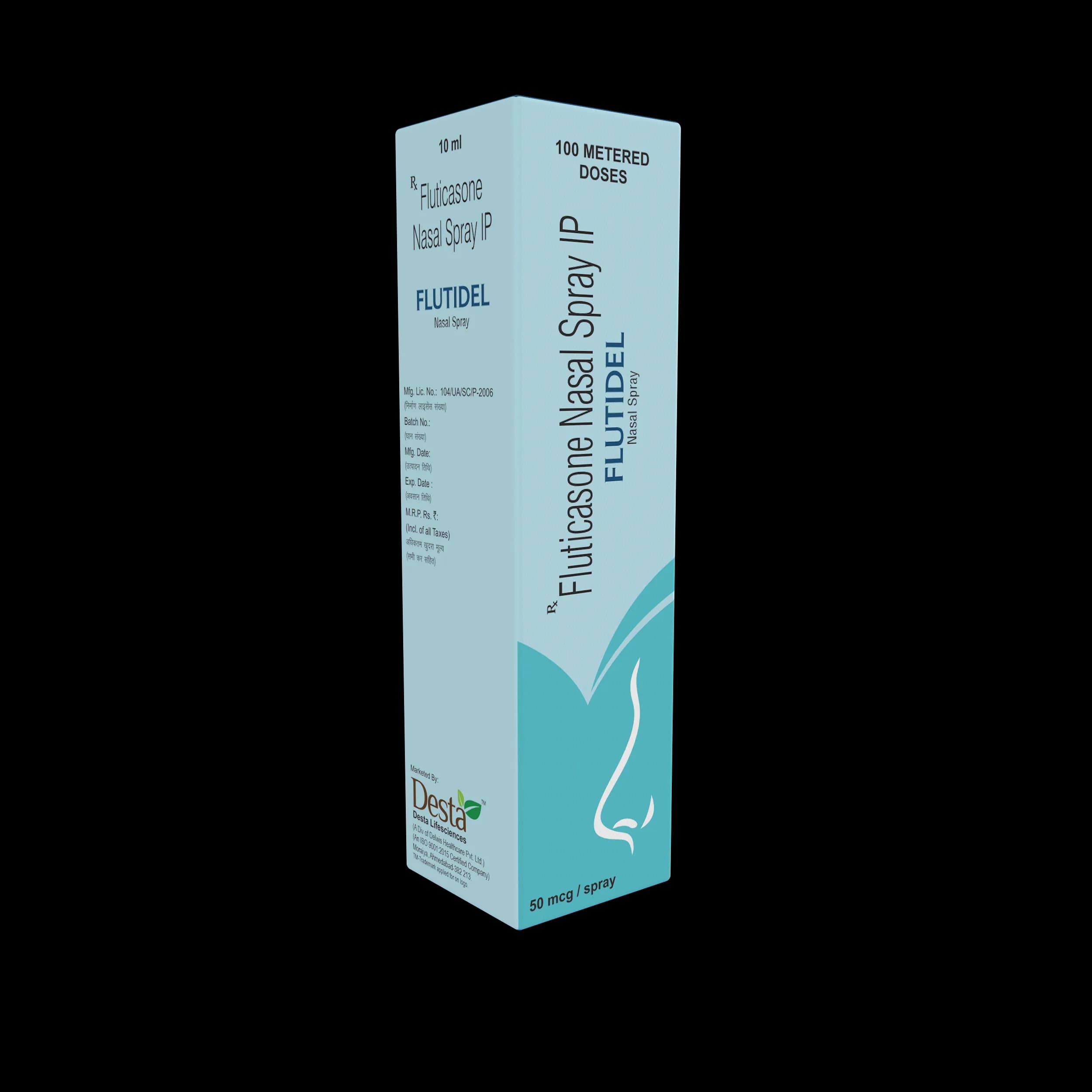
Yes. Delwis Healthcare manufactures Fluticasone Propionate 0.05% w/v Nasal Spray IP (50mcg per metered dose, 10ml — 100 doses) for third party and contract manufacturing clients — with custom brand labeling, carton design, and full WHO-GMP compliant batch documentation for Indian and export markets. Contact info@delwishealthcare.com with your product requirements.