The Science of Gut-Selective Action — Why Rifaximin 400mg Is Different from Systemic Antibiotics
Understanding the pharmacology of rifaximin tablet is essential for any prescriber, hospital procurement officer, or pharmaceutical brand building a gastroenterology portfolio — because the mechanism is the market differentiator.
Rifaximin is a semi-synthetic derivative of rifamycin SV, structurally modified by the addition of a pyridoimidazole ring to its core structure. This seemingly minor structural change produces a profoundly different pharmacokinetic outcome: rifaximin becomes virtually insoluble in aqueous environments at physiological pH, which prevents intestinal absorption and confines its antibacterial activity almost entirely to the gastrointestinal tract.
Mechanism of Action
Like all rifamycins, rifaximin inhibits bacterial RNA synthesis by binding to the beta-subunit of bacterial DNA-dependent RNA polymerase — an enzyme with no mammalian equivalent — blocking transcription and halting bacterial protein production. At the high intraluminal concentrations achieved with oral dosing, this leads to rapid bactericidal action against susceptible pathogens throughout the gut lumen.
Why Non-Absorption Matters Clinically
Conventional systemic antibiotics used for gut infections — fluoroquinolones, metronidazole, co-trimoxazole — distribute throughout the body, exposing non-target tissues to antibacterial activity and driving selection pressure for systemic resistance. Rifaximin's confinement to the intestinal lumen means lower systemic adverse effects, reduced risk of Clostridioides difficile colitis, negligible impact on vaginal and skin flora, and a markedly lower systemic antibiotic resistance profile. This is why non-absorbable antibiotic India searches are growing year-on-year as antimicrobial stewardship awareness increases among Indian physicians.
For rifaximin tablet contract manufacturers in India, this pharmacological uniqueness translates directly into sustained commercial demand — driven by traveler's diarrhea, IBS-D, hepatic encephalopathy, and SIBO across both primary care and hospital settings.
Rifaximin 400mg Uses — Gastroenterology Indications Driving Prescription Volume
The breadth of established and emerging rifaximin 400mg uses spans multiple high-prevalence gastroenterological conditions — making this one of the most therapeutically versatile oral antibacterials in the gastro segment.
Traveler's Diarrhea — The Original Indication
Traveler's diarrhea treatment was the first approved indication for rifaximin and remains among its highest-volume uses globally. Caused predominantly by enterotoxigenic Escherichia coli (ETEC) and other non-invasive enteric pathogens, traveler's diarrhea affects millions of international travelers visiting India and Indians traveling abroad. Rifaximin 400mg administered three times daily for three days achieves clinical cure rates comparable to systemic fluoroquinolones — without contributing to the emerging fluoroquinolone-resistant E. coli problem in India.
IBS with Diarrhea (IBS-D) — A Growing Prescription Driver
IBS diarrhea treatment tablet India searches are among the fastest-growing in the gastroenterology digital landscape. Rifaximin's role in IBS-D is supported by evidence suggesting gut bacterial dysbiosis and small intestinal bacterial overgrowth as contributory mechanisms. A 2-week course of tab rifaximin 400 reduces bloating, abdominal discomfort, and diarrheal frequency — with benefits persisting beyond the treatment period. Unlike conventional IBS therapies targeting symptoms, rifaximin addresses an underlying microbial driver, making it a mechanistically distinct choice for irritable bowel syndrome medicine India.
Hepatic Encephalopathy — Reducing Gut-Derived Ammonia
In patients with cirrhosis, ammonia produced by intestinal bacteria crosses the damaged hepatic circulation into the systemic bloodstream, contributing to hepatic encephalopathy (HE). Hepatic encephalopathy treatment tablet with rifaximin reduces intestinal ammonia-producing bacterial load without systemic antibacterial exposure — an important clinical advantage given the infection susceptibility of cirrhotic patients. Rifaximin 550mg is the primary HE indication dose internationally, but rifaximin 400mg is widely prescribed in India for HE prophylaxis given its cost-accessibility profile.
Small Intestinal Bacterial Overgrowth (SIBO)
SIBO small intestinal bacterial overgrowth treatment represents a growing indication. Rifaximin's ability to deliver high antibacterial concentrations specifically within the small intestine — the site of SIBO — makes it superior to systemic antibiotics for this condition. Symptoms including bloating, flatulence, abdominal distension, and malabsorption respond to rifaximin treatment, with hydrogen breath test normalisation documented in clinical trials.
Bacterial Diarrhea & Intestinal Infections
Beyond traveler's diarrhea, bacterial diarrhea treatment India from various enteric pathogens including Shigella, Salmonella (non-typhoidal), and enteropathogenic E. coli in non-invasive presentations represents significant prescription volume in both urban and rural India. Intestinal bacterial infection tablet prescriptions position rifaximin as a first-line or empirical antibacterial choice for adult acute infective diarrhea across primary care, internal medicine, and gastroenterology practices.
Gut Microbiome Modulation
Emerging evidence supports gut microbiome antibiotic treatment with rifaximin as producing a eubiotic rather than dysbiotic effect — selectively reducing pathogenic bacterial populations while relatively preserving or even enhancing beneficial Lactobacillus and Bifidobacterium species. This eubiotic profile distinguishes rifaximin from conventional antibiotics and is increasingly cited by gastroenterologists as a reason for preference in conditions like IBS-D and SIBO where microbiome composition is central to pathophysiology.
Rifaximin Tablet Manufacturing — Critical Process Controls That Determine Product Quality
Manufacturing a high-quality rifaximin 400mg tablet is technically more demanding than it appears. Rifaximin API has specific physicochemical properties — including polymorphic forms, particle size sensitivity, and photodegradation susceptibility — that require precise formulation science and manufacturing process control to produce a tablet with consistent dissolution, stability, and bioequivalence.
API Polymorphism Management
Rifaximin exists in multiple polymorphic forms (alpha, beta, gamma, and delta) with significantly different aqueous solubility profiles. The alpha polymorph is the pharmacopoeially specified form for rifaximin tablets IP. Ensuring consistent polymorph identity across batches requires validated API sourcing, controlled granulation conditions, and in-process polymorph monitoring — a manufacturing discipline that separates premium suppliers from low-cost generic producers.
Dissolution Profile Optimisation
Because rifaximin's activity is entirely intraluminal, the tablet's dissolution and disintegration behaviour directly determines the extent of drug release into the intestinal lumen. Excipient selection — particularly the disintegrant system and hydrophilic polymer matrix — is critical for achieving the rapid, complete drug release required for therapeutic efficacy. Delwis Healthcare's formulation delivers validated dissolution profiles compliant with IP/USP specifications across the full 10×10 Alu-Alu pack batch.
Photostability & Packaging Interface
Rifaximin degrades on exposure to light — a significant stability risk for poorly packaged batches. The 10×10 Alu-Alu blister format provides complete light occlusion combined with moisture and oxygen barrier protection, maintaining API integrity over the 24-month validated shelf life. Unlike PVC/PVDC or clear blister packaging used by cost-minimising manufacturers, Alu-Alu is non-negotiable for maintaining rifaximin quality over shelf life.
Third Party Manufacturing & Contract Manufacturing — Rifaximin 400mg Tablet
Delwis Healthcare operates as a dedicated third party pharmaceutical manufacturer and CMO partner for rifaximin 400mg tablets — serving gastroenterology brands, hospital supply companies, and pharmaceutical exporters who require a technically capable, WHO-GMP compliant manufacturing partner for this specialised antibacterial.
Demand for best rifaximin tablet India manufacturing is driven by consistent growth across traveler's diarrhea, IBS-D, and SIBO prescriptions — markets that show year-on-year expansion as gastroenterology awareness and specialist physician density increase in Tier 2 and Tier 3 Indian cities.
What We Offer
Third Party Manufacturing
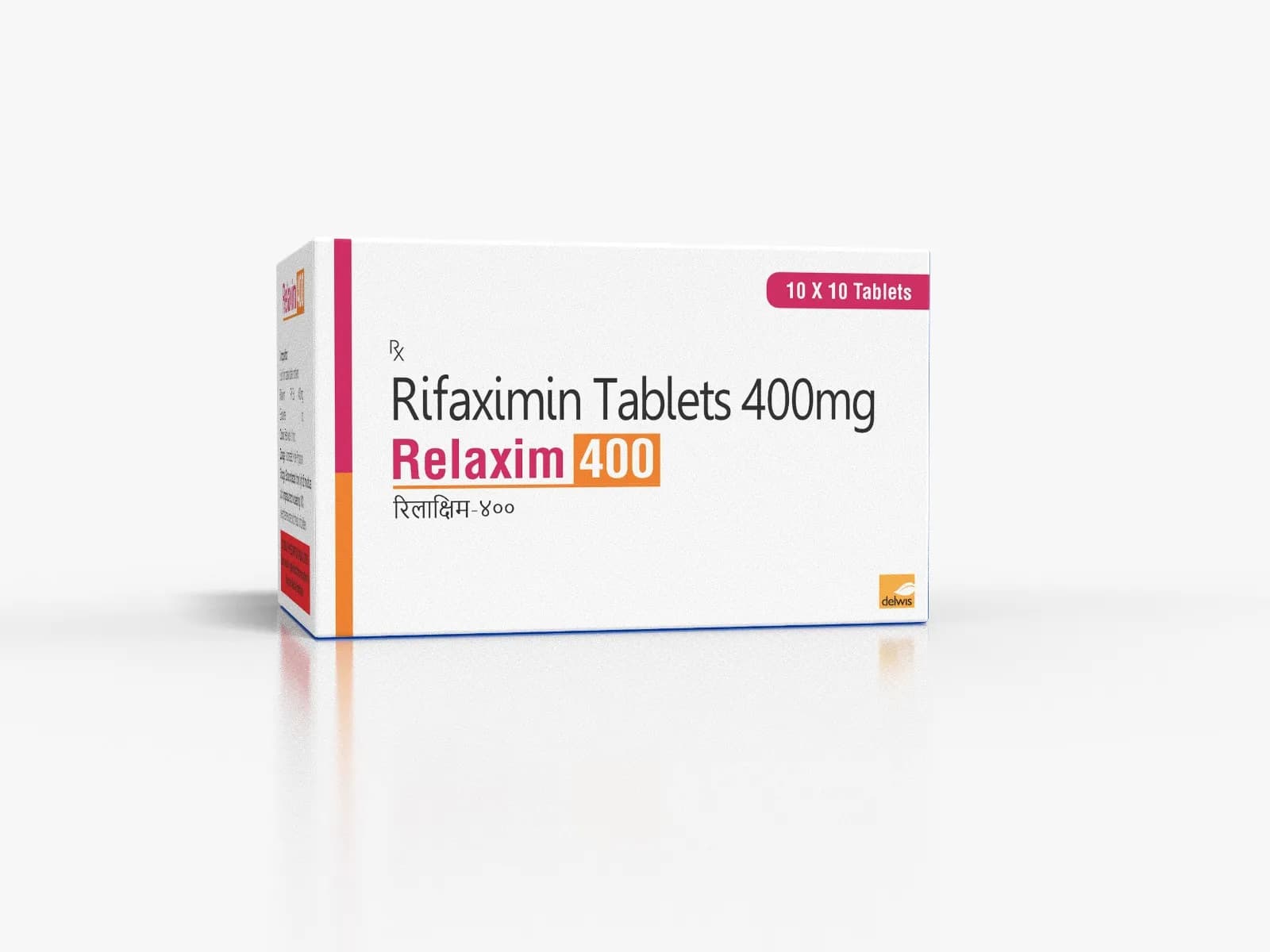
Full GMP-compliant production of rifaximin tablets 400mg under your registered brand name — including API sourcing, tablet compression, film coating, Alu-Alu blister packaging, labeling, and batch documentation — with no manufacturing infrastructure investment from your side.
Contract Manufacturing (CMO)
End-to-end development and manufacturing partnership covering API qualification, formulation development, process validation, scale-up, stability studies, and commercial batch supply — with complete regulatory documentation for your target markets.
Private Label Manufacturing
Custom brand name, carton design, blister foil branding, and labeling in compliance with CDSCO regulatory requirements for the Indian market — or adapted to export market regulatory specifications.
Bulk Supply
High-volume, consistent commercial batch supply for institutional procurement, government tenders, hospital formularies, and export distribution — with batch-wise COA, stability data, and full quality documentation.
Whether you are launching a gastroenterology product range, expanding an existing antibacterial portfolio, or sourcing a reliable rifaximin tablet contract manufacturer in India — Delwis Healthcare delivers manufacturing confidence backed by regulatory compliance and formulation expertise.
Packaging — Rifaximin 400mg in 10×10 Alu-Alu Blister
Every batch of rifaximin tablets IP 400mg is packed in 10×10 Alu-Alu blister — the premium pharmaceutical packaging standard for photosensitive and moisture-sensitive tablet formulations:
- Complete light barrier — Prevents UV and visible-light-induced rifaximin photodegradation throughout the shelf life
- Moisture and oxygen occlusion — Dual aluminium construction eliminates humidity ingress that accelerates API degradation
- Tamper-evidence — Blister integrity confirms product authenticity for pharmacy and institutional channels
- Validated shelf life of 24 months under recommended storage conditions: below 30°C, dry place, away from direct sunlight
Custom carton artwork, branded foil printing, and labeling formats for domestic and export markets are available for all third party manufacturing clients.
Quality Standards — GMP Antibiotic Tablet Manufacturer Gujarat
Every batch of rifaximin 400mg tablet released by Delwis Healthcare clears a validated quality control protocol:
- HPLC Assay — Rifaximin content quantified against reference standard per batch
- Dissolution Testing — Complete release profile validation against IP/USP specifications
- Polymorph Identification — XRPD or DSC confirmation of alpha-polymorph integrity where indicated
- Uniformity of Dosage Units — Per-tablet content uniformity across batch sampling plan
- Physical Testing — Hardness, friability, disintegration, and thickness per pharmacopoeial limits
- Microbial Limit Testing — Non-sterile oral tablet microbiological compliance
- Stability Studies — Real-time and accelerated ICH-compliant data for regulatory submissions
- QMS Alignment — WHO-GMP, ISO 9001 and ISO 14001 certified Quality Management System
Why Gastroenterology Brands Partner with Delwis Healthcare for Rifaximin Manufacturing
Pharmaceutical companies choose Delwis Healthcare for rifaximin 400mg third party manufacturing because of capabilities that generic CMOs do not consistently offer:
- WHO-GMP & ISO Certified — Accepted for CDSCO domestic and international export regulatory submissions
- Rifaximin Formulation Expertise — Polymorph-controlled API sourcing, validated dissolution profiles, and photostability-assured packaging
- Alu-Alu Blister Standard — No compromise on packaging for light and moisture-sensitive APIs
- Gastroenterology Portfolio Focus — Dedicated manufacturing experience across gut-targeted antibacterials and gastro formulations
- CMO Depth — From API qualification to stability data to regulatory dossier support
- Scalable Production — Pilot validation batches through to large commercial volumes
- Export Documentation Ready — COA, COPP, FSC, and stability packages for African, Asian, and Middle Eastern market registrations
- Competitive Manufacturing Cost — Cost-efficient production from Gujarat without compromising on critical quality parameters
What Prescribers, Distributors & Manufacturing Buyers Ask About Rifaximin 400mg
Q1: What is rifaximin 400mg used for?
Rifaximin 400mg uses span several gastrointestinal conditions where gut-targeted antibacterial therapy is indicated. Primary clinical indications include traveler's diarrhea caused by non-invasive enteric pathogens (especially E. coli), IBS with predominant diarrhea (IBS-D), small intestinal bacterial overgrowth (SIBO), hepatic encephalopathy management in cirrhotic patients, and acute bacterial diarrhea. Its non-absorbable nature makes it a preferred choice for antibacterial tablet for diarrhea India prescriptions where systemic antibiotic exposure is undesirable.
Q2: Is rifaximin absorbed into the bloodstream?
No — and this is rifaximin's defining pharmacological characteristic. Rifaximin is not absorbed into the bloodstream to any clinically meaningful extent. Systemic plasma bioavailability after oral dosing is less than 0.4% in healthy subjects with normal intestinal mucosa. This means rifaximin's entire antibacterial action is concentrated within the gut lumen, with no systemic drug exposure — which is why it lacks the systemic adverse effects, drug interactions, and broad resistance selection pressure associated with absorbed antibiotics. This gut-selective profile is why the search term antibiotic that stays in gut India directly maps to rifaximin.
Q3: What is the difference between rifaximin and rifampicin?
Both rifaximin and rifampicin are rifamycin derivatives that inhibit bacterial RNA polymerase, but their clinical applications are entirely different. Rifaximin 400 vs rifampicin: rifampicin is a fully absorbed, potent systemic antibiotic used for tuberculosis and serious systemic infections — with significant hepatotoxicity, drug interactions, and resistance concerns. Rifaximin is non-absorbed, gut-confined, and used exclusively for gastrointestinal indications. Using rifampicin as a gut antibiotic would be clinically inappropriate; rifaximin is specifically engineered for that role.
Q4: How long should rifaximin 400mg be taken for diarrhea?
Duration varies by indication. For traveler's diarrhea, the standard course is rifaximin 400mg three times daily for 3 days. For IBS-D, the evidence-based course is 400mg three times daily for 14 days, with potential retreatment for recurring episodes. For SIBO, courses of 7–14 days are typical, guided by breath test response. For hepatic encephalopathy prophylaxis, long-term or maintenance dosing under specialist supervision is used. Always under treating physician direction.
Q5: Can rifaximin be taken with food?
Yes. Rifaximin tablets can be taken with or without food. Since rifaximin remains within the intestinal lumen regardless of food co-administration, meals do not significantly alter its antibacterial activity or local gut concentrations. Standard advice is to take it at consistent times each day to maintain steady intraluminal drug levels across the treatment course.
Q6: What are the side effects of rifaximin 400mg?
Rifaximin 400 side effects are generally mild and primarily gastrointestinal — including nausea, flatulence, abdominal discomfort, and headache. Because rifaximin is not systemically absorbed, systemic adverse effects are uncommon. Hypersensitivity reactions are rare. Rifaximin does not cause the systemic toxicity, hepatotoxicity, or significant drug-drug interactions associated with absorbed antibiotics. It is among the best-tolerated antibiotics for gut indications, which contributes to its strong prescriber preference in India.
Q7: Is rifaximin 400mg safe for long-term use?
Rifaximin has a well-established safety profile for repeated and extended use in hepatic encephalopathy, where prophylactic use is ongoing. For IBS-D, evidence supports repeated short courses. Long-term continuous use outside these indications should be under specialist guidance. Rifaximin safety long-term is supported by its non-absorbed nature, which limits systemic toxicity accumulation and significantly reduces resistance selection pressure compared to systemic antibiotic maintenance.
Q8: What is SIBO and why is rifaximin the preferred treatment?
SIBO (small intestinal bacterial overgrowth) occurs when bacterial populations normally resident in the colon overpopulate the small intestine — leading to fermentation of carbohydrates, gas production, bloating, diarrhoea, and malabsorption. Rifaximin is the preferred SIBO treatment tablet India because its non-absorbed pharmacokinetics deliver bactericidal concentrations specifically within the small intestine — the site of overgrowth — without disrupting colonic flora or producing systemic antibiotic exposure. No other oral antibacterial class achieves this targeted small intestinal action.
Q9: Do you offer third party manufacturing for rifaximin 400mg tablets?
Yes. Delwis Healthcare is a WHO-GMP certified antibacterial tablet manufacturer in Gujarat offering complete third party and contract manufacturing of rifaximin 400mg tablets IP — including API sourcing with polymorph control, tablet compression, film coating, 10×10 Alu-Alu blister packaging, private labeling, and regulatory documentation for Indian and export markets. Contact info@delwishealthcare.com for manufacturing enquiries.
Q10: What certifications does your rifaximin tablet manufacturing facility hold?
Our facility holds WHO-GMP, ISO 9001, and ISO 14001 certifications. Manufacturing is conducted in full compliance with Indian Pharmacopoeia (IP), USP, and BP standards. Complete batch documentation, HPLC assay data, dissolution profiles, and stability studies are available for CDSCO domestic registration and international export market regulatory submissions.