Two Drugs. One Suspension. A Clinically Complete Answer to Ulcer Pain and Mucosal Damage
Understanding why sucralfate and oxetacaine are combined in a single suspension — rather than prescribed separately — requires stepping inside the pathophysiology of peptic ulcer disease and related acid-mediated GI conditions.
When the gastric or duodenal mucosa is damaged by acid, NSAIDs, H. pylori, or mechanical stress, two problems emerge simultaneously: the structural integrity of the mucosal lining is compromised (creating an open wound bathed in stomach acid), and sensory nerve endings in the inflamed tissue generate persistent, often severe pain. A mucosal protectant alone repairs tissue but does nothing for the pain during the healing period. A local anaesthetic alone manages pain but provides no healing or protective mechanism. The suspension format combining both agents addresses both problems from the first dose.
Sucralfate 1gm — The Cytoprotective Mucosal Barrier Agent
Sucralfate is a basic aluminium salt of sucrose octasulphate. In the acidic environment of the stomach (pH < 4), it undergoes a specific polymerisation reaction that causes it to bind selectively and with high affinity to the damaged, denuded mucosa at the ulcer base and margin — forming a viscous, adhesive gel barrier that physically covers the ulcer crater. This protective coat serves multiple functions: it shields the ulcer surface from further acid and pepsin attack, prevents bile acid back-diffusion, stimulates local prostaglandin synthesis (enhancing natural mucosal defense mechanisms), adsorbs pepsin and bile salts that would otherwise perpetuate mucosal damage, and promotes growth factor-mediated tissue regeneration at the wound site.
Critically, sucralfate achieves all of this without suppressing acid secretion — making it the preferred mucosal protectant in clinical scenarios where acid suppression is incomplete, insufficient, or where the prescriber seeks additive protection alongside a PPI or H2-blocker. It also works independently of the acid secretory axis, meaning its cytoprotective effect remains consistent regardless of the degree of acid suppression achieved by co-prescribed agents.
As an oral sucralfate suspension, the liquid form ensures the protective coat is distributed uniformly across the mucosal surface — delivering superior coverage compared to tablets, which depend on dissolution and gravity, and are less effective in coating erosions and mucosal folds, particularly in the oesophagus and gastric body.
Oxetacaine 20mg — The GI-Specific Local Anaesthetic
Oxetacaine (oxethazaine) is a topical local anaesthetic specifically formulated for use on mucous membranes of the gastrointestinal tract. Unlike systemic analgesics, oxetacaine works directly at the mucosal pain receptor sites — blocking sodium channels in sensory nerve endings within the GI lining and producing reversible, prolonged local anaesthesia. Its pharmacological profile is uniquely suited to GI applications: it remains active across a wide pH range (maintaining efficacy even in the highly acidic stomach), demonstrates prolonged mucosal retention time, and provides sustained relief that covers the post-dose period more completely than short-acting local anaesthetics.
For patients with peptic ulcer disease, gastric ulcer, or oesophagitis, oxetacaine's rapid onset of mucosal anaesthesia provides the symptomatic relief that makes the treatment tolerable and allows patients to eat, drink, and comply with the full treatment course — a critically underappreciated compliance benefit for a medication class that requires consistent pre-meal dosing to be effective.
Together, this sucralfate oxetacaine oral suspension delivers what neither agent can alone: immediate pain control alongside progressive mucosal healing — the clinical combination that has made this suspension a durable first-line and adjunctive choice in India's gastroenterology prescribing landscape for over two decades.
Sucralfate and Oxetacaine Suspension Uses — Full Spectrum of Gastroenterological Indications
The sucralfate and oxetacaine suspension uses span the breadth of acid-mediated upper gastrointestinal conditions — positioning this as a high-versatility gastroenterology product rather than a single-indication niche suspension.
Peptic Ulcer Disease — Gastric & Duodenal Ulcer
Peptic ulcer disease remains one of the highest-volume gastroenterology diagnoses in India, driven by H. pylori prevalence, NSAID use, dietary factors, and stress. Sucralfate suspension has a four-decade clinical evidence base in peptic ulcer healing — achieving gastric ulcer healing rates comparable to cimetidine and ranitidine in controlled trials, with a mechanism entirely distinct from acid suppression. For duodenal ulcer treatment, sucralfate's targeted adhesion to the duodenal mucosa (where the low pH environment maximises its gel-forming polymerisation) makes it particularly effective as monotherapy or in combination with a PPI. The addition of oxetacaine to the suspension provides immediate relief from the epigastric burning and postprandial pain that characterise active peptic ulcer disease.
GERD & Reflux Oesophagitis — Coating the Oesophageal Lining
In GERD and erosive oesophagitis, acid reflux repeatedly damages the oesophageal mucosa — a tissue with limited inherent defence mechanisms compared to the stomach's mucus layer. Sucralfate suspension's liquid form coats the oesophageal lining directly — physically protecting the inflamed mucosa from ongoing acid exposure and promoting healing of erosive lesions. This makes the sucralfate oxetacaine suspension for GERD and acid reflux clinically valuable not just as symptomatic relief but as a mucosal repair agent — particularly in patients with incomplete symptom control on PPIs alone or in whom long-term PPI dependency is a clinical concern. Oxetacaine's oesophageal anaesthetic action simultaneously relieves the burning and discomfort of reflux oesophagitis.
Chronic Gastritis
In chronic gastritis — whether H. pylori-associated, autoimmune, or chemical — the inflamed, eroded gastric mucosa requires both protection from ongoing acid damage and active healing support. Sucralfate's cytoprotective mechanism stimulates local prostaglandin production, promotes gastric mucosal regeneration, and provides a physical protective coat — addressing gastritis treatment at the mucosal level rather than simply reducing the acid that bathes the inflamed tissue.
NSAID-Induced Gastric Damage & GI Mucosal Protection
NSAIDs are the most common iatrogenic cause of upper GI mucosal injury in India — prescribed across orthopaedic, rheumatology, gynaecology, and general medicine practice. NSAID-induced gastric damage results primarily from inhibition of cyclo-oxygenase-mediated prostaglandin synthesis — removing the stomach's endogenous mucosal protection. Sucralfate provides exogenous cytoprotection that partially compensates for this prostaglandin deficit, making sucralfate and oxetacaine suspension a logical prophylactic and therapeutic choice in patients on chronic NSAID therapy.
Stress Ulcer Prophylaxis
In critically ill patients, ICU admissions, and post-surgical settings, stress ulcers represent a significant risk of upper GI bleeding. Sucralfate suspension has been studied as a stress ulcer prevention agent, with a clinical profile that avoids the risk of nosocomial pneumonia associated with acid-suppressing agents — making it a preferred option in specific critical care populations where maintaining gastric acidity is considered beneficial for respiratory infection prevention.
Oesophagitis & Heartburn Beyond GERD
Non-erosive oesophagitis, pill-induced oesophagitis, and chemotherapy-related oesophageal mucositis represent additional clinical settings where sucralfate suspension's direct mucosal coating action — combined with oxetacaine's local anaesthesia — provides meaningful symptomatic relief and healing support unavailable from acid suppression alone.
What Makes Sucralfate Oxetacaine Suspension Technically Challenging to Manufacture — and Why It Matters
Pharmaceutical suspension manufacturing is never straightforward — but sucralfate oxetacaine suspension presents a specific set of formulation and manufacturing challenges that directly distinguish capable manufacturers from generic toll producers. Pharma brands sourcing a sucralfate suspension manufacturer need to understand these challenges because they directly impact the clinical performance, stability, and shelf-life consistency of the finished product.
Sucralfate is a high molecular weight, water-insoluble aluminium salt — making uniform particle dispersion within the suspension base the central manufacturing challenge. Unlike soluble APIs that dissolve into a homogeneous liquid, sucralfate must be reduced to a precise, controlled particle size distribution and maintained in stable suspension throughout the product shelf life. Sedimentation is the primary stability risk: if particle size is not tightly controlled during blending and milling, or if the rheological profile of the suspension base is not correctly formulated, sucralfate settles into a compact, difficult-to-redisperse sediment — compromising dose uniformity with every bottle.
Oxetacaine presents a different challenge: pH-dependent solubility. At the formulation's target pH — which must simultaneously accommodate sucralfate's aluminium chemistry and oxetacaine's solubilisation requirements — careful pH adjustment and excipient selection are essential to ensure oxetacaine remains uniformly distributed and chemically stable across the product shelf life.
At Delwis Healthcare's suspension manufacturing facility, these challenges are addressed through:
- Controlled wet milling and particle size reduction of sucralfate to the validated particle size range that ensures dose uniformity and optimal mucosal coating performance
- Precision rheology engineering — the suspension base viscosity is formulated to maintain uniform sucralfate suspension without impeding pourability or ease of dose measurement for the patient
- pH-optimised formulation balancing sucralfate aluminium chemistry stability, oxetacaine solubilisation, and shelf-life compatibility across the 100ml and 200ml pack sizes
- High-shear homogenisation followed by controlled-speed blending to achieve consistent API co-dispersion without particle agglomeration
- Validated filling lines with in-process weight-per-fill checks across every production batch
- cGMP and WHO-GMP compliant cleanroom manufacturing for all pharmaceutical suspension production steps
This manufacturing depth is what separates a GMP certified ulcer suspension manufacturer from a commodity contract producer — and it is directly reflected in the clinical consistency that prescribers and patients experience at the point of use.
Build Your Gastroenterology Suspension Brand — Third Party Manufacturing & CMO Services for Sucralfate Oxetacaine Suspension
Delwis Healthcare is a dedicated third party pharmaceutical manufacturer and CMO partner for sucralfate 1gm + oxetacaine 20mg oral suspension — providing complete manufacturing solutions for pharma brands, gastroenterology companies, and healthcare distributors building GI suspension product ranges for India and export markets.
Third Party Manufacturing
Launch a fully manufactured sucralfate o syrup under your pharmaceutical brand — with complete WHO-GMP compliant production, quality release testing, bottle filling (100ml / 200ml), outer carton packing, and label printing. No manufacturing infrastructure required on your end. Suitable for established pharma companies adding a gastroenterology suspension SKU without operational complexity.
Contract Manufacturing (CMO)
For brands that require more than just manufacturing capacity — our CMO model covers formulation stability work, particle size optimisation studies, scale-up from pilot to commercial batch, regulatory documentation generation, and ongoing stability program management. Built for pharmaceutical companies that need a technically capable long-term partner for their gastric ulcer treatment suspension portfolio.
Private Label Suspension Manufacturing
Customised bottle labeling, carton design, batch coding, and packaging format aligned with your brand identity and target therapeutic segment — available for domestic Indian market launches and export distribution. Both 100ml and 200ml pack sizes supported with custom outer carton specifications.
Custom Formulation Development
Viscosity modification, flavour profiling, preservative system optimisation, or alternate excipient selection to meet specific export market regulatory requirements or prescriber preference — our formulation team works directly with your R&D or regulatory team to develop the product variant you need.
Bulk Contract Supply
High-volume suspension manufacturing for institutional procurement, government tender supply, hospital formularies, and large-scale export distributors — with complete batch documentation, COA, and supply continuity assurance.
Pharmaceutical companies searching for a WHO-GMP gastro suspension manufacturer in Ahmedabad or a reliable third party ulcer suspension manufacturing partner in India will find Delwis Healthcare operationally ready, technically equipped, and compliance-certified for immediate engagement.
Packaging — 100ml & 200ml Sucralfate Oxetacaine Suspension with Outer Carton
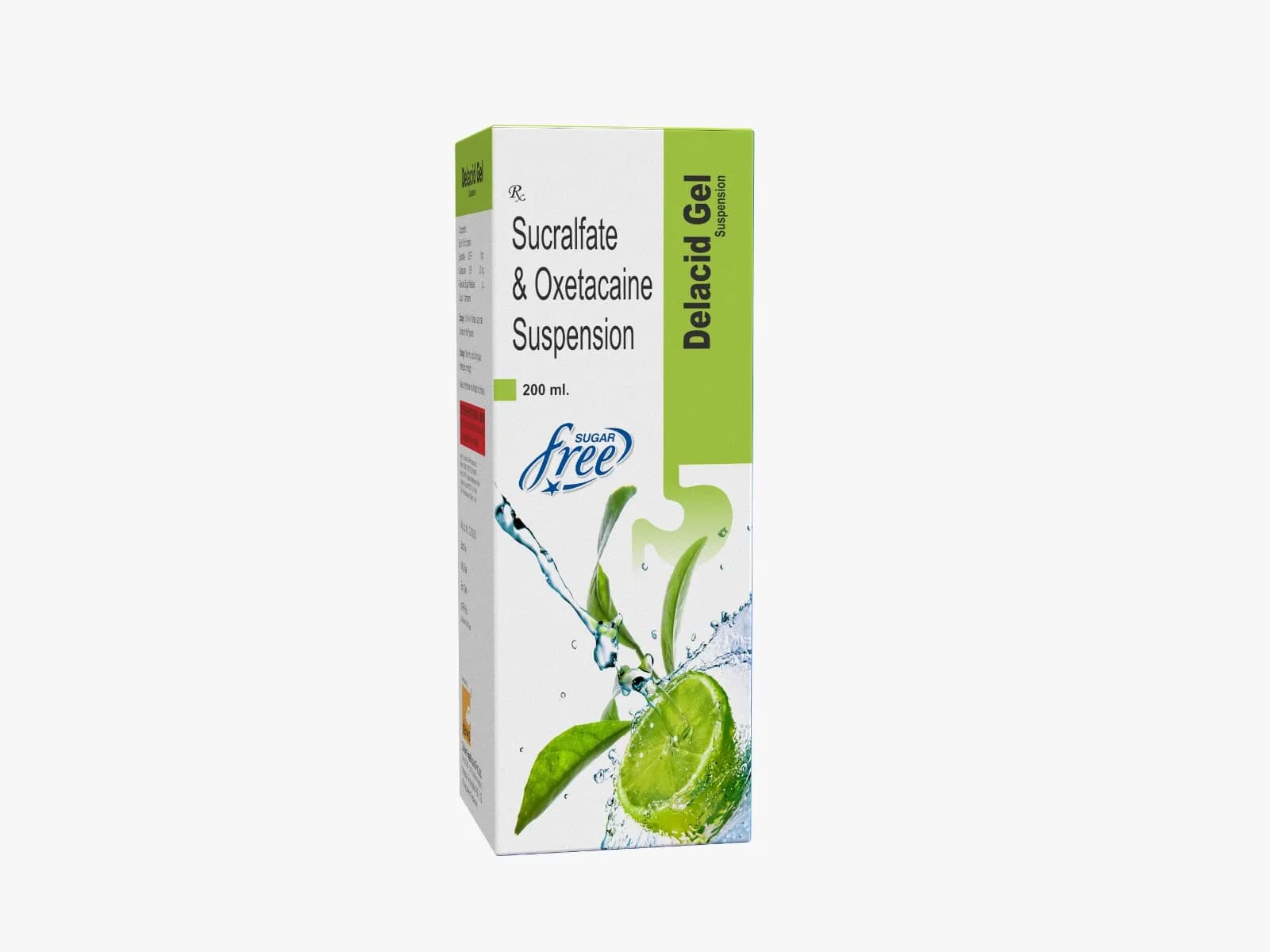
Sucralfate 1gm + Oxetacaine 20mg Oral Suspension is manufactured and supplied in two standard pack sizes — 100ml and 200ml PET bottles with outer carton — the pharmaceutical standard for oral gastroenterology suspension products in the Indian and export markets.
The PET bottle construction provides chemical resistance to the alkaline sucralfate formulation, UV light protection to prevent photodegradation of the suspension components, and tamper-evident sealing to ensure product integrity from manufacturing through to dispensing. The outer carton carries full prescribing information, batch-specific details, and regulatory labeling — customised to the third party buyer's brand specifications.
Validated shelf life: 24 months under recommended storage (cool, dry place below 30°C, away from direct sunlight; shake well before use). Custom pack sizes and institutional bulk packaging formats are available for export buyers and contract manufacturing clients requiring specific market packaging configurations.
Analytical Testing & Quality Release — Every Batch of Sucralfate Suspension Manufactured to Pharmacopoeial Standards
The quality of a sucralfate oral suspension is not established by the certificate on the wall — it is established by the rigour of what happens to every production batch before it leaves the facility. At Delwis Healthcare, each batch of sucralfate 1gm + oxetacaine 20mg suspension undergoes a comprehensive quality control and release testing programme:
- HPLC Quantification — Individual content determination for both sucralfate and oxetacaine against validated pharmacopoeial reference standards, confirming label claim compliance per batch
- Particle Size Analysis — Sucralfate particle size distribution verified against the validated specification that ensures both dose uniformity and optimal mucosal adhesion performance
- pH Testing — Batch pH verified against the validated range that supports both API stability and the product's cytoprotective mechanism
- Viscosity & Rheological Testing — Suspension consistency confirmed to meet the validated range ensuring pourability, dose measurement accuracy, and sedimentation resistance
- Redispersibility Testing — Ensures the sucralfate sediment, if formed during storage, redisperses fully to a uniform suspension upon normal shaking — a critical performance parameter for patient dose consistency
- Microbial Limit Testing — Full microbiological compliance testing for oral suspension pharmaceutical products
- Preservative Efficacy Testing — Validates the antimicrobial preservative system maintains product safety across the 24-month shelf life
- Stability Studies — ICH-compliant real-time and accelerated stability data available for DCGI submissions and export market regulatory dossiers
- Raw Material Release — Sucralfate API, oxetacaine API, and critical excipients are each tested and released against specification prior to batch commencement
QMS fully aligned with WHO-GMP, IP, and USP standards — with complete electronic batch records and traceability documentation maintained for every production run.
Sucralfate Oxetacaine Suspension vs Antacid vs PPI — Understanding Where This Combination Sits in GI Prescribing
Prescribers, pharma brand managers, and marketing teams building around this suspension need to understand its therapeutic positioning against the broader gastroenterology treatment landscape — because that positioning drives the prescriber conversations and the product's commercial differentiation.
vs Antacid Syrups: Antacids neutralise existing stomach acid temporarily — they do not protect the mucosal lining, do not promote ulcer healing, and provide no local anaesthetic pain relief. Their effect is measured in minutes to an hour. Sucralfate oxetacaine suspension is not an antacid — it is a cytoprotective agent with a healing mechanism. The clinical benefit extends across the dosing interval, not just the 30–60 minutes of acid neutralisation.
vs PPIs (Omeprazole/Pantoprazole/Esomeprazole): PPIs are the dominant acid suppression agents in India, but they suppress acid — they do not repair mucosal damage, do not coat the ulcer site, and do not address GI pain locally. A significant proportion of GERD and peptic ulcer patients have residual symptoms on PPI monotherapy. Sucralfate suspension is often prescribed alongside a PPI as additive mucosal protection — and is a preferred standalone option in patients for whom PPI therapy is contraindicated, insufficient, or being tapered. The addition of oxetacaine provides the pain dimension that no PPI addresses.
vs Sucralfate Tablets: Tablets require dissolution, produce a less uniform gastric distribution, and cannot coat oesophageal erosions effectively. Suspension directly coats the mucosal surface as it passes through — delivering superior clinical coverage across the stomach, duodenum, and oesophagus. For sucralfate suspension uses in GERD and oesophagitis specifically, the liquid form is the clinically preferred choice.
This clear therapeutic differentiation — and the absence of any direct competitor combining all three mechanisms (mucosal barrier + prostaglandin stimulation + local anaesthesia) in one oral suspension — is what gives this product its sustained prescription volume and commercial longevity in the Indian gastroenterology market.
Frequently Asked Questions — Sucralfate & Oxetacaine Suspension: Clinical, Formulation & Manufacturing
Q1: What is sucralfate and oxetacaine suspension used for?
Sucralfate and oxetacaine suspension uses span the full range of acid-mediated upper GI conditions: peptic ulcer disease (gastric and duodenal ulcer), GERD and reflux oesophagitis, chronic gastritis, NSAID-induced gastric mucosal damage, stress ulcer prophylaxis, and esophagitis. Sucralfate physically coats and protects the damaged mucosal lining while oxetacaine provides direct, prolonged local anaesthesia at the GI pain site — together addressing both mucosal healing and symptomatic relief in a single suspension.
Q2: How does sucralfate and oxetacaine suspension work together?
Sucralfate polymerises in the acidic gastric environment, binding selectively to the damaged mucosa and forming a physical protective barrier that shields ulcer tissue from acid and pepsin while stimulating prostaglandin-mediated healing. Oxetacaine acts as a site-specific GI local anaesthetic — blocking sensory nerve conduction in the inflamed mucosal tissue and delivering fast-onset, prolonged pain relief. The combination addresses the two independent clinical problems in active peptic disease that neither agent resolves alone.
Q3: Should sucralfate and oxetacaine suspension be taken before or after food?
This suspension is typically prescribed to be taken before meals and at bedtime — 30–60 minutes before eating. The pre-meal timing allows sucralfate to bind to the mucosal surface before food triggers acid secretion, maximising the protective barrier's effectiveness during the meal. Oxetacaine's pre-meal anaesthetic action also pre-empts the postprandial pain that often peaks when food contacts an actively ulcerated mucosa. Always follow the specific prescribing physician's dosing instructions.
Q4: How is sucralfate oxetacaine suspension different from antacid syrup?
An antacid neutralises stomach acid chemically for a limited duration — it has no mucosal healing mechanism, no cytoprotective action, and no local anaesthetic component. Sucralfate oxetacaine suspension works entirely differently: sucralfate physically coats and seals the damaged mucosa regardless of acid levels, while oxetacaine anaesthetises the pain-sensitive mucosal nerve endings directly. The therapeutic benefit extends well beyond the brief acid-neutralising window of conventional antacids and addresses the structural healing deficit that antacids never touch.
Q5: Can sucralfate oxetacaine suspension be used alongside a PPI?
Yes — and this is a common prescribing pattern. Sucralfate's cytoprotective, barrier-forming mechanism is complementary to PPI acid suppression rather than redundant. In patients with incomplete symptom control on a PPI alone, adding sucralfate oxetacaine suspension provides additive mucosal protection and local anaesthetic pain relief that the PPI cannot supply. The combination is particularly useful in erosive GERD, refractory peptic ulcer, and NSAID-treated patients requiring enhanced gastroprotection.
Q6: Is sucralfate and oxetacaine suspension safe during pregnancy?
Sucralfate has a minimal systemic absorption profile and has historically been considered relatively safe for use in pregnancy under medical supervision — given its local gastrointestinal action. Oxetacaine similarly has limited systemic absorption from the GI mucosa. However, use during pregnancy and lactation should always be under qualified prescriber assessment of benefit versus risk, and all use should be clinically supervised.
Q7: How long does sucralfate oxetacaine suspension take to heal ulcers?
Clinical data for sucralfate in duodenal ulcer healing shows healing rates of approximately 70–80% at 4 weeks of treatment — comparable to H2-antagonists. Gastric ulcer healing typically requires 4–8 weeks of consistent pre-meal dosing. Symptomatic relief from oxetacaine begins rapidly after each dose. Full mucosal healing requires completing the prescribed treatment course — premature discontinuation on symptom improvement is a common cause of ulcer relapse.
Q8: What makes you a reliable sucralfate oxetacaine suspension manufacturer for third party pharma brands?
Delwis Healthcare's manufacturing capability for this suspension goes beyond standard toll production — our facility specifically addresses the two technical challenges that define quality in sucralfate suspension manufacturing: controlled sucralfate particle size distribution (which determines dose uniformity and mucosal coating performance) and pH-optimised oxetacaine stabilisation within the same suspension matrix. Combined with WHO-GMP certification, in-process particle size analytics, redispersibility testing, and ICH-compliant stability studies, we provide third party pharma brands with a manufacturing partner whose quality output is verifiable at every batch.
Q9: Do you offer stability data and regulatory documentation for DCGI submissions?
Yes. Real-time and accelerated stability studies, HPLC-based batch analysis reports, certificates of analysis, and complete batch manufacturing records are maintained and available to support DCGI new product submissions, product dossier preparation, and international export market regulatory filings across Southeast Asia, Africa, and the Middle East.
Q10: What pack sizes are available for third party manufacturing of this suspension?
Standard pack sizes are 100ml and 200ml PET bottles with outer carton. Custom pack sizes, institutional bulk packaging, and export-specific packaging configurations are available for third party manufacturing clients. Contact info@delwishealthcare.com or +91 9904405470 to discuss your specific requirements.