Aceclofenac's COX-2 Preference and Rabeprazole's Activation Advantage
Aceclofenac inhibits cyclo-oxygenase enzymes that produce prostaglandins — the chemical mediators driving pain, inflammation, and swelling in joint and musculoskeletal conditions. Compared to diclofenac, from which it is structurally derived, aceclofenac shows a more favourable COX-2:COX-1 inhibition ratio — meaning relatively less suppression of the COX-1-mediated prostaglandins that maintain gastric mucosal defence, even before any gastroprotective agent is added. This is the pharmacological basis for why why aceclofenac is better than diclofenac is a frequently searched comparison: the baseline GI risk profile is already improved.
Rabeprazole sodium is a proton pump inhibitor with a distinguishing pharmacological trait — it activates across a broader pH range than several other PPIs, meaning its conversion to the active sulphenamide form within parietal cells is less dependent on achieving maximal gastric acidity first. Clinically, this translates to faster onset of acid suppression and more consistent activity from earlier doses — relevant for patients starting NSAID therapy who need gastroprotection to be effective immediately, not after several days of dose accumulation.
Sustained Release (SR) aceclofenac extends the drug's release profile across the dosing interval — maintaining therapeutic plasma levels with reduced peak-trough fluctuation, supporting once-daily dosing convenience and more even symptom control across the day compared to immediate-release formulations.
Where Aceclofenac and Rabeprazole Tablets Are Uses
Osteoarthritis & Rheumatoid Arthritis — Aceclofenac's anti-inflammatory action addresses joint pain, swelling, and stiffness in both degenerative and inflammatory arthritis, with rabeprazole supporting the gastric tolerance needed for the chronic dosing these conditions require.
Ankylosing Spondylitis — Long-term NSAID use is central to managing axial inflammatory pain in ankylosing spondylitis, making built-in gastroprotection clinically significant for sustained therapy.
Lower Back Pain & Muscle Pain — A high-volume indication where aceclofenac's anti-inflammatory and analgesic action addresses acute and chronic musculoskeletal pain.
Post-Operative & Post-Traumatic Pain — Effective for managing inflammatory pain following surgery or injury, where short-course high-dose NSAID use benefits from gastric protection from the outset.
Dental Pain & Dysmenorrhoea — Aceclofenac's prostaglandin-inhibiting action addresses acute pain in dental procedures and menstrual pain, both high-frequency OTC-adjacent indications.
Formulating Aceclofenac SR with Rabeprazole — Two Release Profiles, One Tablet
Combining a sustained-release NSAID with a PPI in a single dosage form requires managing two fundamentally different release requirements within one tablet matrix. Aceclofenac SR depends on a controlled-release polymer matrix that delays and extends drug release across hours. Rabeprazole, by contrast, is acid-labile — it degrades rapidly in gastric pH and must be protected until it reaches the intestine, typically requiring enteric-coated pellets or granules.
Delwis Healthcare's manufacturing process addresses this dual requirement through:
- SR matrix formulation for aceclofenac using validated hydrophilic/hydrophobic polymer ratios for consistent extended release
- Enteric-coated rabeprazole granules incorporated into the tablet without compromising the SR aceclofenac matrix's release kinetics
- Compatibility-tested excipient selection preventing interaction between the NSAID and PPI components during blending and compression
- Film coating providing additional moisture protection for the rabeprazole component
- In-process dissolution testing for both the immediate-release (rabeprazole) and sustained-release (aceclofenac) profiles within the same tablet
Manufacturing Partnership Options — Aceclofenac SR + Rabeprazole Tablets
- Third Party Manufacturing — Full production under your brand: SR aceclofenac + enteric rabeprazole formulation, film coating, Alu-Alu packing, and labeling, with zero infrastructure investment.
- Contract Manufacturing (CMO) — Formulation development for SR/enteric dual-release combinations, dissolution profile validation, scale-up, stability studies, and regulatory documentation.
- Private Label Manufacturing — Custom blister branding, carton design, and batch coding for domestic and export markets.
- Bulk Supply — High-volume production for institutional buyers and export distributors with full COA and batch documentation.
Pharma companies seeking an aceclofenac rabeprazole tablet contract manufacturer in India or an aceclofenac SR tablet manufacturer in Gujarat will find our facility equipped for this dual-release formulation challenge.
Quality Control — Testing Protocol for Aceclofenac SR + Rabeprazole Tablets
- Every batch undergoes: HPLC quantification of both aceclofenac and rabeprazole, dual dissolution testing — sustained-release profile for aceclofenac and immediate-release/enteric profile for rabeprazole, each tested against validated time-point specifications, content uniformity across both APIs, hardness and friability testing confirming the SR matrix's mechanical integrity, moisture content testing protecting rabeprazole stability, microbial limit testing, and ICH-compliant stability studies for DCGI and export dossiers.
- QMS aligned with WHO-GMP, USP, BP, and IP standards, with complete batch documentation and traceability.
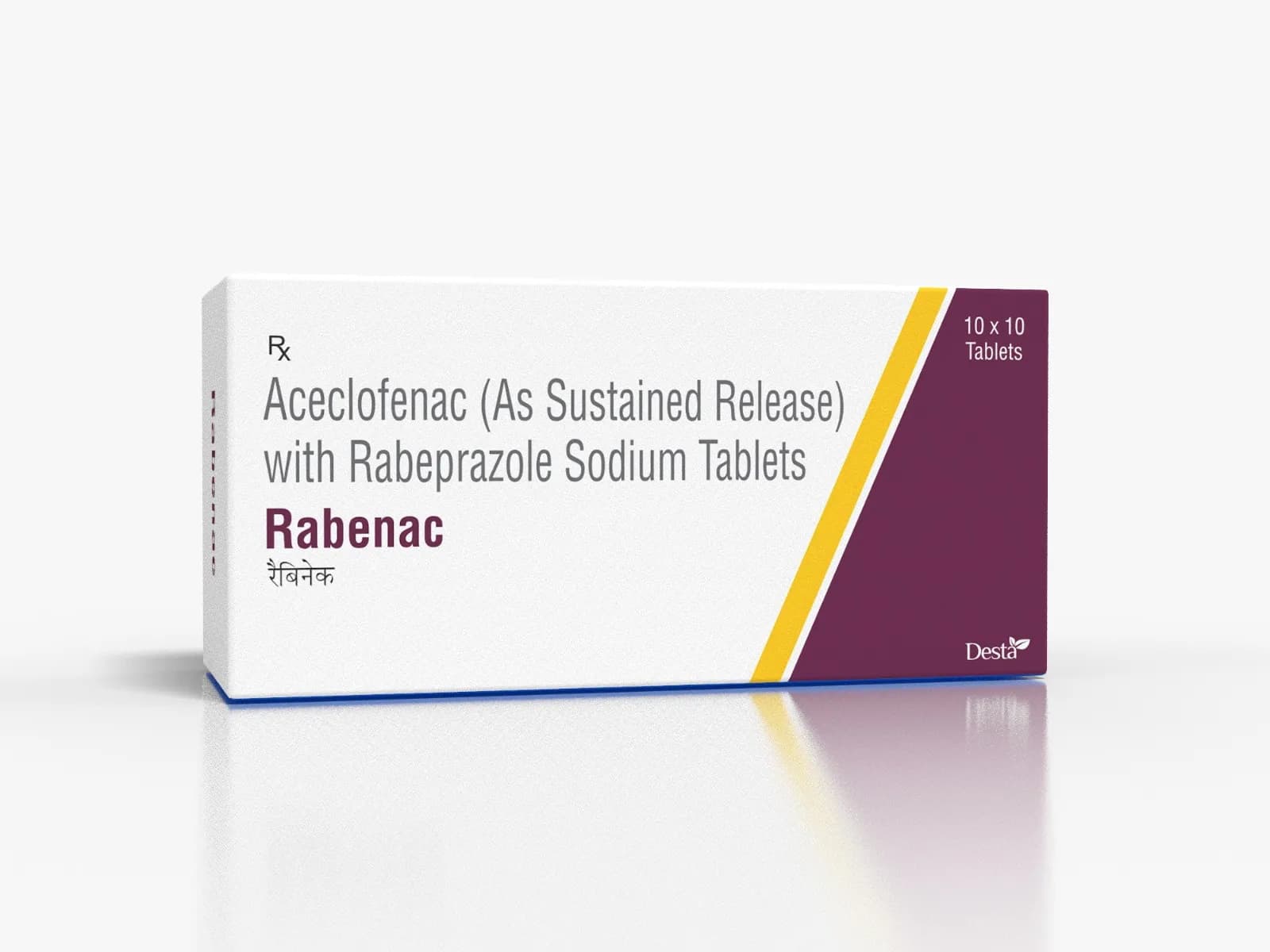
Packaging — 10×10 Alu-Alu Blister
Supplied in 10×10 Alu-Alu blister — full moisture and light barrier protection essential for the enteric-coated rabeprazole component, with tamper-evident sealing. Validated shelf life: 24 months (store below 30°C, dry place). Custom pack configurations available for export and institutional buyers.
Why Pharma Brands Choose Delwis Healthcare for This Combination
- Dual-release formulation expertise — managing SR aceclofenac and enteric rabeprazole within one tablet, a technical capability many toll manufacturers lack
- WHO-GMP, ISO 9001, ISO 14001 certified facility in Ahmedabad, Gujarat
- Validated dissolution profiles for both release mechanisms, batch after batch
- Flexible MOQ — from development batches to commercial volumes
- Full regulatory documentation for DCGI and export filings
- Private label and export-ready packaging support across markets
FAQs — Aceclofenac SR & Rabeprazole Tablet
Q1: What is aceclofenac and rabeprazole tablet used for?It treats pain and inflammation in osteoarthritis, rheumatoid arthritis, ankylosing spondylitis, lower back pain, muscle pain, and post-operative or post-traumatic pain, while rabeprazole protects the stomach lining from NSAID-induced acid damage.
Q2: Why is rabeprazole combined with aceclofenac specifically?Aceclofenac, like other NSAIDs, can cause gastric irritation by reducing protective prostaglandins. Rabeprazole suppresses stomach acid production, reducing the risk of gastritis and ulcers — and its pH-independent activation provides protection from earlier in the dosing course compared to some other PPIs.
Q3: How is aceclofenac different from diclofenac?Aceclofenac is structurally derived from diclofenac but shows a more favourable COX-2:COX-1 inhibition ratio — meaning comparatively less impact on the gastric-protective prostaglandins regulated by COX-1, contributing to its improved GI tolerability profile.
Q4: Should this tablet be taken with food?Yes — taking it with a meal supports tolerability and aligns with standard NSAID administration guidance to minimise gastric discomfort.
Q5: What is the shelf life and storage requirement?24 months, stored below 30°C in a dry place — important for protecting the enteric-coated rabeprazole component from moisture degradation.
Q6: Do you offer third party manufacturing for this combination?Yes — complete contract manufacturing including SR/enteric dual-release formulation, Alu-Alu packaging, private labeling, and regulatory documentation. Contact info@delwishealthcare.com.
Q7: What certifications does your facility hold?WHO-GMP, ISO 9001, ISO 14001 — compliant with USP, BP, and IP standards, with full stability and batch documentation for regulatory submissions.