The Resistance Problem in Paediatric Infections — Why 457mg Amoxycillin Clavulanate Exists
India's paediatric outpatient antibiotic prescribing landscape faces a growing clinical challenge that standard amoxycillin monotherapy cannot resolve. An estimated 25–40% of Haemophilus influenzae strains and a significant proportion of Staphylococcus aureus, Moraxella catarrhalis, and Streptococcus pneumoniae isolates — the primary bacterial pathogens behind children's ear, throat, sinus, chest, and urinary infections — produce beta-lactamase enzymes that hydrolytically destroy the amoxycillin molecule before it can reach its penicillin-binding protein targets.
The clinical result: treatment failure on standard antibiotics, symptom recurrence, prolonged illness, and escalating antibiotic use in children who could have been effectively treated from the first prescription — if the right formulation had been prescribed.
Amoxycillin and potassium clavulanate dry syrup resolves this precisely. The 400mg amoxycillin component delivers broad-spectrum bactericidal action by inhibiting bacterial cell wall transpeptidase enzymes (penicillin-binding proteins) — preventing cross-linking of peptidoglycan chains and triggering cell lysis in actively dividing bacteria. The 57mg potassium clavulanate component is not a conventional antibiotic — it is a mechanism-based, irreversible beta-lactamase inhibitor that binds to and permanently inactivates the bacterial enzyme responsible for antibiotic resistance, protecting amoxycillin from degradation and restoring its full bactericidal activity against organisms that would otherwise be resistant.
The 400mg:57mg ratio (total 457mg per 5ml in the reconstituted suspension) is the pharmacologically validated high-dose paediatric formulation — providing the amoxycillin exposure levels required to achieve pharmacodynamic target attainment (sustained free drug concentrations above MIC) against intermediate-resistance S. pneumoniae strains, which have shifted significantly toward higher MICs across Indian paediatric populations over the past decade.
For pharma brands building a paediatric antibiotic dry syrup portfolio, this 457mg formulation is the clinical standard rather than a niche variant — it is the most widely prescribed amoxycillin-clavulanate strength in paediatric infectious disease management in India.
Bacterial Infections in Children This Formulation Is Prescribed For — Indication-by-Indication
The amoxycillin clavulanate dry syrup uses for children span every major paediatric infectious disease category where gram-positive and gram-negative beta-lactamase-producing organisms are the causative pathogens. Understanding the full clinical indication profile is critical for pharma brands positioning this product across paediatric, ENT, chest, and general medicine prescribing networks.
Ear — Acute Otitis Media
Acute otitis media is the single most common reason a paediatric antibiotic is prescribed in India. Streptococcus pneumoniae, Haemophilus influenzae, and Moraxella catarrhalis are the three predominant causative bacteria — two of which (H. influenzae and M. catarrhalis) are frequently beta-lactamase producers. The high-dose 457mg amoxycillin-clavulanate formulation is specifically recommended for ear infection medicine for children in treatment guidelines because it achieves middle-ear fluid concentrations that exceed the MIC of non-susceptible pneumococcal strains — the primary source of treatment failure in otitis media managed with standard amoxycillin doses.
Throat — Tonsillitis, Pharyngitis & Recurrent Streptococcal Infection
Recurrent tonsillitis and treatment-resistant pharyngitis in children are frequently driven by beta-lactamase-producing Staphylococcus aureus co-colonisation in tonsillar crypts — which shields the primary Streptococcus pyogenes pathogen from amoxycillin monotherapy. The tonsillitis antibiotic syrup for children that breaks this pattern requires the clavulanate component to deactivate the protective beta-lactamase shield, allowing amoxycillin to reach and eliminate the streptococcal pathogen that is actually causing the infection.
Chest — Community-Acquired Pneumonia & Bronchitis
Community-acquired pneumonia in children under five is one of India's most significant paediatric morbidity drivers. Amoxycillin-clavulanate at the 457mg high-dose formulation is a first-line chest infection syrup for kids India across outpatient paediatric pneumonia management guidelines — providing coverage against the mixed gram-positive and gram-negative bacterial pathogens responsible for community-acquired lower respiratory tract infections, including those complicated by beta-lactamase-producing H. influenzae.
Sinusitis — Acute Bacterial Rhinosinusitis
Luliconazole's ability to penetrate nail plate structures makes it a relevant option for nail fungal infection treatment in certain sub-ungual and superficial white onychomycosis presentations — particularly where topical-only management is clinically appropriate.
Cutaneous Candidiasis
Beyond dermatophytic infections, luliconazole cream also demonstrates activity against Candida albicans and other Candida species responsible for cutaneous candidiasis — including intertriginous infections in skin folds, particularly in diabetic and immunocompromised patients.
Tinea Versicolor (Pityriasis Versicolor)
Bacterial sinusitis in children — often following a persistent or worsening viral upper respiratory infection — involves the same pathogen profile as otitis media. The sinusitis antibiotic for children syrup requirement is identical: adequate amoxycillin-clavulanate exposure in the sinus mucosa against beta-lactamase-producing organisms, where the 457mg formulation delivers reliably.
Urinary Tract Infections in Children
Paediatric urinary tract infections caused by E. coli (including beta-lactamase-positive strains), Klebsiella pneumoniae, and Proteus mirabilis are an important indication for this combination — particularly in children with recurrent UTI where prior antibiotic exposure has selected for beta-lactamase-producing uropathogens. The urinary tract infection syrup for children indication is one of the less-marketed but clinically significant applications of this formulation in paediatric nephrology and urology practice.
Skin & Soft Tissue Infections
Impetigo, infected eczema, cellulitis, and wound infections in children caused by Staphylococcus aureus and Streptococcus pyogenes — including community-acquired beta-lactamase-producing strains — respond to this combination's dual bactericidal and resistance-inhibiting mechanism, making it a reliable choice for skin infection antibiotic syrup for children when first-line therapy has failed or resistant organisms are suspected.
Glass Bottle + WFI Packaging — Why This Dry Syrup Format Is Clinically Superior to PET Alternatives
The choice of 30ml glass bottle with Water for Injection (WFI) for this paediatric dry syrup is not a cosmetic or legacy decision — it reflects a specific set of clinical and pharmaceutical quality requirements that pharma brands and paediatricians should understand when evaluating amoxycillin clavulanate 457mg WFI glass bottle 30ml products from different manufacturers.
Glass vs PET bottle for antibiotic dry syrups: Amoxycillin is pH-sensitive and undergoes accelerated degradation in the presence of moisture and elevated temperatures. Glass provides a superior moisture barrier compared to PET — reducing vapour transmission through the container wall and protecting the dry powder's chemical integrity across the product shelf life and through post-reconstitution storage. Glass also has zero risk of plasticiser leaching into the reconstituted antibiotic suspension — an important consideration for paediatric formulations where trace chemical exposure from packaging is a legitimate safety consideration.
Water for Injection (WFI) as the reconstitution diluent: The inclusion of Water for Injection as the packaged diluent — rather than asking caregivers to use tap water, filtered water, or boiled water of variable quality — eliminates a critical source of microbiological contamination risk at the point of reconstitution. In India's diverse dispensing and home storage environments, WFI-packaged dry syrups ensure the reconstituted suspension meets its specified microbiological specification from the very first dose — not dependent on the quality of locally available water.
30ml pack size for paediatric weight-based dosing: The 30ml volume is calibrated to deliver a standard paediatric treatment course of 7–10 days at typical weight-based dosing (90mg/kg/day amoxycillin component for high-dose therapy, given in divided doses) for children across the common paediatric weight ranges — providing sufficient volume for accurate, complete-course dosing without wastage or necessity of multiple bottles in most standard clinical cases.
For paediatric antibiotic dry syrup manufacturers and pharma brands positioning this product in the premium paediatric segment, the glass + WFI specification is a genuine quality differentiator over commodity PET-bottled alternatives — and one that paediatric prescribers and quality-conscious pharmacy buyers actively value.
Reconstitution, Dosing & Administration — What Prescribers and Contract Manufacturing Clients Need to Know
Amoxycillin and potassium clavulanate oral suspension is a dry powder formulation that requires reconstitution with the supplied Water for Injection before dispensing or administration. The manufacturing quality of the dry powder blend directly determines how the reconstituted suspension performs clinically — and this is one of the areas where manufacturing precision at Delwis Healthcare's facility directly impacts the end product experience.
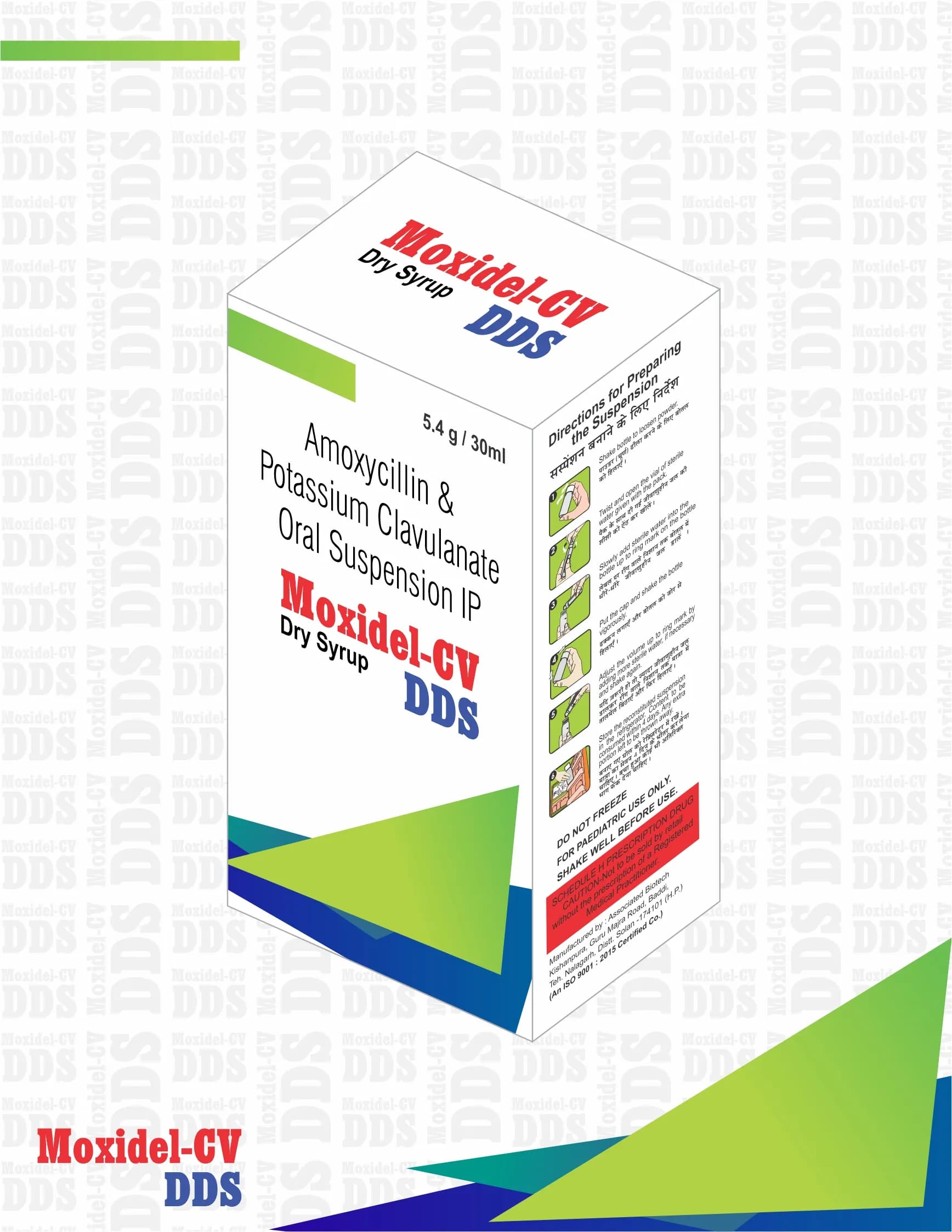
Reconstitution process: The dry powder is reconstituted by adding the entire contents of the WFI vial to the glass bottle containing the dry powder, closing the cap, and shaking vigorously until the powder is completely and uniformly dispersed. The reconstituted suspension should be a uniform, smooth liquid without powder clumping or incomplete dissolution — an outcome that depends on the particle size distribution of the dry blend, the hydrophilicity of the excipient system, and the blend uniformity achieved during manufacturing. A poorly blended or inadequately milled dry powder produces a lumpy, difficult-to-reconstitute suspension that caregivers struggle with and that delivers non-uniform doses.
Shelf life post-reconstitution: Once reconstituted, the suspension is stable for 7 days under refrigeration (2–8°C) — standard for amoxycillin-clavulanate oral suspensions. The dry powder in the sealed glass bottle carries a 24-month shelf life from date of manufacture under recommended storage conditions (below 25°C, protected from direct light and moisture).
Dosing: Weight-based paediatric dosing is prescribed by the treating physician based on the severity and type of infection, the child's current weight, and the specific amoxycillin component target (standard dose: 25–45mg/kg/day; high dose: 80–90mg/kg/day in divided doses, particularly for otitis media). The 400mg amoxycillin per 5ml concentration allows for straightforward weight-based volume calculation — a key formulation advantage for paediatric accuracy and caregiver compliance.
With food: Administering the reconstituted suspension with food — particularly at the start of a meal — improves amoxycillin absorption and significantly reduces the incidence of GI side effects (nausea, diarrhoea) in children, which is a primary reason for dose non-compliance in paediatric antibiotic courses.
Third Party & Contract Manufacturing — Amoxycillin Clavulanate Pediatric Dry Syrup for Your Brand
Delwis Healthcare is a WHO-GMP certified third party pharmaceutical manufacturer and CMO partner for amoxycillin 400mg + potassium clavulanate 57mg paediatric dry syrup — serving pharmaceutical companies, paediatric product brands, hospital supply organisations, and export distributors building or expanding a paediatric antibiotic dry syrup portfolio.
Manufacturing Partnership Services
Third Party Antibiotic Dry Syrup Manufacturing Manufacture this amoxycillin and clavulanic acid dry syrup under your pharmaceutical brand with complete cGMP-compliant production — covering API blending, granulation, dry powder filling, glass bottle packaging with WFI, outer carton packing, and label printing to your brand specifications. No manufacturing infrastructure investment required. The most direct path to adding a high-volume paediatric antibiotic SKU to your product range.
Contract Development & Manufacturing (CMO)
For brands requiring more than production capacity — our CMO offering covers blend optimisation, reconstitution profile validation, particle size studies for dissolution and reconstitutability, API compatibility testing (amoxycillin-clavulanate stability under stress conditions), scale-up from pilot to commercial batch, full stability programme execution, and regulatory documentation preparation. Built for companies that need a technically rigorous long-term paediatric antibiotic manufacturing partner.
Private Label Manufacturing
Complete custom branding for your paediatric antibiotic dry syrup range — including custom label design, carton artwork, dosage instruction leaflet, and batch coding to your brand identity. Available for Indian domestic market and export market buyers, with both standard and export-compliant documentation.
Regulatory & Export Documentation Support
Stability data, HPLC-based batch analysis reports, certificates of analysis, and full batch manufacturing records maintained for DCGI new product registration support, WHO prequalification dossiers, and export market regulatory submissions across Southeast Asia, Africa, and the Middle East.
Scalable Batch Manufacturing
From regulatory and development batches through pilot runs to full commercial production volumes — our dry syrup manufacturing facility scales with your demand without compromising blend uniformity, reconstitution quality, or pharmacopoeial compliance at any batch size.
Pharma companies searching for a GMP certified paediatric antibiotic dry syrup manufacturer in India or a WHO-GMP paediatric dry syrup manufacturer in Ahmedabad will find Delwis Healthcare technically equipped, compliance-certified, and operationally ready.
Dry Syrup Manufacturing Quality Control — From Blend Uniformity to Reconstitution Performance
The quality of a paediatric antibiotic dry syrup is determined at multiple critical stages of manufacturing — and the consequences of quality failure in a product dosed to children by body weight are more significant than in adult formulations where dose precision is less critical. Every batch of amoxycillin 400mg + potassium clavulanate 57mg dry syrup manufactured at Delwis Healthcare passes a comprehensive release protocol:
- HPLC Dual API Quantification — Independent content determination for both amoxycillin and potassium clavulanate per batch, confirming the 400mg:57mg label claim and the pharmacopoeial content uniformity specification
- Blend Uniformity Testing — Confirms uniform distribution of both APIs throughout the dry powder blend, ensuring every 5ml dose of the reconstituted suspension delivers the labelled antibiotic content regardless of which part of the bottle it is drawn from
- Reconstitution Performance Testing — The dry powder is reconstituted under standard conditions and assessed for time to full dispersion, absence of clumping, and visual suspension uniformity — directly reflecting the clinical reconstitution experience
- Particle Size Distribution — Critical for reconstitution rate, dose uniformity, and palatability of the final suspension
- pH of Reconstituted Suspension — Verified within the validated range that ensures both API chemical stability and palatability for paediatric administration
- Dissolution Testing — Amoxycillin and clavulanate dissolution profiles from the reconstituted suspension confirmed against IP specifications
- Microbial Limit Testing — Microbiological compliance of the dry powder and reconstituted suspension per IP oral suspension standards
- Moisture Content (Karl Fischer) — Critical for amoxycillin stability in dry powder form; moisture above threshold accelerates degradation of both APIs during shelf life
- Stability Studies — ICH-compliant real-time and accelerated stability data on the dry powder and reconstituted suspension for DCGI and export market regulatory dossiers
QMS aligned with WHO-GMP, IP, USP, and BP pharmacopoeial standards, with full electronic batch records, traceability, and documentation maintained for every production batch.
Frequently Asked Questions — Amoxycillin & Potassium Clavulanate Dry Syrup
Q1: What is amoxycillin and potassium clavulanate dry syrup used for in children?
Amoxycillin and potassium clavulanate dry syrup uses for children cover all major paediatric bacterial infections where beta-lactamase-producing organisms are involved: acute otitis media (ear infections), acute bacterial sinusitis, community-acquired pneumonia, bronchitis, tonsillitis and pharyngitis, urinary tract infections, and skin and soft tissue infections. The 457mg (400mg + 57mg per 5ml) formulation is the high-dose paediatric variant specifically recommended for moderate-to-severe infections and for children with prior antibiotic exposure where resistance is clinically suspected.
Q2: How does amoxycillin clavulanate dry syrup work against resistant bacteria?
Amoxycillin kills bacteria by binding to penicillin-binding proteins and blocking cell wall synthesis — causing bacterial cell lysis. In beta-lactamase-producing bacteria, this mechanism is defeated because the enzyme degrades amoxycillin before it reaches its target. Potassium clavulanate enters first, binds irreversibly to the beta-lactamase enzyme, and permanently inactivates it — removing the resistance mechanism and allowing amoxycillin to kill the organism without interference. This is why the combination works against infections that plain amoxycillin cannot treat.
Q3: How is amoxycillin clavulanate dry syrup reconstituted?
The dry powder in the glass bottle is reconstituted by adding the entire volume of the packaged Water for Injection into the bottle, closing it securely, and shaking vigorously until the powder is completely and uniformly dispersed. The reconstituted suspension should be used within 7 days when stored under refrigeration (2–8°C). Shake the bottle thoroughly before measuring and administering each individual dose — the suspension sediments on standing, and failure to shake before dosing produces inaccurate antibiotic delivery.
Q4: What is the dosage of amoxycillin clavulanate dry syrup for children?
Dosage is prescribed by the treating paediatrician based on the child's body weight and the nature and severity of the infection. Standard dosing is 25–45mg/kg/day of the amoxycillin component divided into two daily doses. High-dose therapy (80–90mg/kg/day) is recommended for acute otitis media, particularly in areas with high pneumococcal resistance prevalence and in children under 2 years. The 400mg amoxycillin per 5ml concentration of this formulation facilitates weight-based volume calculation for accurate paediatric dosing.
Q5: Should amoxycillin clavulanate syrup be given before or after food?
Administering the reconstituted suspension at the beginning of a meal or with food is clinically recommended — it both optimises amoxycillin absorption (food, particularly a fat-containing meal, slows gastric emptying and increases GI transit time, improving amoxycillin bioavailability) and significantly reduces the incidence of GI side effects including nausea and diarrhoea that are the most common reasons for dose non-compliance in paediatric antibiotic courses.
Q6: Is amoxycillin clavulanate dry syrup safe for infants and toddlers?
Amoxycillin-clavulanate oral suspension is used in children from the neonatal period onwards under paediatric supervision — with doses carefully calculated by body weight. For infants under 3 months and neonates, specific dosing protocols and closer clinical monitoring are required. As with all prescription antibiotics in paediatrics, use should always be under the direction of a qualified prescriber with appropriate dosage calculation, clinical indication, and monitoring.
Q7: What is the difference between amoxycillin suspension and amoxycillin clavulanate dry syrup?
Plain amoxycillin suspension contains only the antibiotic — effective against susceptible bacteria but defeated by beta-lactamase-producing organisms. Amoxycillin and clavulanic acid dry syrup adds potassium clavulanate as a beta-lactamase inhibitor — protecting amoxycillin from enzymatic destruction and extending its coverage to resistant organisms that plain amoxycillin cannot treat. The clinical indication for clavulanate addition is specifically: infections where beta-lactamase-producing pathogens are likely or confirmed causative agents.
Q8: Why is a glass bottle with WFI used rather than PET packaging for this dry syrup?
Glass provides superior moisture barrier protection compared to PET — critical for maintaining the chemical stability of the amoxycillin and clavulanate APIs in dry powder form across the 24-month shelf life. Including Water for Injection as the packaged reconstitution diluent eliminates the microbiological risk of caregivers using tap water or household-filtered water of variable quality — ensuring the reconstituted suspension meets its microbiological specification from the first dose regardless of the dispensing or home storage environment.
Q9: Are you a third party manufacturer of amoxycillin clavulanate pediatric dry syrup?
Yes. Delwis Healthcare is a WHO-GMP certified third party pharmaceutical manufacturer and CMO partner for amoxycillin 400mg + potassium clavulanate 57mg paediatric dry syrup — offering complete contract manufacturing including API blending, dry powder filling, glass bottle + WFI packaging, private labeling, and full regulatory documentation support for domestic Indian market and export market pharmaceutical brands.
Q10: What certifications does your paediatric dry syrup manufacturing facility hold?
Our facility is certified under WHO-GMP, ISO 9001, and ISO 14001, with manufacturing processes validated in compliance with IP, USP, and BP pharmacopoeial standards. Complete stability data, batch analysis reports, COA, and regulatory compliance documentation are maintained and available for DCGI product registration submissions and export market regulatory filings. Contact info@delwishealthcare.com or +91 9904405470 for manufacturing enquiries.