Introduction: Why the Choice of Formulation Is as Important as the Drug Itself
When a dermatologist prescribes an antifungal for ringworm on your forearm, they almost always reach for a cream. When the same dermatologist treats jock itch, athlete's foot between the toes, or a skin fold infection under the breasts — they frequently reach for a powder instead.
The active antifungal ingredient is often identical. In both cases it may well be clotrimazole 1% — the same molecule, the same mechanism of action. So why does the formulation change?
The answer is not about preference or convenience. It is about dermatological pharmacology — specifically, about how the microenvironment where the infection lives determines whether the drug can work effectively. In warm, sweaty, occluded skin zones, the formulation base is not a neutral carrier. It actively participates in whether treatment succeeds or fails.
This article explains the science behind why antifungal dusting powder outperforms cream in high-moisture skin areas — covering five evidence-based advantages that dermatologists and pharmacists draw on when making this prescribing distinction. You will also find clear guidance on when cream remains the better choice, so the picture is complete.
Understanding the Problem First: Why Fungal Infections Return in Moist Skin Zones
Before explaining why powder has specific advantages, it helps to understand what makes moist skin areas different as infection sites.
Dermatophyte fungi — the organisms responsible for tinea pedis (athlete's foot), tinea cruris (jock itch), and tinea corporis (ringworm) — are not evenly distributed across the body. They concentrate in specific microclimates: the web spaces between toes, the inguinal folds of the groin, the skin beneath the breasts, the axillae, and abdominal skin folds. These locations share three characteristics that dermatophytes exploit:
Warmth: Skin folds trap body heat, raising local temperature by 2–4°C above adjacent open skin — within the range that accelerates fungal metabolic activity and reproductive rate.
Moisture: Sweat glands are densely distributed in the groin, axillae, and feet. Footwear occlusion and skin-to-skin contact in folds prevent evaporation, maintaining continuous skin surface hydration.
Reduced airflow: Occluded microenvironments have limited oxygen exchange and poor ventilation — conditions that favour the anaerobic-tolerant metabolism of many dermatophytes.
The critical clinical implication: eliminating the active fungal infection without simultaneously modifying these three environmental factors leads to recurrence, often within weeks of completing a cream-based treatment course. The fungal cells may be killed by the antifungal — but the ecological conditions that allowed them to establish themselves remain completely unchanged, making reinfection from residual spores or re-exposure highly likely.
This is the gap that antifungal dusting powder is specifically designed to close. And this is why five advantages of powder over cream in these locations are not simply theoretical — they are clinically observable in the recurrence rate difference between formulation types.
Advantage 1: Powder Actively Removes the Moisture That Sustains Fungal Growth
The most important and fundamentally irreplaceable advantage of dusting powder over cream in moist skin areas is its moisture-absorbing capacity — a property that no cream formulation, however well-formulated, can replicate.
Cream formulations are emulsions — oil-in-water or water-in-oil systems with a water phase and an oily phase. When applied to already-moist skin, they add a film layer that:
- Occludes the skin surface, trapping existing moisture beneath
- In water-in-oil creams, adds additional oil-phase content that further seals moisture in
- In hot climates like India's, rapidly becomes uncomfortable in skin folds and between toes, often causing patients to wipe or remove the cream prematurely — reducing treatment contact time
An absorbent talc-based dusting powder does the opposite. Talc is a hydrophilic mineral that draws free moisture from the skin surface by physical adsorption — absorbing sweat and transepidermal water loss (TEWL) from the treated area. The practical effect is a progressively drier microenvironment after each application, rather than a sealed, moist one.
In clinical terms, this translates to:
- Reduced fungal growth rate — dermatophytes require moisture for hyphal extension and spore germination
- Reduced skin maceration — the breakdown of wet stratum corneum that creates entry points for new infection
- Improved antifungal drug contact time — dry skin holds the applied powder in contact with the infection site for longer than moist skin holds a cream layer
For athlete's foot between the toes — where the interdigital space can have persistent skin-surface moisture for 18+ hours a day in enclosed footwear — this drying action is often the difference between a complete cure and a partial response followed by recurrence within the same season.
Advantage 2: Superior Penetration Into Narrow Skin Folds and Interdigital Spaces
The second advantage is geometric — and it is more clinically significant than it may initially appear.
The spaces between the toes, particularly the 3rd/4th and 4th/5th interdigital clefts, are narrow, irregular, and difficult to reach with a cream applied by fingertip. Pressing a cream into a wet, macerated toe web space typically results in:
- Uneven distribution — more product on the accessible outer edges, less in the deepest fold
- Smearing of the macerated skin rather than coating of the infected surface
- Discomfort for the patient from direct fingertip pressure on inflamed skin
A sifter-top dusting powder dispenses in a fine mist that falls into narrow spaces by gravity and air pressure — reaching the deepest part of the interdigital web without mechanical pressure or touch. The patient separates the toes, holds the bottle above the foot, and the powder reaches the entire contact surface of the fold evenly and thoroughly.
The same geometric advantage applies to:
- Groin skin folds: The inguinal crease is a three-dimensional fold where direct cream application by finger can leave gaps, particularly at the medial thigh contact surface
- Abdominal skin folds in overweight patients: Large, deep skin folds with contact surfaces on both sides can be dusted completely from above, reaching both sides of the fold simultaneously
- Axillary vault: The curved, three-dimensional nature of the underarm is better served by a powder that settles evenly than by a cream that runs downward under gravity
This even, complete coverage across the full surface of irregular skin folds ensures the antifungal ingredient — the clotrimazole absorbent dusting powder — reaches every part of the infected surface rather than just the accessible edges.
Advantage 3: Better Patient Compliance Due to Comfort and Convenience in Daily Use
Patient compliance — consistent daily application for the full prescribed treatment duration — is one of the most critical determinants of antifungal treatment success. Incomplete courses are the leading cause of recurrence in tinea infections.
In high-moisture skin areas, cream formulations consistently face compliance challenges that powder does not:
Greasiness in hot weather: In India's climate, a cream applied to the groin, underarms, or between toes in summer months creates an immediate sensation of added warmth and stickiness. Many patients in high-humidity conditions reduce application frequency or wipe the cream off after application — reducing both treatment dose and contact time.
Clothing staining: Cream formulations can stain underwear and socks — a practical deterrent to consistent once or twice-daily application, particularly for patients in professional occupations or those concerned about clothing damage.
Difficulty reapplying during the day: For patients who need mid-day reapplication — athletes, people in physically demanding occupations, individuals who change clothes during the day — carrying a dusting powder bottle in a bag is simpler and more practically feasible than managing a cream tube and ensuring clean, dry hands before application.
Powder comfort profile: Powder applied to moist skin folds is experienced by patients as cooling, drying, and immediately comfortable — sensations that positively reinforce daily use, in contrast to the temporary occlusive discomfort some patients associate with cream in these locations.
The result: powder-based antifungal formulations in moisture-prone zones consistently achieve higher treatment completion rates in practice — which directly translates to higher clinical cure rates and lower recurrence.
Advantage 4: Preventive Efficacy Between Active Infection Episodes
This is an advantage that creams simply cannot offer practically — and it is particularly relevant for patients with recurrent fungal infections in India's climate.
Creams are treatment formulations — they are applied to an active, visible infection. Applying cream to symptom-free skin between episodes as prevention is impractical: greasy, uncomfortable, staining, and poorly tolerated for daily prophylactic use in high-sweat zones.
An antifungal dusting powder, however, can be used as a daily preventive dusting routine in high-risk skin zones during periods of known vulnerability:
- Athletes who shower in communal facilities (gymnasiums, swimming pools, sports grounds)
- During India's monsoon months when skin fold humidity is highest
- In the weeks after completing a treatment course — the highest-risk window for recurrence from residual spores
- By patients with known predisposition to recurrent tinea pedis or tinea cruris
This preventive use creates a daily-maintained hostile microenvironment for fungal spores — dry, powder-coated, and antifungally active — before a new infection can establish itself. No cream formulation achieves this practically.
For dermatologists managing patients with recurrent tinea infections in India — which represent a substantial proportion of the dermatology outpatient caseload during April through September — recommending a powder for post-treatment prophylaxis alongside cream for acute episodes is an evidence-aligned dual approach that addresses both the treatment and recurrence phases of management.
To explore more about specific tinea conditions and when antifungal powder is the appropriate first-line recommendation, read our earlier guide on clotrimazole dusting powder uses — a complete patient and pharmacist reference covering all primary indications.
Advantage 5: Reduced Risk of Skin Maceration in High-Moisture Contact Zones
Maceration — the softening, whitening, and breakdown of the stratum corneum from prolonged moisture exposure — is both a consequence of fungal infection in skin folds and a driver of its persistence. Moist, macerated skin has:
- A compromised barrier function — increasing fungal penetration into deeper epidermal layers
- A higher pH than healthy skin — shifting toward the range that supports fungal and bacterial growth
- Reduced structural integrity — making the skin prone to fissuring, which creates painful entry points for secondary bacterial infection
Cream application to already-macerated interdigital or skin fold skin maintains or worsens the moisture content that drives maceration — particularly water-based cream vehicles that add aqueous phase content directly to the treatment site.
Powder actively reverses maceration by drying the affected surface, reducing the skin-surface moisture that sustains the maceration process. As maceration reduces with consistent powder use:
- Skin barrier integrity begins to recover
- pH normalises toward the mildly acidic range that inhibits fungal growth
- The structural fissures that allowed deeper fungal penetration begin to heal
This is why dermatologists managing severe interdigital athlete's foot — with significant maceration, fissuring, and odour from secondary bacterial colonisation — often prefer to initiate treatment with a powder rather than a cream, addressing the maceration as the first priority before considering whether cream-based antifungal therapy would be appropriate for maintenance.
When Cream Is the Right Choice — Completing the Clinical Picture
A clinically honest guide to this comparison must acknowledge that cream is the better formulation choice in specific scenarios. The advantages of powder over cream in moist skin areas do not mean powder is universally superior.
Cream is preferred when:
- The infection is on dry body skin — tinea corporis lesions on the forearms, chest, or legs in non-sweating zones do not need the moisture-management properties of powder; cream's better skin adhesion and occlusive delivery make it the right choice here
- The lesion is well-demarcated and small — a single, well-defined ringworm patch responds efficiently to cream applied precisely to the borders; powder's dispersion is less targeted for this presentation
- The skin is severely inflamed or exudative — in active, weeping eczematous tinea, very broken skin with exudate may require the moisturising and emollient properties of a cream base before transitioning to powder; applying powder to severely exudative skin can cause caking
- An antibiotic + antifungal combination is needed — infected eczema or secondary bacterial superinfection on top of fungal infection requires an antibiotic-corticosteroid-antifungal combination, which is only practically formulated as a cream — for example, formulations like fusidic acid and mometasone furoate cream for infected inflammatory dermatoses. Our full cream manufacturing range covers these combination dermatological formulations for pharma brands and institutions
The decision between powder and cream is therefore not a general hierarchy — it is a location-specific and presentation-specific clinical choice. For moist skin areas with pure fungal infection: powder. For dry skin areas or complex mixed infections: cream or combination formulations.
A Practical Location-to-Formulation Guide for Dermatologists and Pharmacists
Body Location | Typical Moisture Level | Preferred Antifungal Format |
|---|
Interdigital toe spaces (athlete's foot) | Very High | ✅ Powder |
Inguinal folds / groin (jock itch) | High | ✅ Powder |
Inframammary fold (under breasts) | High | ✅ Powder |
Axillae (underarms) | High | ✅ Powder |
Abdominal skin folds | High | ✅ Powder |
Perianal / gluteal fold | Moderate-High | ✅ Powder |
Plantar foot surface (sole) | Moderate | Either — powder preferred in summer |
Forearm / trunk / leg skin | Low (dry) | ✅ Cream |
Scalp (tinea capitis) | Variable | Shampoo or lotion — not powder |
Nail (tinea unguium) | N/A (nail plate) | Topical lacquer — not standard powder |
Mixed bacterial + fungal infection | Variable | ✅ Combination cream |
Conclusion
The choice between antifungal powder and cream is not arbitrary — it is a formulation science decision rooted in where the infection is, what the local skin microenvironment looks like, and whether moisture management is as important as antifungal delivery. For the five most clinically significant reasons covered in this guide — moisture removal, coverage in skin folds, patient compliance, preventive efficacy, and maceration reversal — antifungal dusting powder in high-moisture skin zones outperforms cream in ways that directly affect treatment outcomes and recurrence rates.
For pharmaceutical brands building a dermatology portfolio that covers both the moist-skin treatment case (powder) and the dry-skin and complex-infection cases (cream), the decision is not an either/or — it is a complete range question. Our powder manufacturing range and cream manufacturing range are both manufactured to the same WHO-GMP quality standards at our Ahmedabad facility, giving pharma partners a single sourcing point for a complete dermatology antifungal product line.
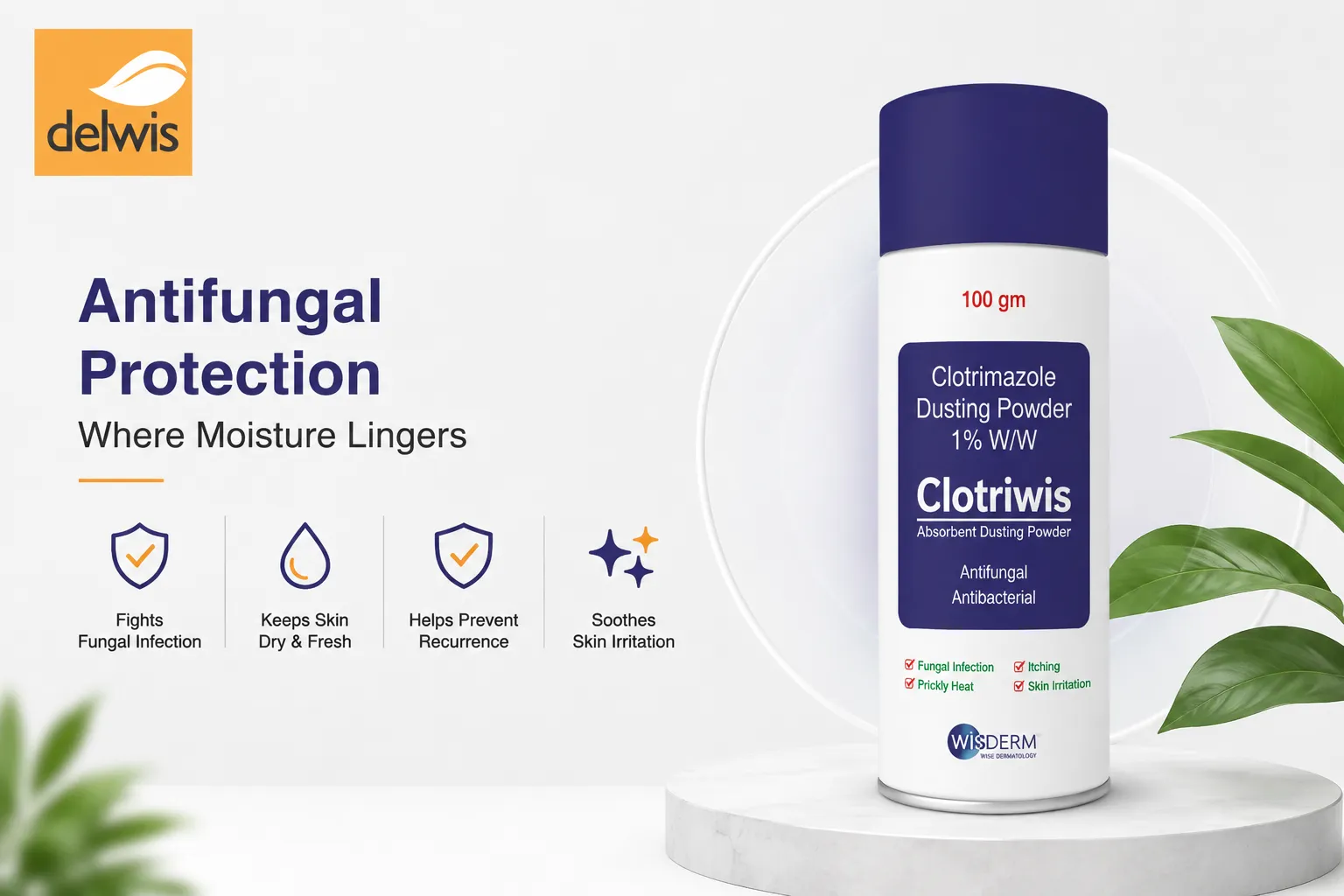
To explore the complete formulation details, pack specifications, and manufacturing capabilities for clotrimazole absorbent dusting powder, visit the Delwis Healthcare product page.
Frequently Asked Questions
Q: Why do dermatologists recommend powder instead of cream for athlete's foot and jock itch?
Because these infections occur in warm, sweaty, occluded skin zones where moisture sustains fungal growth. Powder simultaneously delivers antifungal therapy and actively dries the microenvironment — removing the conditions that allow the fungus to survive and recur. Cream can maintain moisture in these locations, potentially contributing to recurrence even after the active infection clears.
Q: Is antifungal powder as effective as cream at killing the fungus?
Yes — when the active ingredient and concentration are equivalent (e.g., clotrimazole 1% in both formats), the antifungal efficacy against the fungal organism itself is comparable. The difference is the formulation's effect on the skin microenvironment, patient compliance, coverage in skin folds, and prevention of recurrence — where powder has measurable advantages in high-moisture skin zones.
Q: Can antifungal powder be used every day as prevention?
Yes — this is one of powder's practical advantages over cream. Daily preventive dusting of high-risk zones (feet, groin) during monsoon and summer months, after exercise, or post-treatment to prevent recurrence is a clinically rational and well-tolerated approach. It is practically feasible in a way that preventive cream application is not.
Q: Does antifungal powder work for ringworm on the body?
For ringworm on dry body skin — the trunk, arms, or legs — cream is generally the more efficient delivery format because it adheres to the skin surface and maintains drug contact without the dispersion that powder undergoes on open, non-occluded skin. Powder is preferred for ringworm in or near skin folds, groin, or feet where moisture management matters alongside antifungal treatment.
Q: Which skin fold infections respond best to antifungal powder?
Candidal intertrigo (skin fold yeast infection) — under the breasts, in abdominal folds, the axillae, and groin — responds particularly well to powder because the affected skin surfaces face each other with no airflow between them. Powder applied between these surfaces dries both contact sides simultaneously while delivering clotrimazole antifungal action. These are the presentations where powder most consistently outperforms cream.
This article is written for educational purposes and for healthcare professionals and pharmaceutical industry professionals. It does not constitute prescribing advice. All treatment decisions should be made by qualified dermatologists or healthcare professionals based on individual clinical assessment.