Introduction: Why a Powder, and Why It Matters for Fungal Infections
Walk into any pharmacy in India during the summer or monsoon months and ask about ringworm, jock itch, or athlete's foot, and there's a good chance the pharmacist will reach for a dusting powder rather than a cream. This isn't a matter of preference — it's a deliberate clinical choice rooted in how fungal infections actually behave on skin.
Dermatophyte fungi — the organisms responsible for tinea infections — thrive specifically in warm, moist, occluded environments. The spaces between toes, the groin, underarms, and skin folds are exactly these conditions. A cream applied to already-moist skin can, somewhat counterintuitively, help maintain the very environment the fungus needs to survive. A powder, by contrast, treats the infection while actively drying out the surrounding skin — removing the conditions that allow the fungus to persist and recur.
This guide is built for two audiences: patients trying to understand what their pharmacist or doctor has recommended, and pharmacists who want a complete, easy-to-reference resource for explaining clotrimazole dusting powder uses to the patients they counsel every day.
What Is Clotrimazole Dusting Powder?
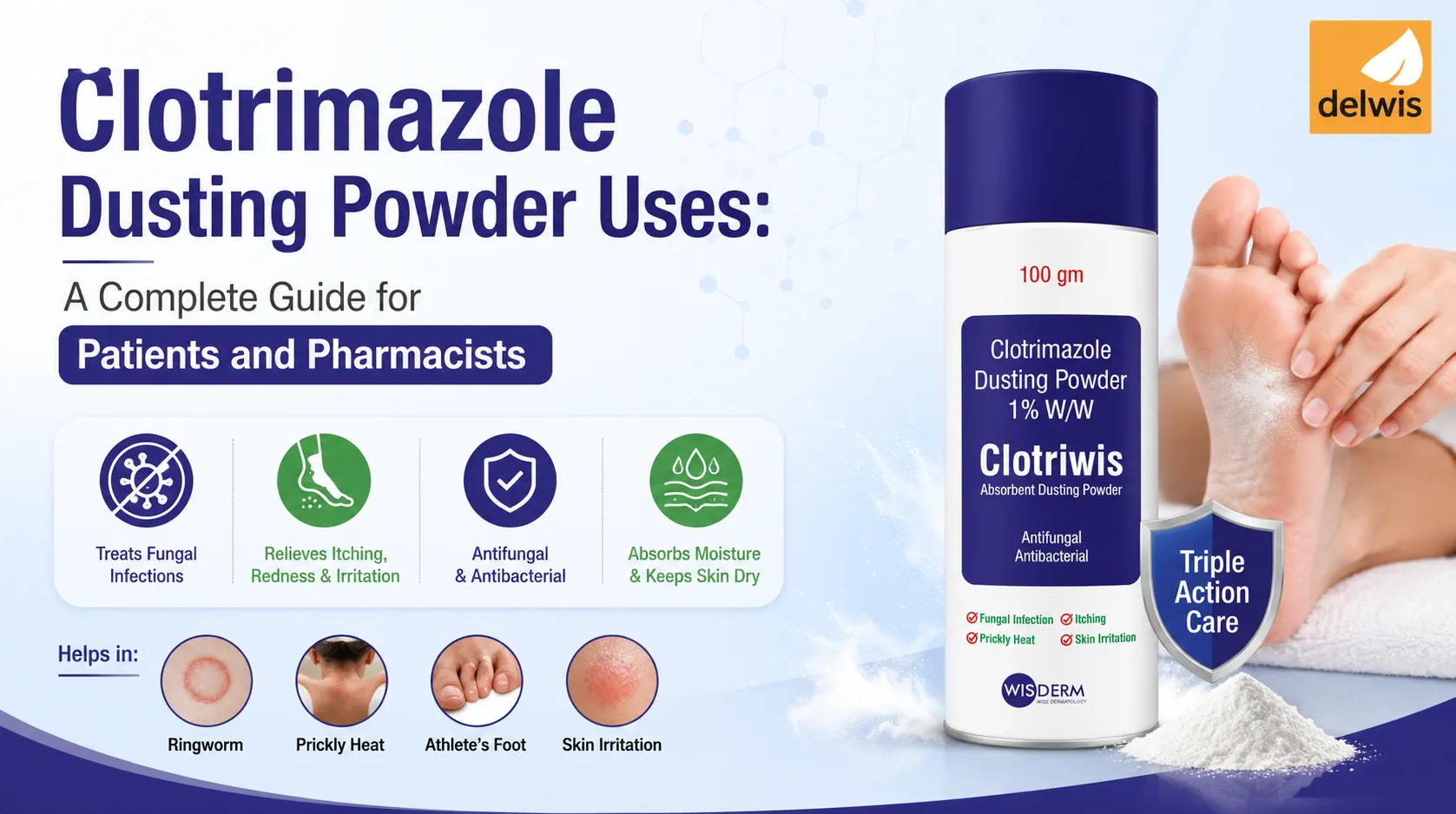
Clotrimazole dusting powder is a topical antifungal formulation that combines an active antifungal ingredient — clotrimazole — with a moisture-absorbing powder base, typically built on a talc or talc-substitute carrier. The powder format is what sets it apart from clotrimazole creams, gels, or lotions, which share the same active ingredient but lack the absorbent, drying property that makes powder particularly effective in specific body locations.
Clotrimazole itself belongs to the imidazole class of antifungal agents — a well-established drug family used worldwide for treating superficial fungal infections of the skin. It is typically formulated at a 1% w/w concentration, meaning every 100 grams of powder contains 1 gram of active clotrimazole, distributed evenly through the powder base via a controlled manufacturing blending process.
The product is commonly packaged in a sifter-top or flip-cap bottle, allowing the patient to dust a controlled, even layer of powder directly onto the skin without the mess or excess product use that can occur with loosely poured powders.
How Does Clotrimazole Dusting Powder Work?
To appreciate why this formulation is effective, it helps to separate the two things happening simultaneously when the powder is applied: an antifungal chemical action and a physical moisture-management action.
The Antifungal Action: Disrupting the Fungal Cell Membrane
Clotrimazole works by interfering with a process called ergosterol biosynthesis. Ergosterol is a lipid molecule that forms the structural backbone of the fungal cell membrane — performing essentially the same role that cholesterol performs in human cell membranes. Without sufficient ergosterol, the fungal cell membrane cannot maintain its shape, regulate what passes in and out of the cell, or protect the cell's internal contents.
Clotrimazole blocks an enzyme called lanosterol 14α-demethylase — part of the cytochrome P450 enzyme family in fungi — which is responsible for converting a precursor molecule called lanosterol into ergosterol. By inhibiting this enzyme, clotrimazole prevents the fungal cell from producing the ergosterol it needs. The cell membrane becomes progressively unstable, develops increased permeability, leaks essential cellular contents, and the fungal cell eventually dies.
This mechanism is shared across the broader imidazole antifungal class, but clotrimazole has one of the longest and most extensively documented clinical track records among these agents — making it a trusted, well-understood choice for both prescribers and pharmacists.
The Moisture-Management Action: Why the Powder Base Matters
This is the part of the formulation that creams simply cannot replicate. The talc-based powder carrier in clotrimazole dusting powder actively absorbs moisture from the skin surface — sweat, residual dampness from bathing, or environmental humidity trapped in skin folds.
This matters because moisture is not just an uncomfortable side effect of fungal infection — it is one of the primary conditions that sustains fungal growth and causes recurrence even after the active infection has technically been treated. A cream-based antifungal, applied to a moist skin fold, can leave that area just as damp as before — meaning the fungus, while chemically inhibited during active treatment, has every environmental advantage to return the moment treatment stops.
By drying the microenvironment while simultaneously delivering antifungal action, clotrimazole dusting powder works on two fronts at once — treating the infection and removing the conditions that caused it in the first place. This dual mechanism is precisely why dermatologists and pharmacists across India frequently recommend powder over cream for infections in high-moisture body locations.
Clotrimazole Dusting Powder Uses — Complete Breakdown by Condition
Here is a comprehensive look at every condition where clotrimazole dusting powder uses are clinically appropriate, along with the practical reasoning behind each recommendation.
1. Athlete's Foot (Tinea Pedis) — Between the Toes
The interdigital spaces of the feet — the narrow gaps between toes — are almost perpetually moist due to footwear occlusion, sweating, and limited airflow. This makes them one of the most common and persistent sites for fungal infection in India, particularly among people who wear closed shoes for long hours, use public showers or gyms, or have naturally sweaty feet.
Clotrimazole dusting powder is particularly well-suited here because the powder format can be worked directly into the narrow spaces between each toe — something a thick cream struggles to achieve without leaving residue that traps further moisture. Pharmacists frequently recommend separating the toes during application to ensure the powder reaches every affected fold.
2. Jock Itch (Tinea Cruris) — Groin and Inner Thigh
The groin is one of the warmest, most friction-prone, and sweat-generating areas of the body — creating near-ideal conditions for dermatophyte growth. Jock itch is extremely common in India's climate, particularly in men, in individuals who are overweight, and in those engaged in physical labour or sport.
Because this area generates continuous moisture throughout the day, a drying antifungal powder consistently performs better here than a cream that may sit on already-damp skin. Once or twice-daily application, with attention to full coverage of the affected area and its margins, is the standard recommendation.
3. Ringworm (Tinea Corporis) — Body Skin
Tinea corporis presents as the classic ring-shaped, red, scaly, and itchy patch most people associate with the word "ringworm." While creams remain a perfectly reasonable choice for small, well-defined, dry-skin ringworm patches, powder becomes the preferred format for larger affected areas, for patients in hot and humid climates who find creams uncomfortable, and for lesions located in or near skin folds and sweat-prone zones.
4. Candidal Intertrigo — Skin Fold Infections
Intertrigo refers to inflammation (and frequently infection) occurring in skin folds where two skin surfaces rub together — under the breasts, in the underarms, in abdominal folds, and in the groin. Candida albicans, a yeast rather than a dermatophyte, is the most common culprit in these locations, thriving in the warm, airless, moist conditions these folds create.
This is arguably where the absorbent powder format provides its most decisive clinical advantage. Skin folds are notoriously difficult to keep dry, and any cream applied here tends to accumulate rather than absorb. Clotrimazole dusting powder directly addresses both the candidal infection and the chronic moisture accumulation that makes intertrigo so persistent and recurrent.
5. Prickly Heat with Fungal Involvement
Prickly heat, medically termed miliaria, is fundamentally a sweat gland blockage condition rather than a primary fungal infection — but in India's hot, humid climate, prickly heat–affected skin frequently develops secondary fungal or yeast colonisation due to the prolonged moisture and skin barrier disruption involved. When a pharmacist or dermatologist identifies this secondary fungal component, clotrimazole dusting powder offers a dual benefit: the absorbent base manages the underlying sweat accumulation driving the prickly heat, while clotrimazole addresses any fungal overgrowth.
6. Tinea Versicolor (Pityriasis Versicolor)
This condition, caused by an overgrowth of Malassezia yeast rather than classic dermatophytes, produces patches of lighter or darker skin discolouration — commonly on the chest, back, and shoulders. It is more prevalent in hot, humid climates and in individuals with naturally oily skin. Clotrimazole's broad antifungal spectrum extends activity against Malassezia species, and the powder format is well-tolerated for the larger surface areas this condition typically affects.
7. Preventive Use in High-Sweat Settings
Beyond treating active infections, clotrimazole dusting powder is also used preventively by individuals at elevated risk of recurrent fungal infections — athletes, people in physically demanding occupations, and anyone who experiences prolonged sweating in enclosed footwear or clothing. Regular preventive dusting in high-risk zones (feet, groin) can reduce the frequency of recurrent tinea infections in susceptible individuals, particularly during India's peak humidity months.
How to Apply Clotrimazole Dusting Powder Correctly
Proper technique meaningfully affects how well this treatment works. Here is the step-by-step process patients and pharmacists should follow:
Step 1 — Wash and thoroughly dry the area first This is the single most important step, and the one most commonly skipped. Applying powder over damp skin defeats its core purpose — the powder will clump rather than absorb, and the antifungal won't make proper contact with the skin surface. Wash gently, then pat the area completely dry, including between toes or within skin folds, before applying any powder.
Step 2 — Dust a thin, even layer Hold the bottle a short distance from the skin and dust lightly — a thin, even coating is sufficient. Heavier application does not improve effectiveness and can create unnecessary mess or clumping, especially in skin folds.
Step 3 — Cover the margin, not just the visible patch Extend application roughly 2cm beyond the visible edge of the affected area. Fungal infection typically extends slightly beyond what is visibly inflamed, and treating only the obvious patch increases the risk of the infection persisting at its edges.
Step 4 — Separate skin folds and toe spaces during application For interdigital athlete's foot or skin fold intertrigo, gently separate the toes or fold the skin apart to ensure the powder reaches every contact surface — not just the outer skin.
Step 5 — Apply once or twice daily, as directed Follow the frequency recommended by the prescribing doctor or pharmacist — typically once or twice daily. Reapplying more frequently than directed does not speed up healing and simply uses more product unnecessarily.
Step 6 — Avoid inhalation and eye contact When dusting powder, particularly in enclosed spaces like a bathroom, be mindful of airborne particles. Avoid applying near the face, and keep the powder away from the eyes, nose, and mouth — this is especially important when applying powder to children.
Step 7 — Complete the full treatment course Visible improvement often occurs well before the fungal infection is fully eradicated at a cellular level. Stopping treatment as soon as symptoms improve is one of the most common reasons fungal infections recur. Always complete the full duration recommended by your pharmacist or doctor.
Side Effects of Clotrimazole Dusting Powder
Clotrimazole dusting powder has a strong safety profile, with most patients experiencing no significant issues throughout treatment. That said, patients and pharmacists should be aware of the following:
Common, mild, and usually temporary:
- Mild stinging or burning sensation on first application, particularly if the skin is already irritated or broken
- Slight skin dryness from the absorbent powder base
- Occasional mild redness at the application site
Less common:
- Contact irritation or hypersensitivity reaction to the powder base or active ingredient — uncommon but possible
- Worsening of irritation if applied to significantly broken, weeping, or excoriated skin
When to stop and seek advice: If irritation worsens rather than improves after a few days, if blistering or significant spreading redness develops, or if the treated area appears to be getting worse rather than better, patients should stop using the product and consult a pharmacist or doctor. This may indicate an allergic reaction, an incorrect diagnosis, or a need for a different treatment approach altogether.
Who Should Take Extra Care
Babies and young children: Clotrimazole powder may be used under medical guidance for confirmed fungal nappy rash in infants, but should never be applied routinely or without a clear diagnosis. Special care should be taken to avoid any powder near the baby's face due to inhalation risk.
Pregnant and breastfeeding women: Topical clotrimazole has a generally favourable safety profile due to minimal systemic absorption, but use during pregnancy or breastfeeding should still be guided by a doctor or pharmacist rather than self-initiated.
Elderly patients: No specific additional precautions are typically required, though caution should be taken with very thin or fragile skin, where irritation may occur more readily.
Broken or severely inflamed skin: Powder applied to open wounds, deep cracks, or severely excoriated skin may cause increased stinging. In such cases, a doctor or pharmacist may recommend an alternative formulation until the skin barrier has partially recovered.
Clotrimazole Powder vs Cream: A Quick Patient-Facing Comparison
Patients frequently ask their pharmacist which formulation to choose. As a general guide:
Choose powder when: the affected area is naturally moist or sweaty (feet, groin, skin folds), the infection covers a larger surface area, the climate or season involves high humidity, or the patient finds creams uncomfortably greasy or occlusive in the affected location.
Cream may still be preferred when: the affected patch is small, well-defined, and located on dry body skin away from skin folds, or when a doctor specifically recommends cream for a particular clinical reason.
In many cases, a pharmacist's recommendation will be based on the specific body location and moisture level of the affected skin — which is precisely why powder has become the standard recommendation for foot, groin, and skin fold infections across Indian pharmacy practice.
Conclusion
Clotrimazole dusting powder occupies a genuinely distinct and clinically important place in the treatment of fungal skin infections — not simply as an alternative to cream, but as a purpose-built solution for the specific environmental conditions that allow fungal infections to take hold and recur. By combining proven antifungal action with active moisture management, it addresses both the immediate infection and the underlying conditions that sustain it — which is exactly why pharmacists across India recommend it so consistently for athlete's foot, jock itch, ringworm, candidal intertrigo, and moisture-related fungal conditions.
For patients seeking to understand their treatment, and for pharmacists looking for a complete reference to guide patient counselling, this guide covers the full scope of clotrimazole dusting powder uses, mechanism, application, and safety considerations.
To explore more pharmaceutical-grade topical formulations, visit Delwis Healthcare's complete powder manufacturing range.
Frequently Asked Questions
Q: What is clotrimazole dusting powder used for?
Clotrimazole dusting powder is used to treat superficial fungal skin infections in moisture-prone body areas — most commonly athlete's foot (tinea pedis), jock itch (tinea cruris), ringworm (tinea corporis), candidal intertrigo in skin folds, and fungal involvement associated with prickly heat. The absorbent powder base also helps manage the underlying moisture that allows these infections to persist and recur.
Q: How is clotrimazole powder different from clotrimazole cream?
Both contain the same active antifungal ingredient and work through the same mechanism — disrupting fungal cell membrane formation. The difference lies in the base: powder actively absorbs moisture from the skin, making it better suited for sweaty, occluded areas like the feet, groin, and skin folds, while cream is often preferred for smaller, drier, well-defined patches on body skin.
Q: How long does it take for clotrimazole powder to clear a fungal infection?
Most tinea infections show visible improvement within the first week, with full clinical resolution typically taking 2 to 4 weeks depending on the specific condition and body location. Athlete's foot, due to the chronic moisture in interdigital spaces, may take slightly longer than ringworm on dry body skin. Always complete the full course recommended by your pharmacist or doctor, even after symptoms improve.
Q: Can clotrimazole dusting powder be used in the groin area?
Yes, the groin is one of the primary areas where clotrimazole dusting powder is recommended, precisely because the absorbent base manages the high sweat and friction typical of this body location while delivering antifungal treatment.
Q: Is clotrimazole dusting powder safe for babies?
It can be used under medical guidance for confirmed candidal nappy rash in infants, but should not be used routinely or without a clear diagnosis from a paediatrician or dermatologist. Caution should always be taken to avoid powder near the baby's face.
Q: What are the side effects of clotrimazole dusting powder?
Most patients tolerate it well, with only mild and temporary side effects such as brief stinging on first application, slight dryness, or occasional mild redness. Significant irritation, spreading redness, or blistering should prompt discontinuation and a consultation with a pharmacist or doctor.
This article is intended for informational and educational purposes only. It does not constitute medical advice, diagnosis, or treatment recommendation. Always consult a qualified pharmacist or doctor before starting, modifying, or stopping any medication.