Introduction
If your doctor has prescribed a capsule for acidity, bloating, or a persistent burning sensation in your chest — chances are it contains two active ingredients working together: esomeprazole and domperidone. But what exactly do these two medicines do? Why are they combined into one capsule? And when are they prescribed over single-ingredient alternatives?
This guide answers all of those questions in plain language — covering what esomeprazole and domperidone capsules are, how they work inside your body, what conditions they treat, how to take them correctly, and what to watch for in terms of side effects.
Whether you are a patient trying to understand your prescription, a caregiver researching on behalf of a family member, or a healthcare professional looking for a clinical reference — this is the most complete guide available on this drug combination.
What Are Esomeprazole and Domperidone Capsules?
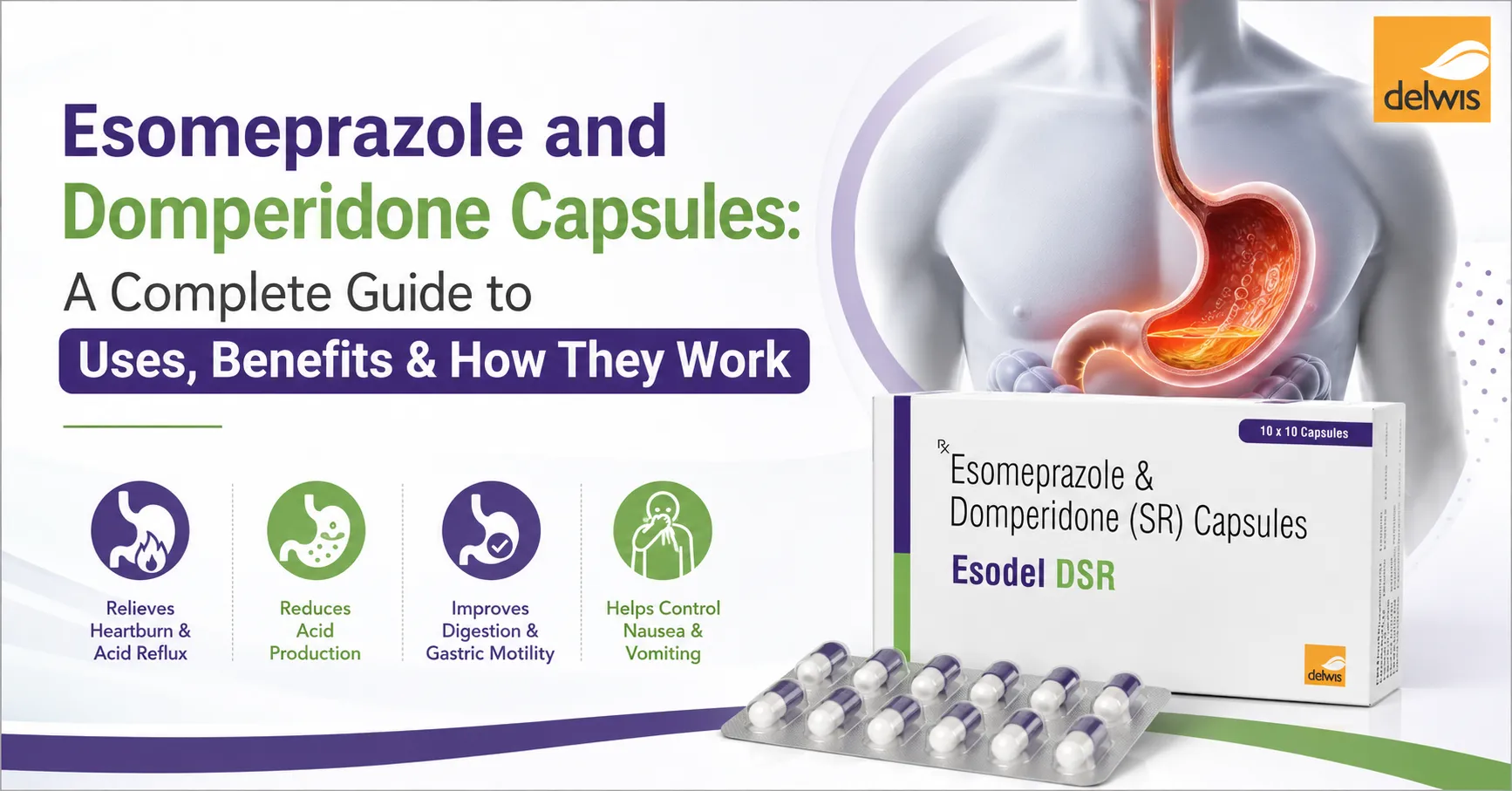
Esomeprazole and domperidone capsules are a fixed-dose combination (FDC) medicine used to treat a range of upper gastrointestinal disorders. The capsule contains two distinctly different drugs — each targeting a different aspect of the same problem.
- Esomeprazole 40mg — a proton pump inhibitor (PPI) that reduces stomach acid production
- Domperidone 30mg SR — a prokinetic agent that improves gastric motility and speeds up stomach emptying
What makes this combination particularly effective is that most upper GI disorders — including GERD, functional dyspepsia, and acid reflux — involve both excessive acid production and sluggish stomach movement. Treating only one of these without the other often leads to incomplete relief. This is why the dual-action esomeprazole and domperidone capsules formulation has become one of the most commonly prescribed gastroenterology medicines in India.
The "SR" in domperidone 30mg SR stands for Sustained Release — meaning the drug is released gradually over several hours, maintaining a consistent therapeutic effect throughout the day rather than a single spike of activity.
How Does This Combination Work? The Mechanism Explained
Understanding how both components work individually makes it clear why they are so effective together.
How Esomeprazole Works
Esomeprazole belongs to a class of medicines called proton pump inhibitors (PPIs). Proton pumps are tiny enzymes (specifically, H+/K+ ATPase enzymes) located in the acid-producing parietal cells lining the stomach wall. Their job is to pump hydrogen ions into the stomach — generating the hydrochloric acid that aids digestion.
Esomeprazole irreversibly binds to and blocks these proton pumps, stopping acid secretion at its source. This is why PPIs are considered more effective than older antacids or H2 blockers — they act on the mechanism of acid production rather than just neutralising acid after it's already been made.
The capsule uses an enteric coating (EC) on the esomeprazole pellets. This coating protects the drug from dissolving in the stomach's acidic environment, allowing it to pass intact into the small intestine where it is absorbed efficiently before travelling to the parietal cells to do its work.
How Domperidone Works
Domperidone is a prokinetic agent — a type of medicine that stimulates movement in the gastrointestinal tract. It works by blocking dopamine D2 receptors in the gut wall, which normally suppress GI muscle activity. By blocking these receptors, domperidone effectively "releases the brake" on gastric motility.
The practical result is that food moves through the stomach faster and more efficiently, the lower oesophageal sphincter (the valve between the stomach and food pipe) tightens to prevent reflux, and symptoms like nausea, bloating, and the sensation of food "sitting" in the stomach are reduced.
Importantly, domperidone does not cross the blood-brain barrier at therapeutic doses — meaning it achieves its GI effects without the neurological side effects seen with older prokinetics like metoclopramide.
Why the Combination Is More Effective Than Either Drug Alone
When acid reflux or GERD occurs, two things are typically happening simultaneously:
- Too much acid is being produced and reaching the oesophagus
- Stomach emptying is delayed, keeping acidic contents in the stomach longer and increasing reflux pressure
Esomeprazole addresses problem 1. Domperidone addresses problem 2. Together, they tackle the condition from both angles — which is why patients on the combination typically experience faster, more complete, and longer-lasting symptom relief compared to either drug prescribed alone.
What Conditions Are Esomeprazole and Domperidone Capsules Used For?
These capsules are prescribed across a wide spectrum of upper gastrointestinal conditions. Here are the primary indications:
1. Gastroesophageal Reflux Disease (GERD)
GERD is the most common reason this combination is prescribed. It occurs when stomach acid repeatedly flows back into the oesophagus, causing a burning sensation, regurgitation, and over time, potential damage to the oesophageal lining. The dual action of acid suppression plus improved gastric emptying makes this combination among the most effective first-line treatments for GERD in India.
2. Functional Dyspepsia
Functional dyspepsia is a chronic condition marked by upper abdominal discomfort, early fullness after eating, bloating, and nausea — without a clear structural cause identifiable on endoscopy. Both acid sensitivity and impaired gastric motility play a role, making this one of the most responsive conditions to esomeprazole + domperidone combination therapy.
3. Acid Reflux and Persistent Heartburn
For patients who experience burning sensations rising from the stomach to the chest or throat — especially after meals, when lying down, or at night — this combination addresses the root causes rather than just masking symptoms temporarily.
4. Bloating and Acidity Together
When both bloating and acidity occur together (a very common clinical presentation in India), the cause is usually both delayed gastric emptying and acid hypersecretion. Domperidone clears the gastric stasis causing bloating while esomeprazole controls the acid. This is why the combination is often preferred over antacids alone for this symptom profile.
5. Peptic Ulcer Disease (as adjunct therapy)
In peptic ulcer management, esomeprazole reduces the acid environment that prevents ulcer healing. Domperidone reduces duodenogastric reflux and improves motility — supporting overall mucosal recovery. The combination is typically used alongside H. pylori eradication therapy where applicable.
6. Nausea and Delayed Gastric Emptying
Nausea secondary to sluggish stomach movement — whether caused by diabetes (gastroparesis), post-surgical GI stasis, or drug side effects — responds well to domperidone's prokinetic action. Esomeprazole addresses any associated acid component, making the combination clinically practical for this presentation.
How to Take Esomeprazole and Domperidone Capsules
Timing: These capsules should be taken 30 to 60 minutes before a meal — ideally before breakfast. This timing ensures esomeprazole is absorbed and activating proton pumps before they are stimulated by food intake, maximising acid suppression. The domperidone SR component is also most effective when taken pre-meal.
How to swallow: Swallow the capsule whole with water. Do not crush, chew, or open the capsule — doing so destroys the enteric coating and sustained-release structure, compromising both the efficacy and safety of the medicine.
Duration: For acute GERD or dyspepsia, a typical course is 4 to 8 weeks. For chronic or recurrent conditions, the prescribing physician will advise on continuation or step-down therapy. Never self-extend a PPI course beyond the prescribed duration without medical guidance.
Missed dose: If you miss a dose, take it as soon as you remember — unless it is close to the time of your next scheduled dose. Never double-dose to compensate for a missed one.
What Are the Side Effects?
Esomeprazole and domperidone capsules are generally well tolerated. Common side effects that may occur, particularly early in treatment, include:
- Headache
- Nausea or mild stomach discomfort
- Diarrhoea or constipation
- Flatulence (gas)
- Dry mouth
These are usually mild and resolve as the body adjusts to the medicine. Less commonly, some patients may experience:
- Elevated liver enzyme levels (detected on blood tests)
- Skin rash or hypersensitivity reactions
- Dizziness
Important precautions: Long-term PPI use (beyond 3 months) should be periodically reviewed by a doctor. Prolonged esomeprazole therapy may warrant monitoring of magnesium levels, vitamin B12, and bone density in at-risk patients. Domperidone should be used with caution in patients with existing cardiac conditions, particularly those with a history of QT interval prolongation.
Always disclose your full medication list to your prescriber before starting this combination, as certain antibiotics, antifungals, and anticoagulants may interact.
Who Should Not Take This Combination?
This combination is generally contraindicated or requires special caution in:
- Patients with known hypersensitivity to esomeprazole, other PPIs, or domperidone
- Patients with severe liver impairment
- Patients with known cardiac arrhythmia or QT prolongation
- Patients taking medicines that significantly inhibit CYP2C19 or CYP3A4 enzymes
- Pregnant or breastfeeding women (use only under strict medical supervision)
Paediatric dosing should always be calculated on a per-kg body weight basis and administered under specialist supervision.
Conclusion
Esomeprazole and domperidone capsules represent one of the most clinically rational and practically effective drug combinations available for upper gastrointestinal disorders in India. By addressing both the acid excess and the motility impairment that drive conditions like GERD, functional dyspepsia, and acid reflux — simultaneously and in a single, convenient capsule — this formulation delivers results that neither agent alone can match.
If you are a healthcare professional or pharmaceutical partner looking to learn more about the manufacturing, formulation technology, and quality standards behind this product, explore the complete product profile of esomeprazole and domperidone capsules by Delwis Healthcare — a WHO-GMP certified manufacturer of DSR gastro capsules from Gujarat, India.
You can also explore our full capsule manufacturing range to see other formulations available for third party and contract manufacturing.
Frequently Asked Questions
Q: Can I take esomeprazole and domperidone capsules long-term?
Short-term use (4–8 weeks) is typically safe for most adults. Long-term use should be supervised by a gastroenterologist who can periodically reassess the need and monitor for any nutritional or metabolic changes associated with prolonged PPI therapy.
Q: Is this the same as a DSR capsule?
Yes. The term "DSR capsule" refers specifically to a Domperidone Sustained Release capsule combined with an Enteric Coated PPI — which is exactly what this formulation is. DSR is a widely used abbreviation in Indian prescribing practice for this drug format.
Q: Can I take antacids alongside this capsule?
In general, antacids are not necessary alongside a PPI like esomeprazole since esomeprazole already suppresses acid at the source. However, if your doctor has prescribed both, follow their guidance. Avoid taking antacids within 2 hours of this capsule to prevent any interaction with the enteric coating dissolution.
Q: Are there different strengths available?
The most commonly prescribed strength in India is esomeprazole 40mg + domperidone 30mg SR. Some formulations are available at esomeprazole 20mg + domperidone 10mg for milder presentations or maintenance dosing. Your prescriber will select the appropriate strength for your condition.
This article is intended for informational and educational purposes only. It does not constitute medical advice. Always consult a qualified healthcare professional before starting, changing, or stopping any medication.