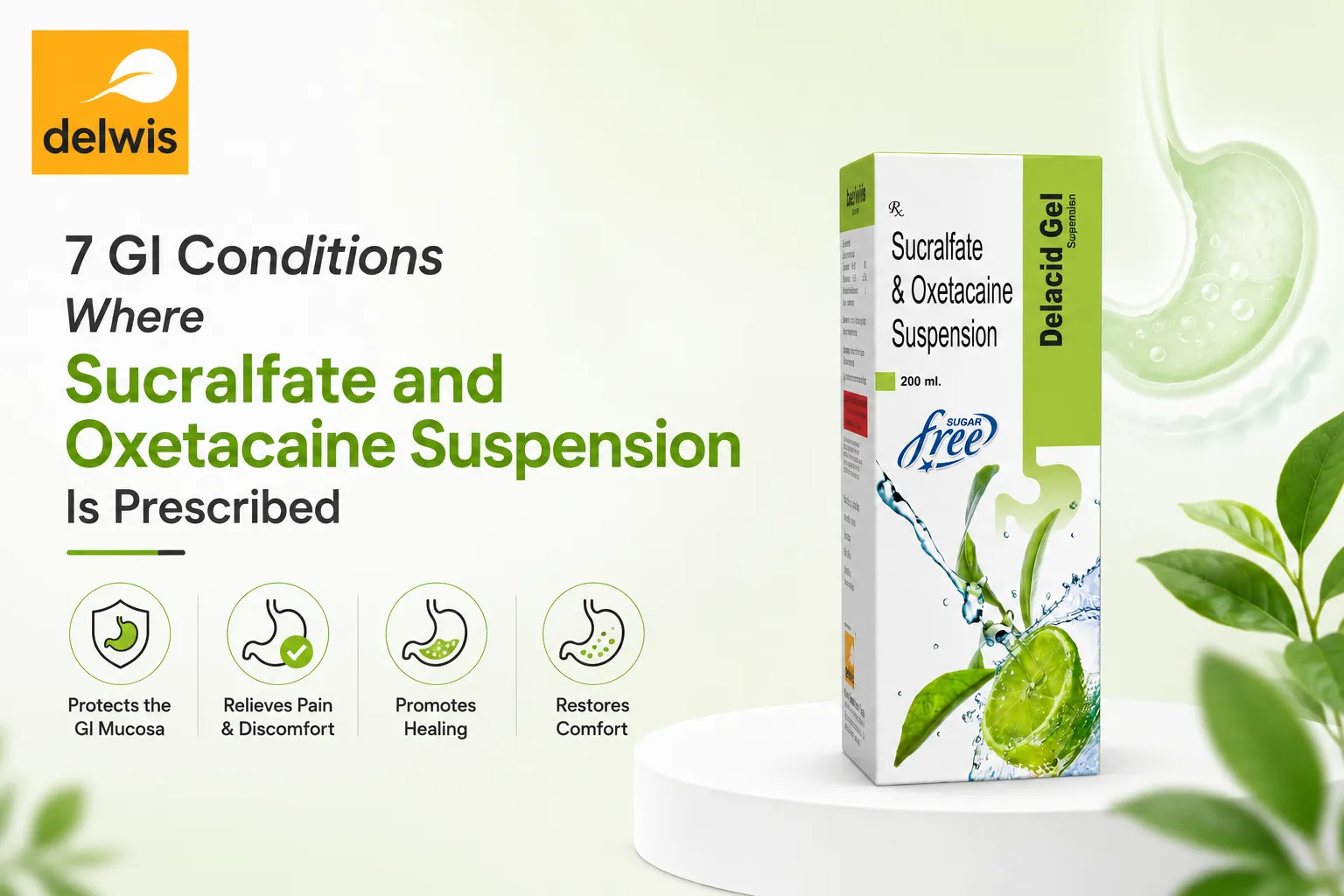
Introduction: Why Gastroenterologists Reach for a Mucosal Protective + Local Anaesthetic Suspension
Not all upper gastrointestinal conditions respond to acid suppression alone. For a significant subset of GI presentations — including active peptic ulceration, oesophageal mucosal damage, NSAID-related gastric injury, and stress-induced erosions — what the gut lining needs is not just less acid, but a physical protective coating and immediate pain relief at the mucosal surface where the damage is occurring.
This is the clinical role of sucralfate and oxetacaine suspension — a dual-action gastroenterological formulation that combines a mucosal barrier agent with a GI-specific local anaesthetic. Gastroenterologists prescribe it across a broader range of conditions than patients typically realise. Understanding exactly which GI conditions it is prescribed for — and why it is specifically chosen over other options in each case — helps patients and prescribers get the most from this formulation.
This guide covers 7 distinct GI conditions where sucralfate and oxetacaine suspension is prescribed, with the clinical reasoning behind each indication.
Condition 1: Peptic Ulcer Disease — Gastric and Duodenal Ulcer
Peptic ulcer disease remains one of the most common gastrointestinal diagnoses in India — driven by high rates of Helicobacter pylori infection, widespread NSAID use, and dietary factors that reduce mucosal defence. Gastric ulcers form in the stomach lining; duodenal ulcers in the first segment of the small intestine.
In both cases, the damaged mucosal surface needs two things simultaneously: protection from ongoing acid attack while healing proceeds, and relief from the pain that peaks when gastric acid contacts the ulcerated tissue.
Sucralfate addresses the first need — it forms a dense, adherent gel coat over the ulcer crater by polymerising in the acidic gastric environment, shielding the raw tissue from acid, pepsin, and bile for several hours per dose. Oxetacaine addresses the second — it anaesthetises the pain-sensitive mucosal nerve endings at the ulcer site, reducing the burning, gnawing epigastric pain that worsens with meals and is the defining symptom of active peptic ulcer disease.
This dual action is why gastroenterologists prescribe the suspension as standard pre-meal therapy in active peptic ulcer management — typically 30–60 minutes before each meal to position the protective gel coat before food triggers the acid surge.
Condition 2: GERD and Reflux Oesophagitis
Gastroesophageal reflux disease (GERD) occurs when gastric acid repeatedly reaches the oesophagus — tissue that lacks the protective mucus layer of the gastric lining and is therefore highly susceptible to acid-induced mucosal damage. When acid reflux is frequent and sustained, oesophageal erosions and ulcerations develop — a condition called reflux oesophagitis.
PPIs are the first-line pharmacological treatment for GERD. However, many patients — particularly those with established oesophageal mucosal damage — have breakthrough symptoms between PPI doses that acid suppression alone cannot adequately manage. The suspension's liquid form is specifically advantageous here: taken as a liquid, it coats the oesophageal mucosal surface on the way down, providing physical barrier protection against the next reflux episode. Tablets or capsules cannot achieve this direct oesophageal coating effect.
In clinical practice, gastroenterologists frequently prescribe sucralfate and oxetacaine suspension alongside a PPI — for example esomeprazole and domperidone capsules — particularly in patients with erosive oesophagitis who need mucosal barrier protection and pain relief in addition to acid suppression. The two mechanisms are complementary: the PPI reduces acid production; the suspension protects the already-damaged mucosal surface.
Condition 3: Chronic Gastritis
Chronic gastritis — persistent inflammation of the stomach lining — arises from several causes in India: long-standing H. pylori colonisation (the most prevalent cause), autoimmune gastritis targeting gastric parietal cells, and chemical gastritis from bile reflux, alcohol, or medication effects. It presents with recurrent epigastric discomfort, nausea, bloating, and a burning sensation that worsens irregularly.
In chronic gastritis, the gastric mucosal barrier is chronically compromised — the mucus layer is thinner, bicarbonate secretion is reduced, and prostaglandin-mediated mucosal defence is impaired. Acid continues to be produced but has reduced protection to act against. Sucralfate's cytoprotective action — forming a physical barrier and stimulating local prostaglandin synthesis — provides direct mucosal support that does not depend on suppressing acid production. For patients with chronic gastritis where acid suppression alone gives partial relief, the addition of sucralfate with oxetacaine provides the mucosal protective layer and localised pain control that bridges the therapeutic gap.
Condition 4: NSAID-Induced Gastrointestinal Damage
This is one of the most clinically important indications for this suspension in India — and one of the most underutilised opportunities for preventive prescribing.
NSAIDs — including ibuprofen, diclofenac, naproxen, and aspirin — are among the most widely prescribed drugs in India across pain management, rheumatology, orthopaedics, and general medicine. Their mechanism of action (inhibition of cyclo-oxygenase enzymes) suppresses not only the inflammatory prostaglandins driving pain but also the gastric mucosal protective prostaglandins that maintain the stomach's first line of defence.
The result: NSAID use progressively depletes the mucosal protection that prevents acid from damaging the gastric and duodenal lining, leading to erosions, submucosal haemorrhages, and frank peptic ulceration in susceptible patients.
When NSAIDs are clinically necessary but gastroprotection is required, gastroenterologists and rheumatologists have two approaches: add a PPI, or add a cytoprotective mucosal agent like sucralfate. For patients where an NSAID is needed alongside mucosal protection — or where NSAID-related aceclofenac and rabeprazole tablet combinations provide the NSAID with built-in PPI cover but symptomatic breakthrough occurs — sucralfate and oxetacaine suspension provides an additional mucosal barrier layer, particularly useful for pre-established gastric erosions that need direct physical protection while healing.
Condition 5: Post-Surgical and Stress Ulcer Prevention
In critically ill patients, major surgical patients, ICU admissions, and patients under significant physiological stress — including those with severe burns, head injury, multi-organ dysfunction, or mechanical ventilation — the risk of acute stress ulceration of the gastric and duodenal mucosa is significantly elevated.
Stress ulcers form through impaired mucosal blood flow, acid hypersecretion under stress, and loss of mucosal defence mechanisms that normally prevent acid from reaching the underlying tissue. They can lead to significant upper GI bleeding — a serious complication in already-critically ill patients.
Sucralfate oral suspension has a specific and evidence-supported role in stress ulcer prophylaxis that differentiates it from H2 blockers and PPIs also used for this purpose: because sucralfate does not suppress gastric acid (it acts by coating the mucosa), it does not raise gastric pH in the same way as acid suppressants — which in mechanically ventilated patients may reduce the risk of ventilator-associated pneumonia caused by acid-suppressed gastric colonisation. For selected ICU patients where stress ulcer prophylaxis is indicated, gastroenterologists and intensivists may choose sucralfate suspension precisely because of this non-acid-suppressive gastroprotective mechanism.
Condition 6: Oesophagitis — Pill-Induced and Non-GERD Causes
Not all oesophagitis is caused by acid reflux. Pill-induced oesophagitis occurs when oral medications with direct mucosal irritant properties remain in prolonged contact with the oesophageal wall — most commonly bisphosphonates (used for osteoporosis), tetracycline antibiotics, potassium supplements, and certain anti-inflammatory drugs. The result is localised oesophageal mucosal erosion and ulceration at the level of stasis, producing dysphagia (difficulty swallowing), odynophagia (painful swallowing), and retrosternal chest pain.
Sucralfate and oxetacaine suspension is an appropriate and rational treatment for pill-induced oesophagitis: the suspension coats the damaged oesophageal mucosa directly as it is swallowed, forming a protective barrier over the erosion site while oxetacaine anaesthetises the painful mucosal nerve endings — making swallowing more manageable during the recovery period. This application of sucralfate uses its liquid-mediated oesophageal coating advantage in a setting unrelated to GERD but equally dependent on direct mucosal contact.
Condition 7: H. pylori-Associated Ulcer (Adjunct Therapy)
Helicobacter pylori is the most common cause of peptic ulcer disease in India, affecting a significant proportion of the population. Standard eradication therapy uses a combination of two antibiotics plus a PPI — a protocol called triple or quadruple therapy — to clear the organism from the gastric mucosa. Treatment duration is typically 10–14 days.
During and after H. pylori eradication therapy, the gastric mucosa — already damaged by the infection itself — is recovering from the inflammation and mucosal disruption that active H. pylori colonisation causes. Sucralfate and oxetacaine suspension prescribed as adjunct therapy during or after the eradication course supports mucosal recovery by providing the physical barrier protection and local pain relief that the healing gastric lining needs while regenerating — while the antibiotic + PPI eradication protocol clears the organism. This adjunctive use is particularly relevant for patients with active ulceration at the time of diagnosis, where mucosal healing support alongside eradication is a rational clinical approach.
A Note on When This Suspension Complements Rather Than Replaces PPI Therapy
A common question from patients is whether sucralfate and oxetacaine suspension replaces their existing PPI medication. The answer in most clinical scenarios is no — the suspension and a PPI work through different, complementary mechanisms.
PPIs reduce acid production. The suspension coats and protects the already-damaged mucosal surface. Both are addressing the same underlying problem from different angles, and in conditions with established mucosal damage — oesophagitis, active peptic ulcer, severe GERD — the combined approach delivers more complete symptom control and faster mucosal healing than either alone.
Your gastroenterologist will determine whether you need the suspension alongside your existing acid suppressant, as a substitute for it, or as the primary treatment depending on the specific diagnosis and severity of your condition.
Conclusion
Sucralfate and oxetacaine suspension is prescribed across a broader range of upper gastrointestinal conditions than patients often expect from a single formulation. Its clinical value lies in the combination of mucosal physical protection (sucralfate's barrier-forming mechanism) and direct mucosal pain relief (oxetacaine's local anaesthetic action) — addressing two aspects of GI disease that acid suppression alone cannot cover.
For the complete clinical picture — including how the suspension works, the correct dosage and food timing, side effects, drug interactions, and safety — visit our detailed guide on sucralfate and oxetacaine suspension uses on the Delwis Healthcare blog.
To explore the full product composition, manufacturing quality standards, and third-party manufacturing details for this formulation, visit the sucralfate and oxetacaine suspension product page. For pharmaceutical brands and CMO partners building a gastroenterology portfolio, explore the complete hyperacidity and reflux range and suspension manufacturing capabilities at Delwis Healthcare's WHO-GMP certified Ahmedabad facility.
This article is written for informational and educational purposes only. It does not constitute medical advice, clinical guidance, or a substitute for professional gastroenterological assessment. Always consult a qualified gastroenterologist or physician for diagnosis and treatment recommendations.