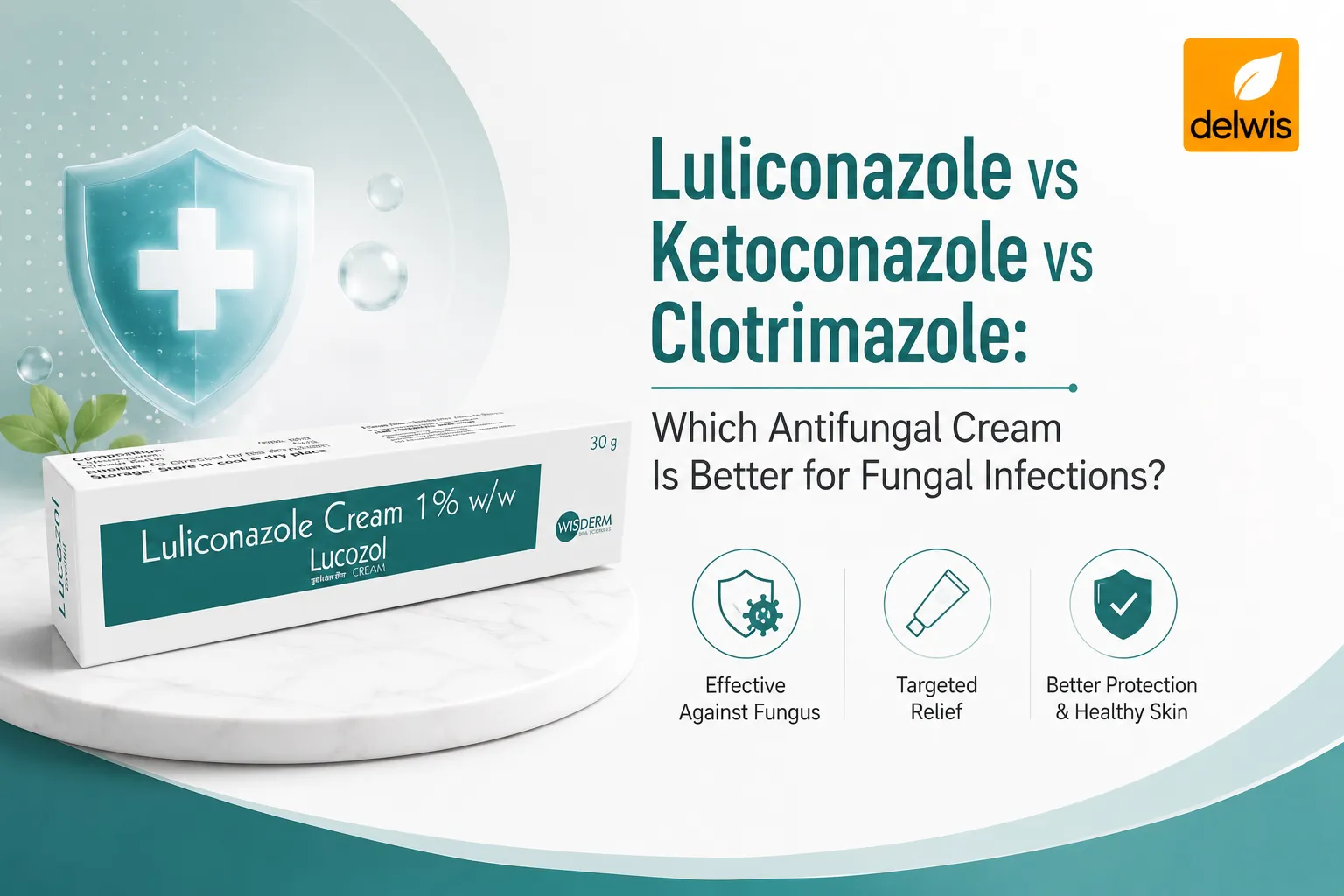
Fungal skin infections are common dermatological conditions that can cause itching, redness, scaling, burning, and discomfort. Depending on the type and location of infection, healthcare professionals may recommend different topical antifungal medicines, including luliconazole, ketoconazole, or clotrimazole.
But which antifungal cream is better?
The answer depends on the type of fungal infection, causative organism, affected body area, severity, previous treatment response, and individual patient factors. There is no single antifungal cream that is universally best for every fungal infection.
This guide compares luliconazole, ketoconazole, and clotrimazole, explains how they work, discusses common uses and differences, and highlights what pharmaceutical companies should consider when developing or sourcing topical antifungal products.
Quick answer: Luliconazole, ketoconazole, and clotrimazole are all topical antifungal medicines, but they have different spectrums of activity, dosing considerations, and clinical uses. The most appropriate option depends on the diagnosed fungal infection and the healthcare professional's recommendation.
What Are Antifungal Creams?
Antifungal creams are topical medicines designed to control or eliminate fungal organisms responsible for skin infections. They are commonly used for conditions such as tinea corporis (ringworm), tinea cruris (jock itch), tinea pedis (athlete's foot), and certain yeast-related skin infections.
Most topical antifungals work by interfering with components of the fungal cell membrane. Because human cells and fungal cells have different biological structures, these medicines can selectively interfere with fungal growth when used appropriately.
Common topical antifungal ingredients include:
- Luliconazole
- Ketoconazole
- Clotrimazole
- Miconazole
- Terbinafine
- Sertaconazole
- Ciclopirox
The choice between these medicines should be based on the infection rather than simply choosing the product considered the "strongest."
Luliconazole vs Ketoconazole vs Clotrimazole: At a Glance
Feature | Luliconazole | Ketoconazole | Clotrimazole |
Drug class | Imidazole antifungal | Imidazole antifungal | Imidazole antifungal |
Main action | Interferes with fungal ergosterol synthesis | Interferes with fungal ergosterol synthesis | Interferes with fungal ergosterol synthesis |
Common topical use | Dermatophyte infections | Dermatophyte and certain yeast infections | Dermatophyte and yeast infections |
Common dosage frequency | Often once daily, depending on product/indication | Varies by formulation and indication | Commonly applied multiple times daily depending on product/condition |
Suitable for | Selected superficial fungal infections | Several fungal and yeast-related conditions | Broad range of superficial fungal infections |
Prescription status | Depends on market and formulation | Depends on market and formulation | Depends on market and formulation |
The table provides a general comparison. Product labeling, approved indications, strength, age restrictions, and directions can vary by country and formulation.
How Does Luliconazole Work?
Luliconazole is an azole antifungal that interferes with the production of ergosterol, an essential component of the fungal cell membrane.
By disrupting fungal membrane formation and function, it helps inhibit the growth and survival of susceptible fungi.
It is used topically for certain dermatophyte infections, including infections affecting areas such as the feet, groin, and body, depending on the approved product indication.
One practical consideration is its dosing schedule. Certain topical formulations are designed for once-daily application, which may make treatment easier to follow for some patients.
For pharmaceutical businesses evaluating topical antifungal products for their portfolios, consistent formulation quality, manufacturing controls, packaging, and regulatory compliance are important considerations when selecting a manufacturing partner. Companies looking for commercial production can explore Delwis Healthcare's Luliconazole Cream Manufacturer capabilities.
Luliconazole is a topical azole antifungal used for selected superficial fungal infections. For a more detailed explanation of its uses, benefits, mechanism of action, and important treatment considerations, see our complete guide to Luliconazole Cream IP 1% w/w.
How Does Ketoconazole Work?
Ketoconazole is another azole antifungal. It works primarily by interfering with fungal ergosterol synthesis, affecting the integrity and function of the fungal cell membrane.
Topical ketoconazole has been used for several fungal and yeast-related skin conditions. Depending on the formulation, it may also be used for certain conditions involving Malassezia, a yeast associated with disorders such as seborrheic dermatitis and pityriasis versicolor.
The appropriate formulation and treatment duration depend on the condition being treated and the product's approved labeling.
How Does Clotrimazole Work?
Clotrimazole is a widely used topical azole antifungal. Like luliconazole and ketoconazole, it interferes with ergosterol production in susceptible fungi.
It is commonly used for a variety of superficial fungal infections, including:
- Athlete's foot
- Ringworm
- Jock itch
- Certain yeast infections of the skin
Clotrimazole has been available in topical formulations for many years and is used in numerous pharmaceutical products worldwide.
Luliconazole vs Ketoconazole: Which Is Better?
There is no universal winner between luliconazole and ketoconazole.
The better choice depends on what organism is causing the infection and where the infection is located.
Luliconazole may be considered when:
- A dermatophyte infection has been diagnosed.
- A topical azole is appropriate.
- A convenient dosing schedule is desirable.
- The product is approved for the patient's specific condition.
Ketoconazole may be considered when:
- A susceptible fungal or yeast infection is being treated.
- The condition is appropriate for topical ketoconazole.
- The healthcare professional considers its antifungal spectrum suitable.
An important point is that different antifungal medicines should not be considered interchangeable simply because they belong to the same broad drug class.
Luliconazole vs Clotrimazole: Which Is Better?
Luliconazole and clotrimazole are both azole antifungals, but their approved uses and dosing instructions can differ.
Clotrimazole has a broad history of topical use and is available in various formulations. Luliconazole is a newer-generation topical azole with activity against several dermatophytes.
For a patient with a confirmed fungal infection, the choice may depend on:
- Type of fungal infection
- Location of the infection
- Severity
- Patient age
- Previous treatment
- Local treatment guidelines
- Product labeling
- Healthcare professional's assessment
Therefore, it is better to ask which medicine is appropriate for a particular infection rather than asking which medicine is universally stronger.
Miconazole vs Luliconazole: What's the Difference?
Miconazole and luliconazole are both topical azole antifungals, but they have different chemical structures, approved indications, formulations, and dosing instructions.
Miconazole is widely used for several superficial fungal and yeast infections, while luliconazole is particularly used for selected dermatophyte infections.
If an infection does not improve with an appropriate topical treatment, repeatedly changing antifungal products without confirming the diagnosis may not solve the problem. Some skin conditions can resemble fungal infections but may actually be caused by eczema, psoriasis, bacterial infection, or other dermatological conditions.
Which Antifungal Cream Is Best for Fungal Infections?
There is no single best antifungal cream for every fungal infection.
The most appropriate treatment depends on the organism and clinical diagnosis.
For example:
Tinea pedis (athlete's foot)
Topical antifungal treatment may be used for localized infections. The selected medicine depends on the diagnosis and severity.
Tinea corporis (ringworm)
Several topical antifungal medicines can be effective against susceptible dermatophytes. Treatment selection depends on the patient's circumstances and the product indication.
Tinea cruris (jock itch)
A suitable topical antifungal may be recommended, particularly when the infection is limited to the groin area.
Pityriasis versicolor
Treatment may involve medicines active against Malassezia. The appropriate product depends on the affected area, severity, and healthcare professional's recommendation.
The key takeaway is that correct diagnosis is more important than simply selecting a product marketed as the strongest antifungal cream.
Does Luliconazole Contain Steroids?
No. Luliconazole is an antifungal medicine, not a corticosteroid.
However, some dermatological products may combine an antifungal ingredient with a corticosteroid or other active ingredient. These combination products should not be confused with a formulation containing luliconazole alone.
Using steroid-containing creams without appropriate medical guidance can sometimes mask symptoms or worsen certain fungal infections. Therefore, consumers should check the active ingredients and use dermatological products according to professional advice.
What Are the Common Side Effects of Topical Antifungal Creams?
Topical antifungal medicines are generally intended to act locally, but some people may experience application-site reactions.
Possible effects can include:
- Mild burning
- Itching
- Redness
- Irritation
- Dryness
- Stinging at the application site
Most reactions are mild, but persistent or severe irritation should be discussed with a healthcare professional.
If symptoms become worse, spread rapidly, or fail to improve after appropriate treatment, the diagnosis and treatment plan may need to be reassessed.
Why Does the Correct Diagnosis Matter?
A fungal-looking rash is not necessarily a fungal infection.
Conditions such as:
- Eczema
- Contact dermatitis
- Psoriasis
- Bacterial infections
- Certain inflammatory skin conditions
can sometimes resemble fungal infections.
This is particularly important when an over-the-counter antifungal treatment does not improve the condition.
A healthcare professional may use clinical examination and, when necessary, laboratory testing such as microscopy or fungal culture to confirm the diagnosis.
How to Choose the Right Topical Antifungal
When selecting a topical antifungal product, healthcare professionals generally consider several factors.
1. Identify the infection
The suspected organism and type of infection influence treatment selection.
2. Consider the affected body area
Skin thickness, moisture, friction, and location can influence treatment requirements.
3. Follow the approved dosing instructions
Different active ingredients and formulations can have different application schedules.
4. Consider patient-specific factors
Age, pregnancy, allergies, other medicines, previous treatment, and medical history may influence the appropriate choice.
5. Complete the recommended treatment
Stopping treatment too early can contribute to incomplete clearance and recurrence.
For Pharmaceutical Companies: What to Consider When Developing a Topical Antifungal Product
For pharmaceutical companies, distributors, and healthcare brands, choosing the right contract manufacturing partner is just as important as selecting the active pharmaceutical ingredient.
A reliable manufacturing partner should have appropriate capabilities for:
- Raw material qualification
- Formula development
- Controlled mixing and homogenization
- Tube or container filling
- In-process quality checks
- Finished-product testing
- Packaging and labeling
- Batch documentation
- Regulatory support
- Scalable commercial production
Topical products require controlled manufacturing processes to achieve consistent appearance, texture, homogeneity, assay, stability, and microbiological quality.
For businesses exploring broader pharmaceutical manufacturing capabilities, you can learn more about Cream Manufacturing and evaluate the manufacturing approach relevant to your product portfolio.
Why Choose a CMO or Third-Party Manufacturing Partner?
Developing and manufacturing a topical pharmaceutical product internally can require significant investment in facilities, equipment, quality systems, technical personnel, validation, and regulatory processes.
A qualified CMO or third-party pharmaceutical manufacturer can help businesses access established manufacturing infrastructure and production expertise.
For B2B customers, important evaluation factors include:
- Manufacturing facility and GMP compliance
- Quality assurance and quality control systems
- Production capacity
- Batch-size flexibility
- Product development capabilities
- Packaging options
- Documentation and traceability
- Regulatory support
- Supply consistency
- Experience with topical dosage forms
The right manufacturing partnership can help pharmaceutical companies move from product development to commercial supply more efficiently while maintaining appropriate quality standards.
Conclusion
Luliconazole, ketoconazole, and clotrimazole are established topical antifungal medicines, but there is no single product that is best for every fungal infection. Their suitability depends on the causative organism, infection site, severity, patient characteristics, and approved product indications.
Luliconazole may be an appropriate option for selected dermatophyte infections, while ketoconazole and clotrimazole have their own established uses across different fungal and yeast-related conditions. Comparing medicines based solely on which one is "stronger" can therefore be misleading.
For pharmaceutical companies developing or expanding a dermatology portfolio, product quality and manufacturing consistency are equally important. Working with an experienced manufacturing partner can support formulation, controlled production, quality testing, packaging, and commercial supply.
If your organization is evaluating a topical antifungal product for B2B pharmaceutical supply, explore Delwis Healthcare's Luliconazole Cream Manufacturer capabilities or visit Delwis Healthcare to learn more about its pharmaceutical manufacturing solutions.
Frequently Asked Questions
Which is better, luliconazole or clotrimazole?
Neither is universally better. Both are topical azole antifungals, and the appropriate choice depends on the fungal infection, affected area, patient factors, product labeling, and healthcare professional's recommendation.
Is luliconazole stronger than ketoconazole?
It is not appropriate to describe one medicine as universally "stronger." Luliconazole and ketoconazole have different antifungal profiles and approved uses. Treatment should be selected according to the specific infection.
Which antifungal cream is best for ringworm?
Several topical antifungal medicines can be used for localized ringworm, including medicines from the azole and allylamine classes. The appropriate treatment depends on the diagnosis and individual circumstances.
Is luliconazole suitable for athlete's foot?
Luliconazole is used for certain dermatophyte infections affecting the feet when the product is approved for that indication. Patients should follow the directions provided by their healthcare professional or the product labeling.
Can antifungal cream be used for every itchy rash?
No. Itching can have many causes, including fungal infection, eczema, dermatitis, and other skin conditions. An antifungal should not automatically be used for every itchy rash.
Does an antifungal cream contain steroids?
Not necessarily. Antifungal-only products do not contain corticosteroids. However, some dermatological formulations are combination products, so the active ingredients should always be checked carefully.
What should I do if a fungal infection does not improve?
If symptoms persist, worsen, or repeatedly return despite appropriate treatment, consult a healthcare professional. The diagnosis may need to be confirmed or an alternative treatment considered.