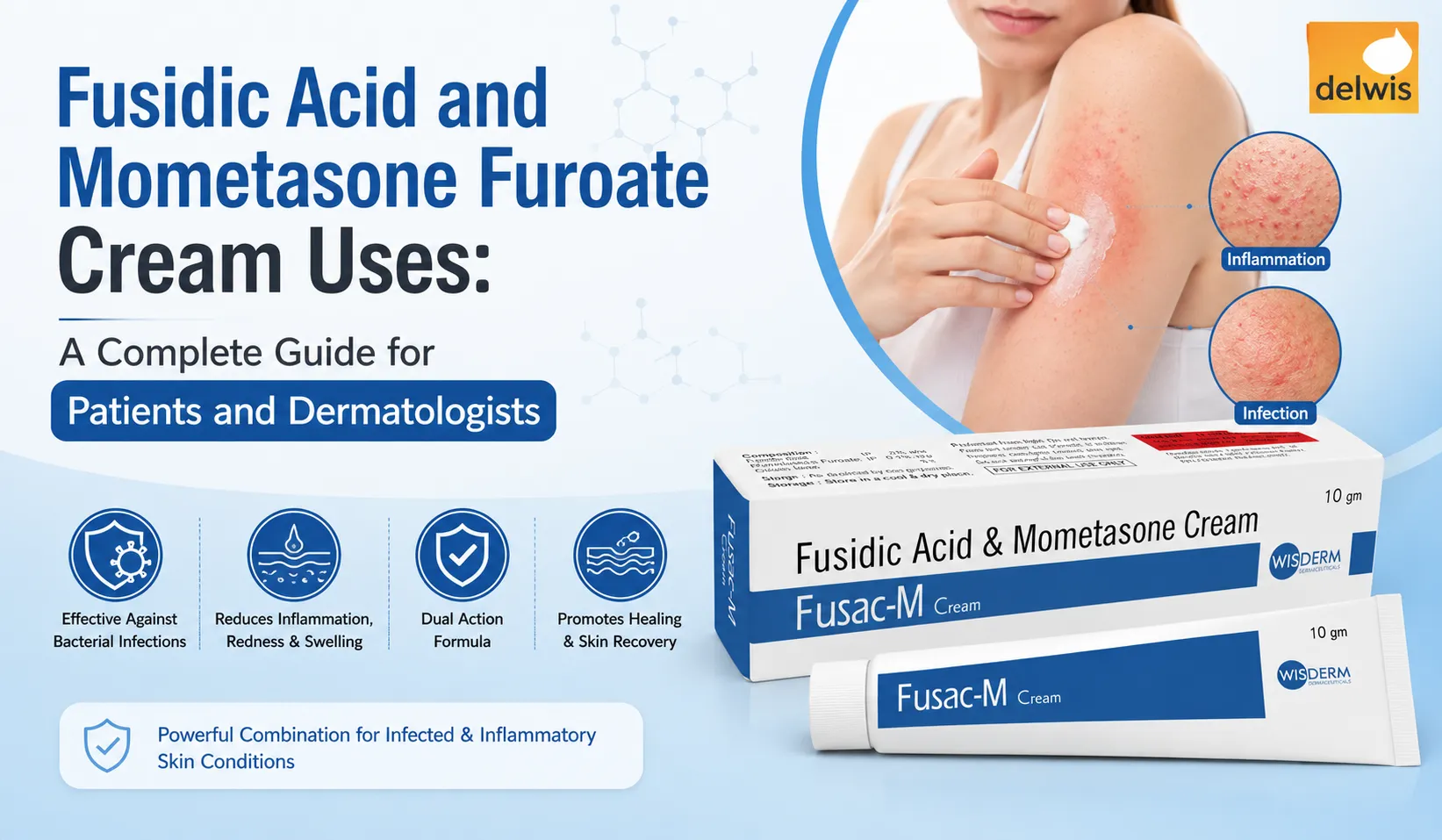
Introduction: The Clinical Problem This Cream Was Made to Solve
Dermatologists across India see it every day — a patient with eczema whose skin has also become infected, or someone with a rash that keeps worsening despite standard anti-inflammatory treatment. What looks like a straightforward skin inflammation problem has, somewhere along the way, developed a bacterial infection on top of it. And treating only the inflammation — or only the infection — leaves the other driver untouched, producing incomplete results and the frustrating cycle of partial improvement followed by relapse.
This is precisely the clinical scenario that fusidic acid and mometasone furoate cream was formulated to address. By combining two complementary active ingredients in a single topical cream — a broad-spectrum topical antibiotic and a moderately potent corticosteroid — this fixed-dose combination tackles both the bacterial infection and the inflammatory response simultaneously, in one application, delivering the comprehensive treatment that single-agent therapy cannot.
This guide covers everything patients and dermatologists need to know — what this cream is, how each ingredient works, every condition it is used for, how to apply it correctly, what side effects to watch for, and the important precautions for safe use.
What Is Fusidic Acid and Mometasone Furoate Cream?
Fusidic acid and mometasone furoate cream is a fixed-dose combination (FDC) topical dermatological formulation containing two distinct active pharmaceutical ingredients:
- Fusidic Acid 2.0% w/w — a steroidal antibiotic belonging to the fusidane class, with targeted bactericidal and bacteriostatic activity primarily against gram-positive bacteria, most importantly Staphylococcus aureus
- Mometasone Furoate 0.1% w/w — a synthetic fluorinated corticosteroid classified as a Class III moderately potent topical steroid, with strong anti-inflammatory and antipruritic properties
The "2%" and "0.1%" concentrations represent the amounts of each API per 100 grams of cream base — concentrations clinically validated to deliver effective therapeutic activity at the skin surface while minimising systemic absorption from topical use.
This combination cream is available in 10 gram laminated tubes and is prescribed for once or twice-daily topical application, as directed by the treating dermatologist. The formulation is a water-in-oil or oil-in-water emulsion with a smooth, skin-compatible texture designed for good epidermal penetration and patient tolerability.
How Does This Cream Work? The Dual-Action Mechanism
Understanding how each component works — and why the two together are more clinically effective than either alone — is the foundation of appreciating this cream's place in dermatological treatment.
How Fusidic Acid Works: Targeting Bacterial Protein Synthesis
Fusidic acid exerts its antibacterial action through a mechanism entirely distinct from most other antibiotic classes. Its target is the bacterial elongation factor G (EF-G) — a ribosomal protein essential for the translocation step of bacterial protein synthesis. By binding to and stabilising the EF-G/ribosome complex after each translocation cycle, fusidic acid traps the ribosome in an inactive state, preventing further protein chain elongation and halting bacterial replication.
This unique mechanism gives fusidic acid two important clinical advantages:
No cross-resistance with common antibiotic classes — Since it acts on EF-G rather than cell wall synthesis (like beta-lactams), membrane disruption (like polymyxins), or 30S/50S ribosomal subunits (like aminoglycosides or macrolides), organisms resistant to those classes typically remain susceptible to fusidic acid.
High selectivity for bacterial EF-G — Human cells also use elongation factors, but fusidic acid's binding affinity for the bacterial EF-G is orders of magnitude higher than for the mammalian equivalent — giving it the antibacterial specificity needed for safe topical use.
At 2% topical concentration, fusidic acid achieves effective tissue concentrations in the epidermis and superficial dermis — the layers where most primary and secondary bacterial skin infections reside — while maintaining the low systemic absorption profile that makes it safe for application on inflamed, compromised skin.
How Mometasone Furoate Works: Shutting Down the Inflammatory Cascade
Mometasone furoate acts by binding to intracellular glucocorticoid receptors (GRs) present in keratinocytes, fibroblasts, and immune cells within the skin. The activated GR complex migrates to the cell nucleus, where it modulates gene transcription — downregulating the production of pro-inflammatory mediators.
The practical result of this cascade suppression is:
- Reduced prostaglandin and leukotriene synthesis — cutting off the chemical signals that drive vasodilation and oedema
- Inhibition of pro-inflammatory cytokines (including IL-1, IL-6, TNF-α) — reducing immune cell recruitment to the site of infection and inflammation
- Mast cell and eosinophil suppression — controlling the hypersensitivity component of eczematous reactions
- Reduction in capillary permeability — decreasing fluid leakage into the dermis that causes swelling and weeping
The clinical translation of these effects is rapid resolution of the redness, swelling, intense itch, and weeping that characterise inflamed, infected skin — the symptoms patients find most distressing and that most impair quality of life.
As a Class III topical corticosteroid, mometasone furoate occupies a clinically valuable position: it is significantly more potent than hydrocortisone and betamethasone valerate (Class IV/V), yet carries a lower risk of skin atrophy than the highest-potency agents like clobetasol propionate — making it well-suited for combination use in infected dermatoses where both efficacy and local tolerability matter.
Why the Two Together Outperform Either Alone
In infected inflammatory skin conditions, two pathological processes are occurring simultaneously:
Process 1: Bacteria (most commonly Staphylococcus aureus) are colonising and infecting the compromised skin — producing toxins, triggering further inflammation, and preventing the skin barrier from healing.
Process 2: The inflammatory cascade — driven by the underlying dermatosis (eczema, dermatitis) and further amplified by the bacterial infection itself — is causing erythema, pruritus, oedema, and weeping that breaks the skin barrier further, facilitating more bacterial entry.
These two processes feed each other. Treating only the infection (with antibiotic alone) does not resolve the inflammation driving barrier breakdown and symptom burden. Treating only the inflammation (with corticosteroid alone) — without clearing the bacteria — risks worsening the infection by suppressing the immune response that is partly keeping bacterial proliferation in check.
The combination breaks both sides of this cycle simultaneously — which is why fusidic acid and mometasone furoate cream produces faster, more complete, and more durable clinical resolution than either monotherapy in infected inflammatory dermatoses.
Fusidic Acid and Mometasone Furoate Cream Uses — The Complete Indication List
The primary clinical applications of this combination cream cover the full spectrum of infected inflammatory dermatoses — conditions defined by the coexistence of bacterial infection and cutaneous inflammation. Here is the complete guide to every key indication:
1. Infected Eczema — The Most Common Indication
Eczema — whether atopic, contact, or seborrhoeic — creates a chronically compromised skin barrier. Fissured, excoriated, inflamed skin is highly vulnerable to secondary bacterial colonisation and infection, most commonly by Staphylococcus aureus, which is found in elevated density on eczematous skin even between flares.
When eczema becomes infected — presenting with weeping, crusting, increased redness, warmth, and intensified pruritus beyond the patient's usual eczema baseline — it is termed infected eczema or secondarily infected atopic dermatitis. This is the single most common indication for fusidic acid and mometasone furoate cream in dermatology practice across India.
The combination clears the Staphylococcus aureus superinfection via fusidic acid while mometasone simultaneously controls the inflammatory eczematous reaction — producing relief of both the infective and inflammatory components, typically within 5–7 days of consistent treatment. Patients commonly notice reduced weeping and crusting within 3–4 days, with itch reduction and redness improvement following closely.
2. Impetigo — Primary Bacterial Skin Infection
Impetigo is a highly contagious primary bacterial skin infection caused predominantly by Staphylococcus aureus and, in some cases, Streptococcus pyogenes. It presents as honey-coloured crusted lesions, bullous (blister-forming) lesions, or erosions — typically on the face, around the nose and mouth, and on exposed areas of the limbs. It is extremely common in children and in settings of close contact, warm climate, and compromised skin hygiene.
Fusidic acid's potent anti-staphylococcal and anti-streptococcal activity makes it a clinically appropriate topical antibiotic for impetigo. Mometasone's anti-inflammatory action addresses the associated erythema, oedema, and discomfort, improving both healing speed and patient comfort. This combination is particularly useful for impetigo presentations with significant perilesional inflammation.
3. Infected Dermatitis (Contact Dermatitis with Secondary Infection)
Contact dermatitis — whether allergic or irritant — produces an inflamed, itchy, blistered, or weeping skin reaction at the site of allergen or irritant exposure. Persistent scratching, barrier disruption, and the moist wound environment of weeping dermatitis create ideal conditions for secondary bacterial colonisation.
Where contact dermatitis has developed secondary bacterial infection — evidenced by increased exudate, crusting, pain, or spreading redness beyond the original reaction site — the combination of fusidic acid (to clear the infection) and mometasone (to resolve the underlying inflammatory reaction) provides targeted dual-mechanism treatment superior to monotherapy with either agent.
4. Folliculitis — Infected Hair Follicles
Folliculitis is a superficial bacterial infection of hair follicles, presenting as clusters of small, red, pus-filled papules or pustules surrounding individual hair shafts — commonly affecting the scalp, beard area, trunk, thighs, and buttocks. The causative organism is most frequently Staphylococcus aureus.
Fusidic acid's direct bactericidal action against S. aureus at the follicular level, combined with mometasone's reduction of the perilesional inflammatory response — the surrounding redness, swelling, and pain — makes this combination a rational topical choice for bacterial folliculitis. Treatment typically involves applying a thin layer over the affected follicular area once or twice daily as directed.
5. Secondary Bacterial Infection in Psoriasis
Psoriatic plaques — chronically thickened, scaly, inflamed skin patches — can develop secondary bacterial superinfection, particularly S. aureus colonisation, that precipitates flares, increases inflammation beyond the baseline psoriatic state, and complicates treatment. Where a secondary bacterial component is identified or strongly suspected in a psoriatic presentation, the dual antibiotic-steroid approach addresses both the infective trigger and the psoriatic inflammatory component.
6. Furunculosis — Deep Follicular Infection (Boils)
Furunculosis refers to deep bacterial infections of hair follicles that extend into the surrounding dermis — presenting as painful, swollen, erythematous nodules that evolve into fluctuant boils with a central purulent core. It is caused by Staphylococcus aureus and is more prevalent in individuals with diabetes, iron deficiency, or impaired immune function.
For early-stage furuncles where the lesion is accessible and suitable for topical therapy, fusidic acid's skin penetration and anti-staphylococcal activity provides a topical antibiotic option, while mometasone addresses the significant perilesional inflammation, tenderness, and erythema. Advanced or fluctuant furuncles typically require incision, drainage, and systemic antibiotics — topical therapy is adjunctive in these cases.
7. Infected Inflammatory Skin Conditions (Infected Dermatoses — Broader Category)
Beyond specific named diagnoses, this cream addresses the broad clinical category of infected dermatoses — a term covering any inflammatory skin condition that has developed concurrent bacterial infection. Chronic skin conditions with compromised barrier function (including nummular eczema, dyshidrotic eczema, and lichen simplex chronicus) are particularly vulnerable to secondary bacterial superinfection, and the combination cream provides the dual action needed to treat both simultaneously.
How to Apply Fusidic Acid and Mometasone Furoate Cream Correctly
Correct application technique is as important as the prescription itself. Follow these steps for best results:
Step 1 — Gently clean the affected area Wash the infected skin with lukewarm water and a mild, pH-balanced cleanser. Pat dry with a soft, clean towel — do not rub aggressively, as this can worsen already-inflamed or excoriated skin.
Step 2 — Apply a thin, even layer Using a fingertip or sterile applicator, apply a small amount of cream — enough to cover the affected area with a thin, even layer. Avoid applying thick or excessive amounts, which does not improve efficacy and increases the risk of local side effects from the corticosteroid component.
Step 3 — Include the margin Extend the application approximately 1 centimetre beyond the visible border of the rash or infection. The bacterial and inflammatory process extends beyond the visibly affected area, and applying only to what is visible risks incomplete treatment and early recurrence.
Step 4 — Follow your dermatologist's frequency instruction This cream is typically prescribed for once or twice-daily application. Follow your prescribing dermatologist's specific instructions on frequency. Do not apply more frequently than prescribed — increased application frequency of a corticosteroid-containing cream does not improve outcomes and increases side effect risk.
Step 5 — Do not cover with occlusive dressings Unless specifically instructed by your dermatologist, do not cover the treated area with bandages, cling film, or airtight dressings. Occlusion significantly increases percutaneous absorption of the corticosteroid component and can cause local and systemic side effects.
Step 6 — Wash hands thoroughly after application Unless the hands themselves are the treated area, wash thoroughly with soap and water after applying the cream.
Step 7 — Complete the full prescribed course This is the most clinically critical step. Do not stop using the cream as soon as symptoms improve. Completing the full course eliminates residual bacteria, prevents relapse, and allows the skin barrier to fully recover. Premature discontinuation is the leading cause of recurrence in infected dermatoses.
Side Effects of Fusidic Acid and Mometasone Furoate Cream
This combination cream is generally well tolerated when used as prescribed for the recommended duration. Both components contribute to its side effect profile:
Common (mild, usually transient):
- Burning or stinging sensation at the application site — particularly on broken or severely inflamed skin; typically settles within a few days
- Mild erythema or skin irritation at the treated area
- Skin dryness or mild peeling
Uncommon:
- Contact sensitisation to fusidic acid or mometasone (allergic contact dermatitis) — rare but possible
- Localised skin thinning (atrophy) with prolonged use — a class effect of topical corticosteroids; much less likely with short, prescribed treatment courses
- Perioral dermatitis or acneiform eruptions with prolonged facial corticosteroid use
Systemic effects (rare, associated only with prolonged, large-area, or occluded use):
- Hypothalamic-pituitary-adrenal (HPA) axis suppression from significant corticosteroid absorption — very unlikely with short-course, limited-area topical use as prescribed
- Cushing's syndrome features — only with extreme misuse over prolonged periods
If you experience significant worsening of redness, pain, or swelling — or notice symptoms spreading beyond the treated area — discontinue use and consult your dermatologist promptly. This may indicate an adverse skin reaction or a diagnosis requiring a different therapeutic approach.
Important Precautions and Who Should Use with Extra Care
Duration: Fusidic acid and mometasone furoate cream is intended for short-course treatment — typically 1 to 2 weeks for most infected inflammatory skin conditions. Prolonged use beyond the prescribed course should only proceed under direct dermatologist supervision. Extended topical corticosteroid use risks skin atrophy, telangiectasia, striae, and altered skin pigmentation.
Facial use: The face has thinner skin with higher steroid absorption potential. Use on the face only under explicit dermatologist guidance, and for the shortest duration necessary.
Skin fold areas (groin, axilla, intertriginous zones): Occlusion in skin folds increases corticosteroid absorption. Short-course use is generally acceptable under dermatologist supervision, but prolonged application in these areas should be avoided.
Children: Paediatric patients have a higher body surface area-to-weight ratio, resulting in proportionally greater systemic absorption from topical corticosteroids. Use in children should be specifically recommended and supervised by a paediatrician or dermatologist, with application restricted to the affected area and duration kept to the minimum necessary.
Pregnancy and breastfeeding: Use only under qualified medical supervision. The risks of systemic corticosteroid absorption from extensive or prolonged topical use need to be weighed against the clinical need. Avoid applying to the breast or nipple area if breastfeeding.
Hypersensitivity: Do not use if you have a known allergy to fusidic acid, any corticosteroid, or any excipient in the cream base.
Eyes and mucous membranes: Avoid contact with eyes, mouth, nostrils, and mucous membranes. If accidental contact occurs, rinse immediately and thoroughly with water.
Viral and fungal skin infections: Fusidic acid is an antibacterial — it has no antiviral or antifungal activity. Mometasone's immunosuppressive action may worsen viral infections (herpes simplex, chickenpox) or fungal infections at the application site. Do not apply to skin suspected of having a primary fungal or viral infection without dermatological diagnosis.
Antibiotic resistance: Prolonged or inappropriate use of topical fusidic acid can select for resistant bacterial strains. Use only as prescribed, for the indicated duration, and on confirmed or strongly suspected bacterial skin infections.
Conclusion
Fusidic acid and mometasone furoate cream represents one of the most clinically rational topical combination formulations in the dermatologist's prescription toolkit — directly addressing the two simultaneous pathological drivers of infected inflammatory skin conditions in a single, convenient application. For patients, it means faster resolution of both the infection and the inflammation producing their symptoms. For dermatologists, it means a therapeutically validated, well-tolerated, and practically effective option for a high-volume category of dermatological presentations that single-agent therapy frequently manages only partially.
Understanding the full scope of fusidic acid and mometasone furoate cream uses — and the pharmacological logic behind the combination — is the foundation for using this cream correctly and achieving the clinical outcomes it is designed to deliver.
To explore more pharmaceutical-grade topical formulations, visit Delwis Healthcare's complete dermatology cream range.
Frequently Asked Questions
Q: What is fusidic acid and mometasone furoate cream used for?
Fusidic acid and mometasone furoate cream is used for infected inflammatory skin conditions — where bacterial infection and skin inflammation coexist and require simultaneous treatment. The most common indications are infected eczema, impetigo, infected contact dermatitis, folliculitis, infected atopic dermatitis, and other infected dermatoses caused predominantly by Staphylococcus aureus.
Q: How does fusidic acid and mometasone cream work?
The two components work through different but complementary mechanisms. Fusidic acid blocks bacterial protein synthesis by inhibiting elongation factor G on the bacterial ribosome — killing the bacteria causing the infection. Mometasone furoate binds to glucocorticoid receptors in skin cells, suppressing the production of pro-inflammatory cytokines, prostaglandins, and leukotrienes — resolving the redness, swelling, and itch of the inflammatory reaction.
Q: How quickly does fusidic acid and mometasone cream show results?
Most patients notice a reduction in weeping, crusting, and intense itch within 3 to 5 days of consistent application. Significant improvement in redness and skin surface appearance typically occurs within 7 days. Complete clinical resolution of most infected dermatoses follows the full prescribed course of 1 to 2 weeks. The full course must always be completed even when symptoms improve early, to prevent bacterial regrowth and relapse.
Q: What are the side effects of fusidic acid and mometasone furoate cream on skin? Common side effects are mild and typically transient — including application-site burning, stinging, or mild redness, particularly in the first few days on severely inflamed skin. Skin thinning (atrophy) is a risk with prolonged corticosteroid use but is very unlikely with short, prescribed treatment courses on limited skin areas. Rare cases of contact sensitisation can occur. If significant irritation or worsening occurs, stop use and consult your dermatologist.
Q: Can fusidic acid and mometasone cream be used on the face?
Facial use is possible but requires specific dermatologist guidance due to the face's thinner skin and higher corticosteroid absorption potential. Self-treatment of facial skin conditions with this cream without a confirmed dermatological diagnosis is not recommended. Always follow your dermatologist's specific guidance on application site, frequency, and duration for facial use.
Q: Is fusidic acid and mometasone furoate cream safe for children?
Paediatric use is possible under dermatologist or paediatrician supervision, but extra caution is required due to children's proportionally higher systemic absorption of topical corticosteroids. Application should be restricted to the affected area, and treatment duration should be kept to the minimum necessary. Never apply to large body surface areas in young children without medical guidance.
Q: How long should I use fusidic acid and mometasone furoate cream?
The standard treatment duration for most infected inflammatory skin conditions is 1 to 2 weeks, as directed by your dermatologist. Do not use for longer than prescribed without re-evaluation by your doctor. Prolonged use of any topical corticosteroid-containing combination cream increases the risk of local side effects.
This article is intended for informational and educational purposes only. It does not constitute medical advice, diagnosis, or treatment recommendation. Always consult a qualified dermatologist or healthcare professional before starting, modifying, or stopping any medication.