Introduction: A Packaging Decision That Is Really a Clinical Decision
In pharmaceutical manufacturing, packaging choices are rarely purely commercial decisions. For moisture-sensitive, combination antibiotic dry syrups — particularly those formulated for children and dosed precisely by body weight — the primary container format, the reconstitution diluent, and the pack size are formulation quality decisions that directly determine whether the product performs as intended at the point of use.
This is especially true for amoxycillin 400mg + potassium clavulanate 57mg paediatric dry syrup — one of India's most prescribed paediatric antibiotic formulations, where the combination's clinical efficacy depends on both APIs being present at full label claim in every dose, from the first reconstituted dose to the last.
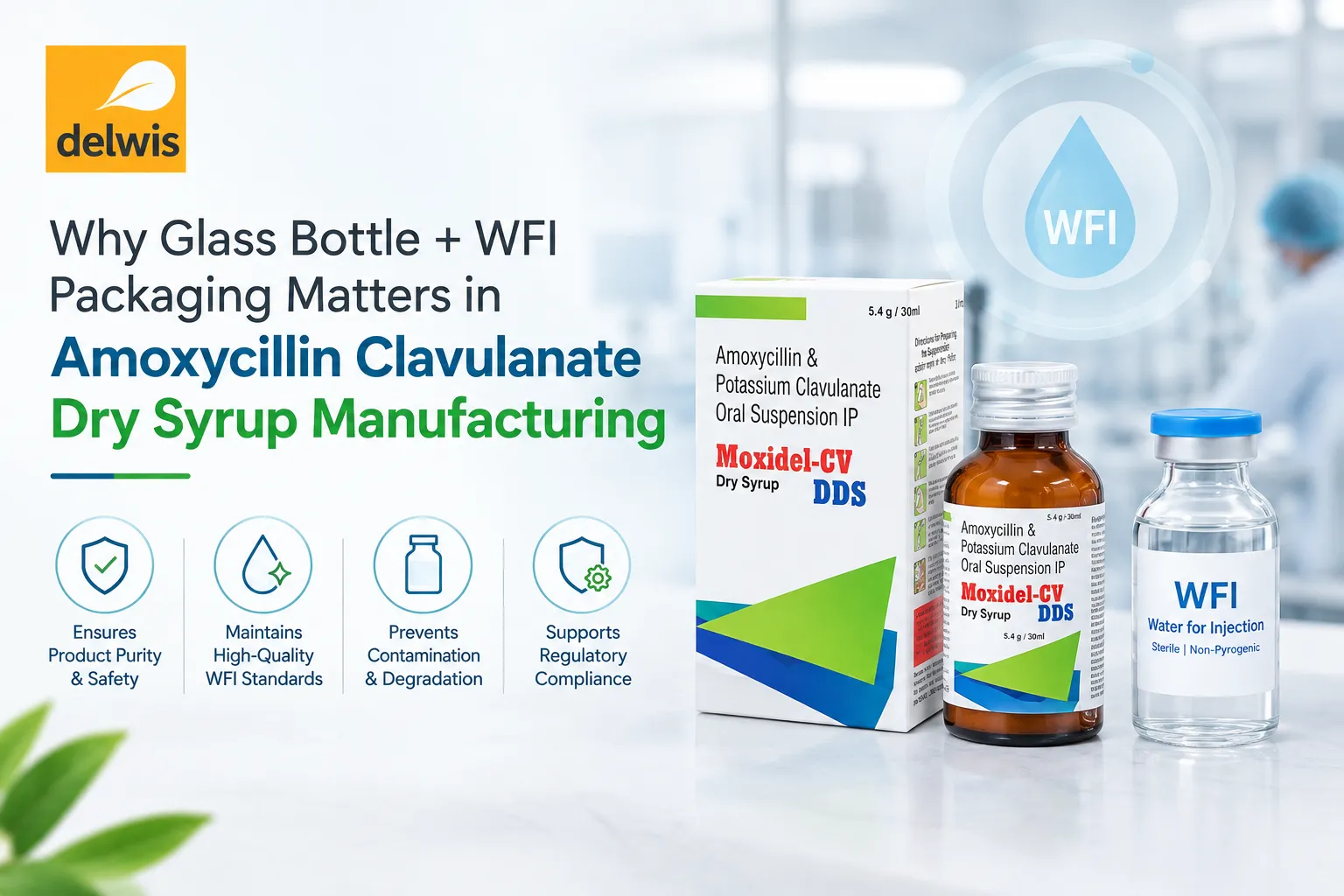
The 30ml glass bottle with packaged Water for Injection (WFI) format that Delwis Healthcare uses for this formulation is not a legacy choice or a premium cosmetic upgrade. It is a specification that addresses specific and documented failure modes in paediatric antibiotic dry syrup quality — failures that PET packaging and tap-water reconstitution introduce at the manufacturing, distribution, dispensing, and home-use stages of the product journey.
This article explains the science behind each element of the glass + WFI specification, the quality parameters it protects, and what pharma brands and CMO procurement teams should understand when evaluating dry syrup manufacturers for their paediatric antibiotic portfolio.
For a complete guide to the clinical indications and patient-facing aspects of this formulation, see our detailed resource on amoxicillin and clavulanate dry syrup uses for children. The focus of this article is manufacturing quality — specifically packaging science and its downstream clinical consequences.
Why Glass Matters — The Moisture Barrier Argument
The Chemical Vulnerability of Amoxycillin-Clavulanate in Dry Form
Amoxycillin and potassium clavulanate are both chemically labile molecules in the presence of moisture. This is not a minor stability consideration — it is the primary challenge in manufacturing a dry syrup form of this combination that maintains its label claim across a 24-month shelf life under Indian ambient storage conditions.
Amoxycillin: The beta-lactam ring of amoxycillin undergoes hydrolysis in aqueous conditions — the same chemical transformation that makes it water-soluble also makes it moisture-sensitive in dry powder form. Residual moisture in the dry powder above validated limits initiates hydrolytic ring opening, producing breakdown products (amoxycillin penicilloic acid) that have no antibacterial activity and that the HPLC-based quality release protocol quantifies as "related substances."
Potassium Clavulanate: Clavulanate is hygroscopic — it actively absorbs moisture from its surrounding environment. This property makes it one of the most challenging APIs to handle in dry powder manufacturing: it must be processed in humidity-controlled environments, blended under controlled conditions, and sealed in primary packaging that prevents vapour transmission throughout the shelf life. Clavulanate degradation under elevated humidity produces break-down products including clavulanic acid, which has reduced beta-lactamase inhibitory activity compared to the parent compound.
The cumulative result of API degradation: a product that passes its 6-month accelerated stability checkpoint but progressively loses potency toward the end of its 24-month shelf life — delivering sub-therapeutic antibiotic concentrations to children in the critical last months of the product's distribution cycle.
Glass vs PET: The Moisture Vapour Transmission Rate Difference
The key packaging parameter is Moisture Vapour Transmission Rate (MVTR) — the rate at which water vapour permeates through the container wall from the external environment into the headspace and powder.
PET bottles have a measurable MVTR even at moderate thicknesses — in the range of 0.5–2.0 g/m²/day at standard conditions depending on wall thickness, closure design, and ambient humidity. For a dry syrup formulation in a tropical climate with 60–85% relative humidity (India's average ambient condition across 8 months of the year), this translates to a non-trivial and cumulative moisture uptake over the 24-month shelf life.
Type III amber glass bottles — the standard for pharmaceutical liquid preparations — have an MVTR that is, for practical purposes, zero. Glass is an amorphous solid with no molecular pathway for water vapour permeation. Once sealed with a foil-lined, induction-sealed cap, a glass bottle with an intact seal presents a hermetic barrier to moisture ingress for the full product shelf life.
For amoxycillin-clavulanate, this distinction is not marginal. In accelerated stability studies conducted at 40°C/75% RH — conditions that simulate hot, humid Indian summer storage — PET-packaged dry syrups of this formulation consistently show greater degradation of the clavulanate component compared to glass-packaged equivalents at equivalent timepoints. This is not a theoretical risk: it is a documented and reproducible pharmacopoeial stability testing outcome.
Zero Plasticiser Leaching — Paediatric Safety Consideration
Beyond moisture protection, glass offers a second critical advantage for paediatric formulations: chemical inertness. Glass does not leach plasticisers, stabilisers, or polymer-derived extractables into the dry powder or reconstituted suspension.
PET contains antimony trioxide (a polymerisation catalyst), acetaldehyde (a degradation product), and various plasticisers. While the concentrations of these extractables in pharmaceutical-grade PET are regulated and generally low in adult dosing contexts, paediatric formulations — particularly those dosed by body weight to infants and toddlers — face a higher per-kilogram extractable exposure relative to adult products. This is a specific regulatory consideration in paediatric pharmaceutical development that glass packaging eliminates by providing a chemically inert primary container.
Why WFI — The Reconstitution Diluent Argument
What Goes Wrong When Caregivers Use Tap Water
Reconstitution of a dry syrup is the final pharmaceutical manufacturing step — and in contrast to every earlier stage of the manufacturing process, it happens outside the controlled environment of the facility, at the point of dispensing or in the patient's home.
The quality of the reconstitution diluent directly determines the microbiological quality of the final liquid suspension — regardless of how impeccable the manufacturing and packaging quality was up to that point.
Tap water in India — even municipally treated tap water in urban settings — is not a sterile pharmaceutical diluent. It routinely contains:
- Bacterial contamination: Total viable counts in Indian municipal water supplies routinely exceed the limits set for pharmaceutical purified water; total coliforms are detectable in a significant proportion of household tap water samples
- Endotoxins: Gram-negative bacterial lipopolysaccharides (pyrogens) that are not removed by standard municipal water treatment and that can cause febrile reactions in paediatric patients
- Dissolved minerals and ions: Calcium, magnesium, and iron ions that may interact with clavulanate's chelation chemistry or affect suspension pH, potentially accelerating degradation of the reconstituted product
- Variable chemical quality: pH variation, chlorine residuals, and organic matter that affect the stability of the reconstituted antibiotic suspension in ways that are not predictable across different geographic supply regions
Water for Injection (WFI) is manufactured to pharmacopoeial specification (IP/USP/EP) — sterile, pyrogen-free, ion-free, and of controlled pH. It is produced by double-distillation or reverse osmosis followed by ultrafiltration, tested for bacterial endotoxins (less than 0.25 EU/ml by LAL test), and packaged in sealed ampoules or vials under aseptic conditions.
When a packaged WFI ampoule is included with the dry syrup bottle, the reconstitution diluent is controlled to the same pharmaceutical specification as the dry powder itself — ensuring the final reconstituted suspension is microbiologically clean, chemically stable, and within the validated pH range from the first dose regardless of where in India it is dispensed or used.
Eliminating Caregiver Error at the Point of Reconstitution
Including WFI as the packaged diluent also addresses a practical compliance issue: caregiver confusion about what water to use.
Without a packaged diluent, caregivers are typically instructed to use "boiled and cooled water" or "purified water" — instructions that are misunderstood, inconsistently followed, or technically impossible to meet in many Indian household contexts (boiled water is not sterile; boiling reduces but does not eliminate endotoxins). A packaged WFI ampoule eliminates this instruction entirely — the caregiver adds the contents of one ampoule to the bottle, shakes, and the reconstitution is complete with a correctly specified diluent.
This simplification directly improves compliance, reduces reconstitution errors, and ensures every bottle dispensed produces a suspension of consistent pharmaceutical quality.
The 30ml Pack Size — Clinical Precision in Paediatric Dosing
The 30ml pack size is calibrated to deliver a complete standard paediatric treatment course at weight-based high-dose dosing for children across the typical paediatric weight range:
- At 90mg/kg/day amoxycillin (the high-dose otitis media regimen) in two divided doses:
- A 10kg child receives 9ml per dose (18ml/day) → 30ml = approximately 1.7 day supply per bottle → typically 2 bottles prescribed for a 3-day course
- A 15kg child receives 13.5ml per dose (27ml/day) → 30ml covers just over 1 day at high dose
- For standard 25–45mg/kg/day dosing: a 10kg child receives 3.1–5.6ml per dose → 30ml provides 2.6–4.8 days per bottle
The 30ml volume therefore functions as a modular dosing unit — prescribers and pharmacists calculate the number of bottles required for the full treatment course based on the child's weight and the prescribed daily dose. This modularity avoids the waste associated with larger-volume bottles where unused suspension must be discarded after 7 days post-reconstitution, and reduces the cost per treatment course compared to overfilled pack sizes.
Manufacturing Quality Implications — What Glass + WFI Demands from the Manufacturer
The glass + WFI specification is not simply a packaging decision — it implies specific manufacturing capability requirements that differentiate GMP-compliant dry syrup manufacturers from commodity powder fillers:
Humidity-controlled manufacturing environment: Processing clavulanate-containing formulations requires relative humidity control during blending, granulation, and filling — typically maintained below 40% RH in the manufacturing suite to prevent in-process moisture uptake that would compromise the dry powder's stability. This requires HVAC systems validated for humidity control, real-time environmental monitoring during batch manufacture, and documented excursion management procedures.
Precise powder filling into glass: Glass bottle filling requires different tooling and handling protocols compared to PET — glass is heavier, fragile, and requires vibration-dampened filling lines with appropriate contact-part materials to prevent breakage and glass-particle contamination. The filling speed, headspace management, and cap-torque specifications must all be validated for glass-specific parameters.
Induction sealing of glass caps: The foil-induction seal that provides the primary tamper-evidence and moisture barrier for the glass bottle cap requires validated induction-sealing equipment with documented seal integrity testing protocols.
WFI ampoule co-packing: Including a WFI ampoule or vial in the outer carton requires sourcing pharmaceutical-grade WFI from a qualified supplier, managing the WFI component within the same product release framework as the dry powder, and ensuring co-packing processes do not compromise the WFI ampoule's sterility or integrity before dispensing.
The amoxycillin and potassium clavulanate oral suspension manufactured by Delwis Healthcare meets all of these manufacturing quality requirements — with humidity-controlled manufacturing suites, validated glass bottle filling lines, HPLC dual-API batch release testing, moisture content (Karl Fischer) testing of each batch, and ICH-compliant stability programmes covering both real-time and accelerated conditions.
What This Means for Pharma Brand Partners
For pharmaceutical brands evaluating CMO partners for a paediatric amoxycillin-clavulanate dry syrup, the glass + WFI specification is a differentiating quality marker — both in terms of the manufacturing infrastructure it requires from the supplier, and in terms of the product quality story it enables for brand positioning in the premium paediatric antibiotic segment.
Indian paediatric prescribers — particularly in private paediatrics practice and in tertiary hospital settings — are increasingly aware of the quality distinctions between glass and PET dry syrup packaging, and between WFI and tap-water reconstitution. Brands that can credibly communicate these distinctions, backed by a manufacturer's stability data and QC documentation, have a meaningful competitive advantage in the paediatric antibiotic category.
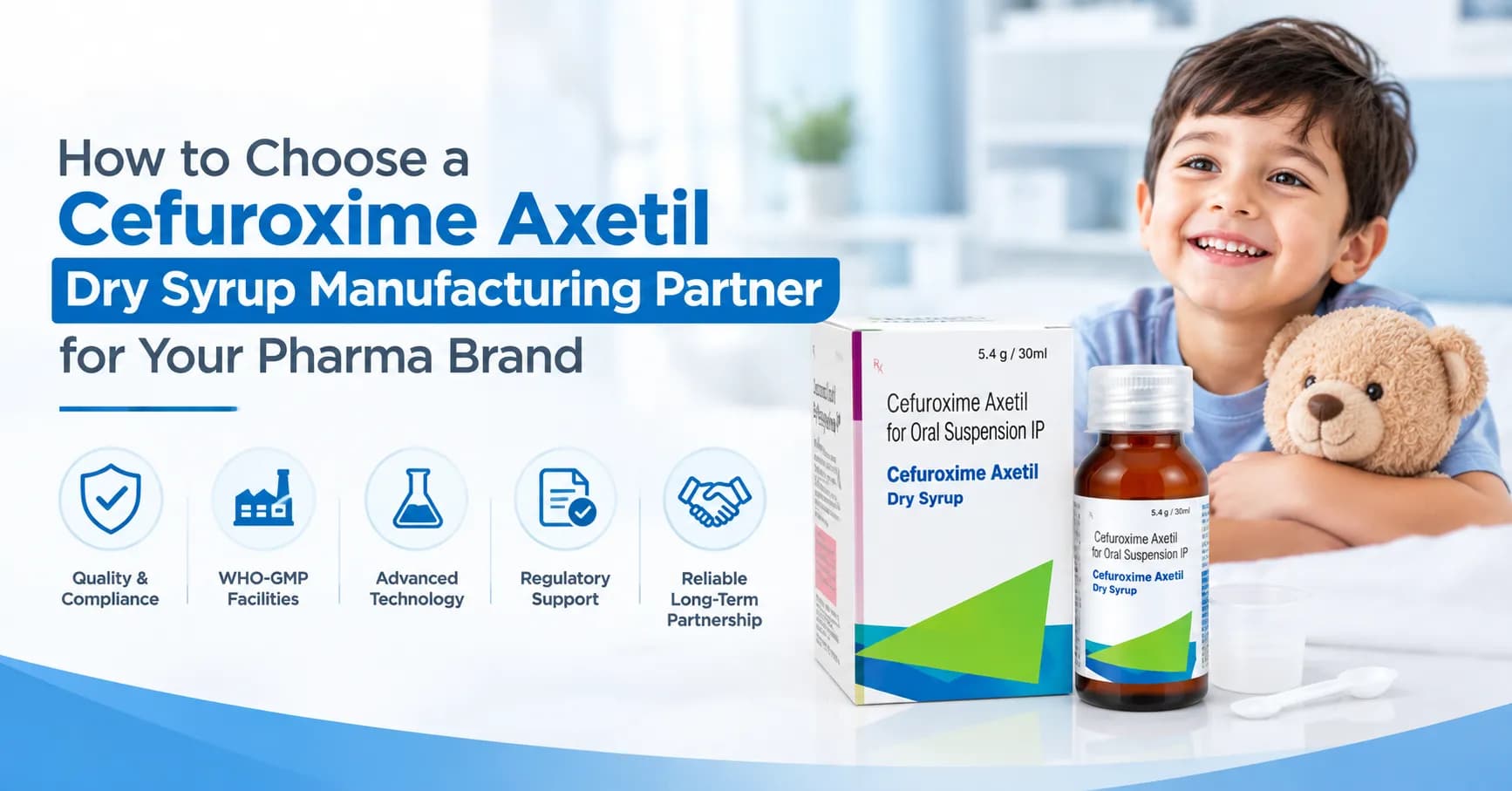
Delwis Healthcare offers complete third-party and CMO manufacturing services for this formulation — including private label, export documentation, and regulatory support — from our WHO-GMP certified facility in Ahmedabad. Our syrup and oral liquid manufacturing and dry syrup manufacturing capabilities cover the full range of paediatric antibiotic oral liquid formulations in our pediatrics range, including the cefuroxime axetil dry syrup as a related second-generation cephalosporin paediatric option for brands building a complete paediatric antibiotic portfolio.
This article is written for pharmaceutical industry professionals, brand managers, and healthcare procurement teams. It is intended for educational and informational purposes within the pharmaceutical manufacturing and B2B supply context.