Introduction: India's Monsoon Months and the Rise of Traveler's Diarrhea
Between June and September, India's gastroenterology and general medicine outpatient departments see a predictable and significant spike in one particular presentation: acute watery diarrhea with abdominal cramps, nausea, and sometimes low-grade fever — occurring in people who have recently traveled within India (particularly between states with different water and food hygiene standards), traveled internationally, or simply eaten at an unfamiliar food establishment.
This is traveler's diarrhea — defined clinically as three or more loose or watery stools within 24 hours, occurring in a person who has recently traveled to a new region — and it is among the most common acute gastrointestinal conditions presenting to clinicians across India every monsoon season.
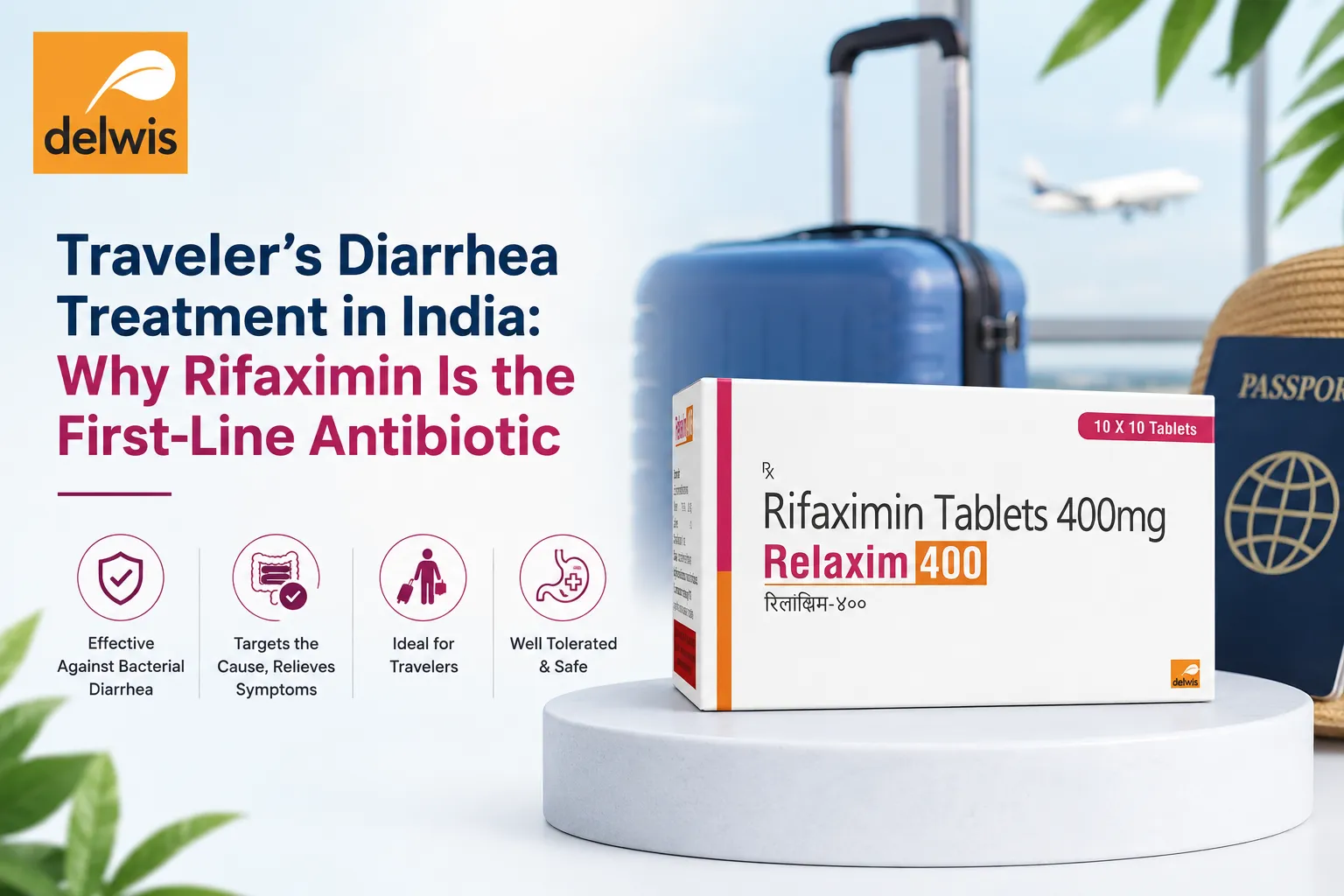
The prescription that resolves it quickly, safely, and without the resistance concerns that have made older antibiotics less reliable is increasingly one molecule: rifaximin. And the question every clinician and every patient or family member managing an episode of traveler's diarrhea in India deserves a clear answer to is — why rifaximin specifically, and how should it be used?
For the complete clinical reference on all indications for rifaximin 400mg tablet — including IBS-D, SIBO, hepatic encephalopathy, and dosage by condition — see our comprehensive guide on rifaximin 400mg uses. This article focuses specifically on traveler's diarrhea: the epidemiology, the pathogen profile, the antibiotic choice rationale, and the practical treatment framework.
What Is Traveler's Diarrhea and Why Is India Both a Destination and Source?
Traveler's diarrhea (TD) occurs when the gastrointestinal tract is exposed to enteric pathogens — bacteria, less commonly viruses or parasites — that the traveler has not previously encountered and has no immunity against. The concept applies to both international travelers visiting India and domestic Indian travelers moving between regions with different food preparation standards, water treatment quality, and endemic pathogen profiles.
India occupies a complex position in the global TD picture: it is both a high-incidence destination for international travelers (India is consistently listed in the top five highest-risk TD destinations globally) and a country with significant internal variation in food and water safety — meaning domestic travel between states can produce genuine TD episodes in people who are locally adapted to their home region's microbial environment.
The peak incidence correlates directly with India's monsoon season, for reasons rooted in basic food safety microbiology:
Monsoon water contamination: Flooding and surface runoff during heavy monsoon rains contaminate groundwater, wells, and water distribution infrastructure with faecal matter — the primary vehicle for enteric pathogen transmission. Even households with municipal water connections frequently experience transient contamination events during monsoon months.
Food spoilage acceleration: Ambient temperatures combined with high humidity create conditions for rapid bacterial proliferation in cooked and raw foods left at room temperature for even short periods — a common reality in Indian street food and home kitchen environments.
Food handling disruptions: Increased rainfall disrupts normal supply chains and food storage conditions, increasing the probability of contaminated ingredients reaching consumers.
This convergence of factors makes the Indian monsoon season the highest-risk period for TD — both for visitors and for domestic travelers moving outside their home region.
The Causative Organisms: Why the Pathogen Profile Determines the Antibiotic
Understanding which bacteria cause traveler's diarrhea in India is essential to understanding why antibiotic selection has evolved over the past decade.
Enterotoxigenic Escherichia coli (ETEC) is the most commonly identified causative organism in traveler's diarrhea globally — responsible for approximately 30–40% of TD episodes in high-risk regions. ETEC strains produce heat-labile (LT) and heat-stable (ST) enterotoxins that stimulate fluid and electrolyte secretion from small intestinal enterocytes, producing the profuse, watery diarrhea characteristic of TD without mucosal invasion (the gut lining is not directly damaged — the toxin acts on cellular signalling pathways).
Enteropathogenic E. coli (EPEC), Campylobacter jejuni, and Aeromonas species account for smaller proportions of TD in India. Norovirus and rotavirus contribute to the viral fraction, while Giardia lamblia is the most relevant parasitic cause in Indian water-associated TD.
For the bacterial fraction — specifically ETEC-driven TD — the critical clinical consideration is the antimicrobial susceptibility profile. ETEC strains in India have shown significant and growing resistance to fluoroquinolones (ciprofloxacin, ofloxacin, norfloxacin) — the antibiotics that were first-line for TD management for two decades. This resistance has been documented at rates of 30–60% in some Indian studies, meaning that empirical fluoroquinolone treatment for TD has a substantial and growing probability of failure in the Indian epidemiological context.
Why Rifaximin Has Become the First-Line Antibiotic for Traveler's Diarrhea
Rifaximin's dominance in traveler's diarrhea treatment — reflected in international travel medicine guidelines and increasingly in Indian gastroenterology practice — is based on four converging properties that address the specific clinical needs of TD management:
1. Near-Zero Systemic Absorption — The Defining Pharmacological Property
Rifaximin is a non-absorbed, gut-targeted antibiotic. After oral ingestion, less than 0.4% of the dose enters the systemic circulation. The drug remains concentrated in the intestinal lumen — where ETEC and other TD-causing bacteria reside — at concentrations that are orders of magnitude higher than any equivalent dose of a systemically absorbed antibiotic could deliver to the gut specifically.
This gut-confined mechanism is why rifaximin is particularly suitable for TD: the causative organisms are in the gut lumen (not in tissues, blood, or organs), and a drug that concentrates precisely there without distributing throughout the body delivers both superior local efficacy and an exceptional safety profile.
The practical patient benefit: no systemic antibiotic side effects. No photosensitivity (unlike fluoroquinolones), no tendon-related adverse events (a documented fluoroquinolone class effect), no significant disruption to vaginal, respiratory, or skin flora (because systemic drug exposure is negligible), and minimal impact on the systemic antibiotic resistance ecosystem.
2. Resistance Profile — Why Rifaximin Succeeds Where Fluoroquinolones Increasingly Fail
The mechanism of rifaximin resistance in bacteria — mutations in the rpoB gene encoding the beta subunit of RNA polymerase — is the same as rifampicin resistance. Critically, this resistance occurs only in gut-confined bacteria in the presence of rifaximin — and because rifaximin is not absorbed systemically, rifaximin-selected resistance in gut organisms is not disseminated systemically to affect treatment of other infections.
More importantly in the Indian context: while fluoroquinolone resistance in ETEC and other enteric gram-negatives has reached clinically significant levels, rifaximin remains highly active against the non-invasive ETEC strains responsible for the majority of watery TD presentations. Clinical cure rates of 80–90% have been documented for rifaximin in ETEC-driven TD in multiple controlled trials.
The one critical limitation: rifaximin is not appropriate for TD presentations with invasive features — bloody stools, high fever (above 38.5°C), or signs of systemic infection. Invasive TD caused by organisms like Salmonella, Shigella, or invasive E. coli requires systemic antibiotic therapy. For these presentations, a systemic antibiotic is necessary — including appropriate agents from the broader antibacterial range for different infection contexts.
3. Fast Clinical Response — Symptom Relief Within 24 Hours
Rifaximin's high intraluminal concentrations produce a rapid bacteriostatic and bactericidal effect against ETEC in the small intestinal lumen. Most patients with non-invasive, watery TD treated with rifaximin experience a significant reduction in stool frequency and abdominal cramping within 24–48 hours of the first dose — faster than the typical 2–3 day response time of oral rehydration therapy alone.
This rapid symptomatic response is clinically significant for travelers — both international visitors who have limited time and may face consequential disruption from ongoing illness, and domestic travelers for whom returning to normal activity quickly is essential.
4. Preservation of Gut Microbiome Integrity
Unlike broad-spectrum systemic antibiotics that deplete gut microbiome diversity — which predisposes to secondary complications including Clostridioides difficile colitis and post-antibiotic dysbiosis — rifaximin's confined, lumen-level activity has been shown to have a relatively microbiome-sparing and even eubiotic (microbiome-normalising) effect in clinical studies.
This property is particularly valuable in TD management because the post-diarrheal gut — already disrupted by the infection — recovers more smoothly when the treatment antibiotic minimises additional microbiome disruption rather than compounding it.
Rifaximin vs Ofloxacin and Ciprofloxacin — The Practical Comparison
GSC data for the Relaxim 400 product page reveals that the query rifaximin 400 vs ofloxacin ornidazole is already ranking at position 1 with 6 impressions — indicating active patient and prescriber comparison intent. Here is the clinical comparison that answers this:
Feature | Rifaximin | Ofloxacin / Ciprofloxacin |
|---|
Mechanism | RNA polymerase inhibition — gut-confined | DNA gyrase / topoisomerase IV — systemic |
Systemic absorption | <0.4% | 70–95% |
ETEC activity | Excellent — maintained | Variable — 30–60% resistance in India |
Invasive TD | ❌ Not appropriate | ✅ Required for systemic/invasive disease |
Safety profile | Excellent — no systemic effects | Photosensitivity, tendinopathy, CNS effects |
Resistance selection pressure | Confined to gut — minimal systemic impact | Systemic — contributes to broader AMR |
Gut microbiome impact | Eubiotic / minimal disruption | Significant broad disruption |
Speed of symptom relief (watery TD) | 24–48 hours | 24–48 hours (when susceptible) |
Pregnancy | Limited data — use with caution | Generally avoided (cartilage concerns) |
Children | Not routinely recommended <12 years | Restricted use in children |
For children with bacterial gut infections who require systemic antibiotic coverage, appropriate paediatric formulations from other antibiotic classes — such as amoxicillin and clavulanate dry syrup — are prescribed based on the specific organism and clinical presentation. For adults with non-invasive TD presentations, rifaximin is the superior first choice based on resistance profile, safety, and gut-specificity.
For moderate-to-severe TD with systemic features, or confirmed invasive bacterial diarrhea requiring broader systemic coverage, cefpodoxime and potassium clavulanate tablets represent an appropriate systemic antibiotic option against susceptible gram-negative enteric organisms.
Practical Treatment Framework — How Rifaximin Is Used for Traveler's Diarrhea
Who is a candidate:
- Adult patients (18 years and above) with acute, watery, non-bloody diarrhea
- Onset consistent with traveler's diarrhea (travel to a new region, unfamiliar food or water exposure)
- No fever above 38.5°C, no systemic symptoms, no bloody or mucoid stools
- Symptoms persisting beyond 24–48 hours despite oral rehydration alone
Standard dosing for TD: Rifaximin 400mg, taken three times daily (TID) for 3 days — a total of 9 tablets across the treatment course. This short, three-day course is appropriate specifically for non-invasive TD. Most patients experience significant improvement within the first 24–48 hours and complete resolution by day 3.
Oral rehydration alongside antibiotic therapy: Rifaximin is not a substitute for oral rehydration. The immediate clinical priority in any diarrheal illness is maintaining hydration and electrolyte balance — particularly in India's heat, where dehydration from diarrhea can progress rapidly. Oral rehydration solution (ORS) should be initiated at the onset of symptoms and continued throughout the antibiotic course.
When to escalate: If symptoms worsen after 48 hours of rifaximin therapy, if fever develops or worsens, if bloody stools appear, or if the patient shows signs of dehydration that cannot be corrected with oral rehydration — a clinical re-evaluation is essential. These features suggest either an invasive pathogen (requiring systemic antibiotic therapy) or a non-bacterial cause (viral, parasitic) that rifaximin will not address.
Prevention: For travelers to high-risk regions within and from India, the following risk-reduction measures reduce TD incidence significantly: consuming only bottled or sterilised water, avoiding raw vegetables, salads, and unpeeled fruits from street vendors, choosing freshly cooked hot food over cold or pre-prepared dishes, and rigorous hand hygiene before eating.
Conclusion
Rifaximin's position as the first-line antibiotic for traveler's diarrhea in India is not simply a guideline recommendation — it is the result of a specific convergence of pharmacological, epidemiological, and antimicrobial stewardship factors that make it the most appropriate choice for the non-invasive watery TD that accounts for the majority of presentations. Its gut-targeted, non-absorbed mechanism delivers superior local antibacterial activity at the exact site of infection, avoids the systemic resistance concerns that have progressively eroded fluoroquinolone reliability for TD, and produces rapid symptom resolution with a safety profile that is among the best of any antibiotic class.
For the complete clinical guide to all rifaximin indications — including IBS-D, SIBO, hepatic encephalopathy, and dosage guidance across all conditions — visit the full guide on rifaximin 400mg uses. For pharmaceutical brands and CMO partners evaluating this molecule for their antibacterial portfolio, explore the rifaximin 400mg tablet product page and the complete antibacterial range at Delwis Healthcare.
This article is written for informational and educational purposes only. It does not constitute medical advice, clinical guidance, or a substitute for professional medical assessment. All antibiotic prescribing decisions should be made by qualified physicians based on individual clinical evaluation and local antimicrobial resistance data.