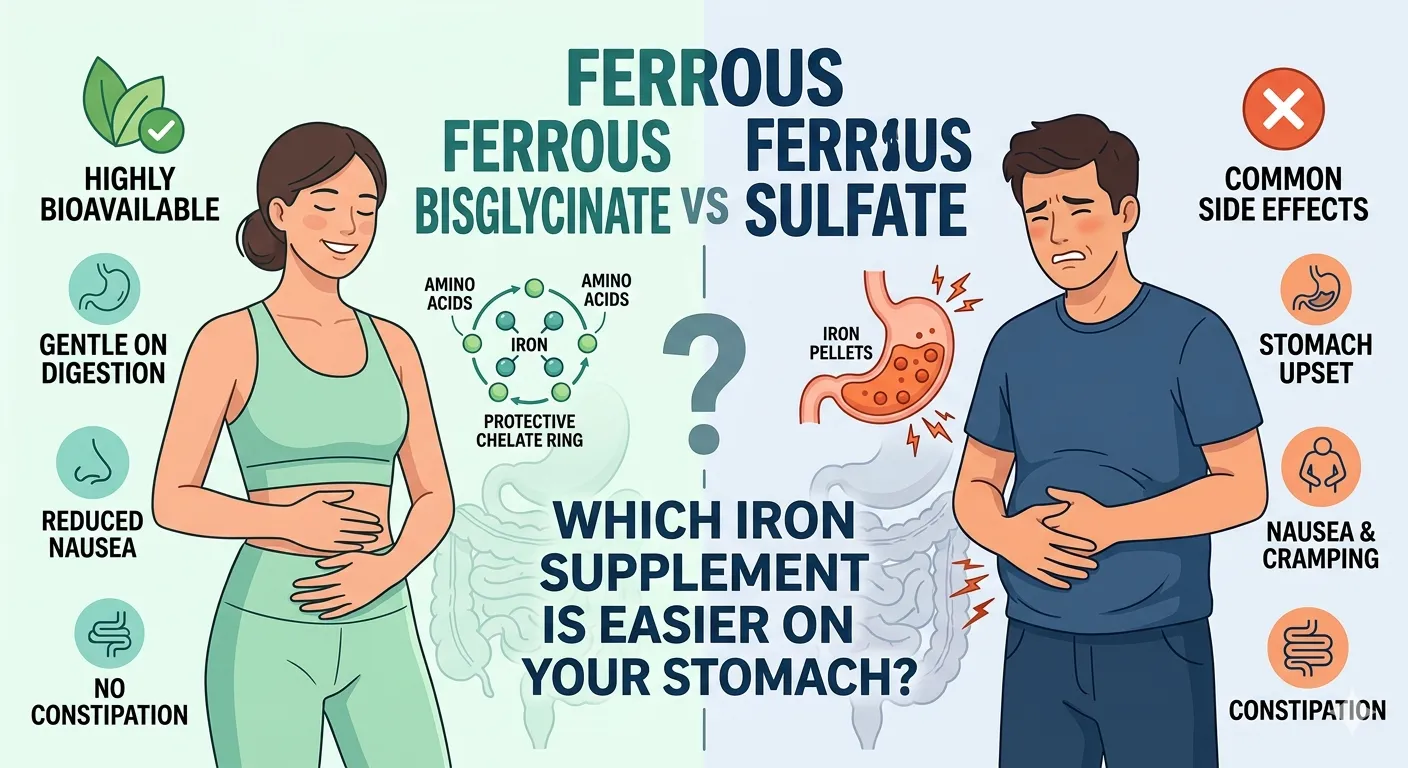
If you have ever been prescribed iron tablets and stopped taking them because of nausea, constipation, or stomach cramps — you are not alone. Iron deficiency anemia affects an estimated 52% of pregnant women and 59% of adolescent girls in India, according to NFHS-5 data. Yet one of the biggest barriers to successful iron therapy is not access — it is tolerance. The form of iron in your supplement makes a dramatic difference, and the choice between ferrous bisglycinate and ferrous sulfate could determine whether your treatment actually works.
What Are Ferrous Bisglycinate and Ferrous Sulfate?
Both are oral iron supplements used to treat and prevent iron deficiency anemia, but their chemistry — and their behaviour in the body — are fundamentally different.
Ferrous sulfate is an inorganic iron salt. When it dissolves in the stomach, it releases free iron ions that interact directly with the gut lining and food compounds, which is precisely what causes nausea, constipation, and stomach cramps in many patients.
Ferrous bisglycinate is a chelated iron — iron bound to two glycine amino acid molecules. This protective structure keeps iron stable throughout the digestive tract, allowing it to be absorbed intact through peptide transporters (PepT1) in the small intestine, without releasing the free ions that irritate the stomach.
Bioavailability: Which Form Gets Absorbed Better?
Bioavailability — how much iron you actually absorb — is where ferrous bisglycinate has a clear clinical advantage.
A peer-reviewed randomised clinical trial found that after 8 weeks of supplementation, patients on ferrous bisglycinate achieved a significantly higher mean haemoglobin level (10.85 g/dL) compared to ferrous sulfate (9.76 g/dL). Mean serum ferritin levels were also superior with bisglycinate — 29.96 ng/mL versus 23.64 ng/mL — confirming more effective replenishment of iron stores.
Crucially, ferrous bisglycinate absorption is not blocked by phytates, tannins, calcium, or oxalates — the common dietary compounds that inhibit ferrous sulfate absorption. This means it can be taken with meals without sacrificing efficacy, a significant practical advantage for patients who cannot tolerate iron on an empty stomach.
Stomach Tolerance: Where the Real Difference Lies
A 2024 randomised study published in the Journal of Pregnancy (Milman & Bergholt) directly compared ferrous bisglycinate and ferrous sulfate in pregnant women. The bisglycinate group showed a significantly lower frequency of total gastrointestinal complaints — including intestinal colic, nausea, and bloating — compared to the sulfate group. The study concluded that ferrous bisglycinate carries a more favourable tolerance profile, largely because the chelated form avoids direct contact between ionic iron and the sensitive gut lining.
Here is how the two forms compare side by side:
- Dosage load: Ferrous bisglycinate achieves equivalent clinical results with lower elemental iron exposure due to superior absorption efficiency, reducing overall gut irritation.
- GI side effects: Ferrous bisglycinate rarely causes nausea or constipation. Ferrous sulfate is the leading reason patients discontinue iron therapy before completing their prescribed course.
- Gut irritation: Chelated iron does not release free iron ions that oxidise and irritate the gut mucosa, unlike ferrous sulfate.
- Food interaction: Ferrous bisglycinate can be taken with food. Ferrous sulfate is ideally taken on an empty stomach, which often worsens tolerability for sensitive patients.
- Patient compliance: Better GI comfort leads directly to higher treatment adherence and completed therapy courses — which determines real-world iron recovery outcomes.
Who Is Ferrous Bisglycinate Best Suited For?
Ferrous bisglycinate is the clinically preferred choice for:
- Pregnant women, where both GI comfort and consistent haemoglobin levels are critical priorities
- Women with heavy menstrual blood loss who require sustained, long-term iron supplementation
- Adolescent girls with iron deficiency and a history of GI sensitivity to conventional iron tablets
- Vegetarians and vegans compensating for low dietary iron and absent dietary vitamin B12
- Anyone who has previously stopped iron therapy due to nausea, dark stools, or stomach discomfort
The Combination Advantage: Why Iron Alone Is Often Not Enough
Iron deficiency anemia is rarely an isolated deficiency. Vitamin B12 (methylcobalamin), folic acid, and zinc all play critical roles in red blood cell maturation, DNA synthesis, and haemoglobin production. Supplementing iron in isolation addresses only part of the problem.
This is why modern hematinic formulations combine ferrous bisglycinate with zinc bisglycinate, folic acid, and methylcobalamin for complete nutritional anemia management. If you are a healthcare professional or pharmaceutical buyer looking for such a formulation, the ferrous bisglycinate tablet from Delwis Healthcare — marketed as Hemogain — combines all four nutrients in a single WHO-GMP certified, Alu-Alu blister tablet, manufactured in Ahmedabad, Gujarat.
The Verdict
Clinical evidence consistently supports ferrous bisglycinate as the more effective and better-tolerated iron supplement. The difference is not merely biochemical — it is behavioural. Patients who experience fewer side effects are far more likely to complete their full course of treatment, and treatment completion is what ultimately determines whether iron therapy succeeds or fails.
For clinicians: switching GI-intolerant patients from ferrous sulfate to a chelated bisglycinate formulation is a clinically sound, evidence-backed decision. For patients: if your iron tablet has been causing stomach problems, there is a validated, gentler alternative — and it absorbs better, too.