Introduction: When Your Paediatrician Prescribes a Different Antibiotic Syrup
Most parents in India are familiar with amoxicillin — the white or pink powder syrup that paediatricians have prescribed for children's ear infections, throat infections, and chest coughs for decades. But increasingly, parents are coming away from the clinic with a prescription for something different: cefuroxime axetil syrup. Some have already had an amoxicillin course that didn't fully clear the infection. Others are on their child's first antibiotic course for a more severe presentation. All of them have the same questions: what is this antibiotic, how is it different, and what exactly is it used for?
This guide answers those questions comprehensively — covering what cefuroxime axetil syrup is, why it belongs to a different and more advanced antibiotic category than amoxicillin, every bacterial infection in children it is used to treat, how to reconstitute and give the dry syrup correctly, dosage by weight, side effects, and the key safety information every parent and paediatrician should have.
For the product composition, packaging details, and manufacturing information behind this formulation, visit the cefuroxime axetil for oral suspension usp page at Delwis Healthcare.
What Is Cefuroxime Axetil Syrup?
Cefuroxime axetil syrup — also called cefuroxime dry syrup or cefuroxime axetil oral suspension — is an oral antibiotic formulation for children containing cefuroxime axetil as the active ingredient, delivering 125mg of cefuroxime per 5ml of reconstituted suspension.
The "axetil" in the name is pharmacologically important. Cefuroxime axetil is an oral prodrug — a chemically modified version of cefuroxime that is specifically engineered to be absorbed from the intestinal wall more efficiently than cefuroxime itself. Once absorbed, the axetil ester is rapidly cleaved by intestinal and hepatic esterases, releasing active cefuroxime into the bloodstream, where it distributes to infection sites throughout the body.
Cefuroxime belongs to the second-generation cephalosporin class of antibiotics — a category that occupies a significant clinical position between the narrow-spectrum first-generation cephalosporins and the broader third-generation agents. Understanding this classification helps explain both when cefuroxime is prescribed and why it is more effective than older antibiotics for many of the infections children commonly develop.
The formulation is available as a dry powder in a 30ml amber glass bottle, supplied with Water for Injection (WFI) for reconstitution. Once mixed, the suspension delivers 125mg cefuroxime per 5ml and must be used within 7 days when stored correctly. It is approved for use in children from 3 months of age through to 12 years.
What Makes It a "Second-Generation" Cephalosporin — and Why It Matters for Children
Parents unfamiliar with antibiotic classifications may wonder why the generation label matters. In practice, it reflects a clinically important difference in the range of bacteria the antibiotic can effectively kill — and its stability against the resistance mechanisms bacteria have developed.
First-generation cephalosporins (such as cephalexin) are primarily effective against gram-positive bacteria — particularly Staphylococcus and Streptococcus — and have limited activity against gram-negative organisms. They are also degraded by beta-lactamase enzymes produced by many resistant gram-negative bacteria.
Second-generation cephalosporins like cefuroxime extend the antibacterial spectrum to cover gram-negative pathogens more effectively — including Haemophilus influenzae and Moraxella catarrhalis, two of the bacteria most responsible for treatment-resistant ear infections, sinusitis, and chest infections in Indian children. Critically, cefuroxime is beta-lactamase stable — it resists degradation by many of the same beta-lactamase enzymes that defeat amoxicillin and first-generation cephalosporins.
Third-generation cephalosporins (such as cefpodoxime, cefixime) have even broader gram-negative coverage but are typically reserved for more severe infections or as step-up therapy.
For children with bacterial infections involving beta-lactamase-producing organisms — which represent a growing and increasingly common proportion of paediatric ear, throat, sinus, and chest infections in India — this second-generation stability is the precise reason cefuroxime axetil syrup is prescribed when plain amoxicillin or first-generation cephalosporins have not achieved adequate results.
How Does Cefuroxime Kill Bacteria? The Mechanism Explained Simply
Cefuroxime, like all cephalosporins, works by disrupting the bacterial cell wall. Bacteria surround themselves with a rigid, mesh-like cell wall made of a material called peptidoglycan — a cross-linked polymer that holds the cell together against osmotic pressure. Without this wall intact, the bacteria cannot survive the pressure differences inside and outside their cells.
Cefuroxime binds to proteins on the bacterial cell surface called penicillin-binding proteins (PBPs) — the enzymes that build and maintain the peptidoglycan cross-links. By blocking these enzymes, cefuroxime prevents the bacteria from synthesising new cell wall material. As the bacteria try to grow and divide, their cell walls weaken and eventually rupture — killing the bacteria.
This mechanism targets a structure that human cells do not have — which is why cefuroxime can kill bacteria without directly harming human cells, and why it has a relatively manageable side effect profile compared to older broad-spectrum antibiotics.
What sets cefuroxime apart from amoxicillin in this mechanism is its stability against beta-lactamase enzymes. Many bacteria have evolved to produce these enzymes specifically to cut open the beta-lactam ring at the core of cephalosporins and penicillins, rendering them inactive. Cefuroxime's molecular structure makes it substantially more resistant to this attack — allowing it to reach its PBP targets even in organisms that would destroy amoxicillin before it could act.
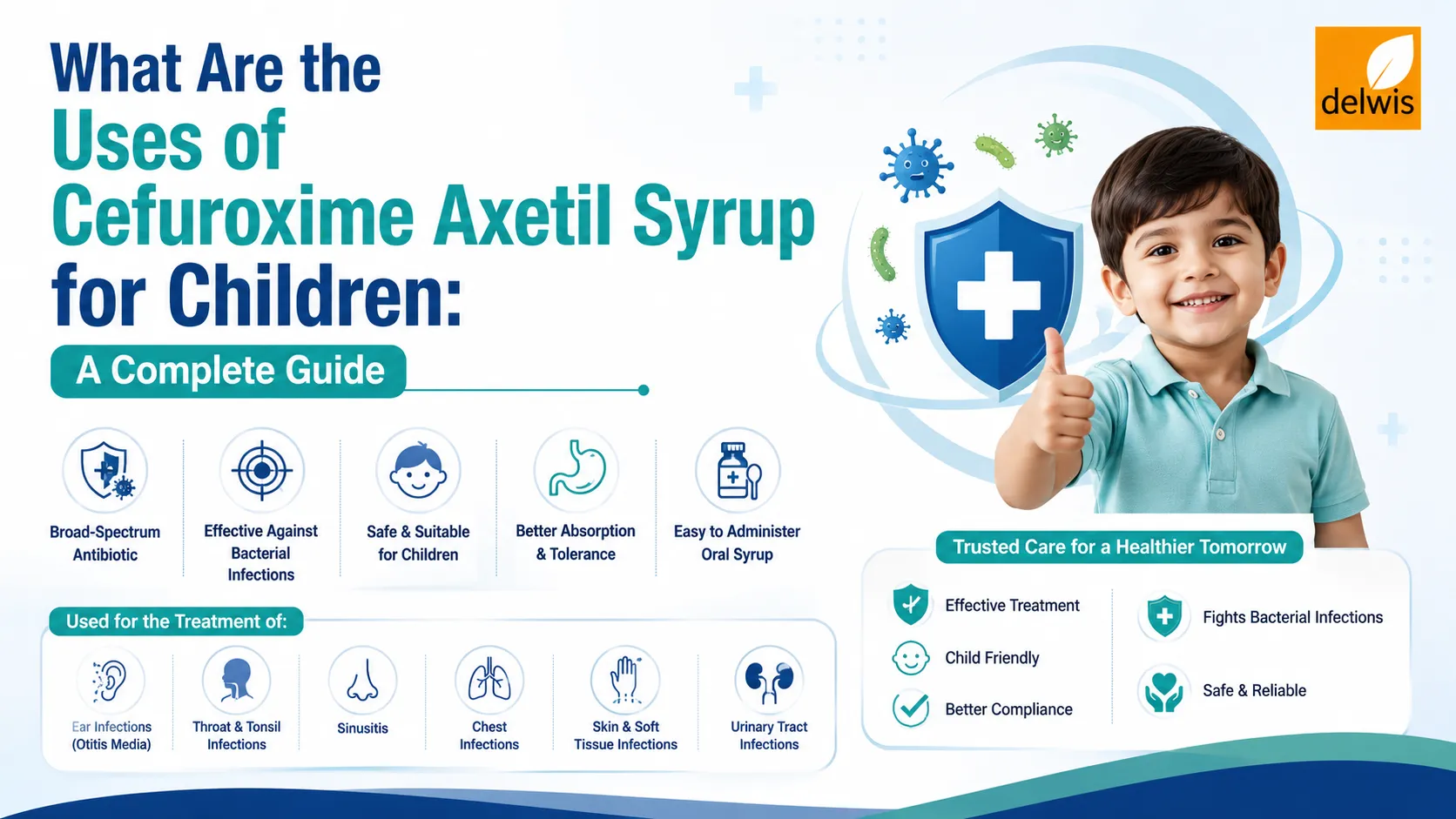
Cefuroxime Axetil Syrup Uses for Children — Condition by Condition
1. Ear Infections — Acute Otitis Media
Acute otitis media is one of the most common reasons a child visits a paediatrician in India. The three bacteria most responsible — Streptococcus pneumoniae, Haemophilus influenzae, and Moraxella catarrhalis — are all within cefuroxime's clinical spectrum. Crucially, both H. influenzae and M. catarrhalis produce beta-lactamase at high rates in Indian paediatric populations, making them resistant to plain amoxicillin in a significant proportion of cases.
Cefuroxime axetil syrup achieves high concentrations in the middle ear fluid (where otitis media infections reside), covering all three major pathogens with beta-lactamase-stable activity. It is a first-choice second-line antibiotic when:
- The child's ear infection has not responded to amoxicillin after 48–72 hours
- The child has had an ear infection within the last month (raising the probability of resistant organisms)
- The presentation is severe (bilateral ear infection, high fever, significant pain)
- The child is under 2 years — where resistant S. pneumoniae strains are proportionally more common
Clinical evidence also shows cefuroxime achieving superior bacteriological eradication rates compared to plain amoxicillin in otitis media caused by beta-lactamase-producing H. influenzae — which is precisely the population most likely to fail on first-line therapy.
Typical duration: 5–10 days, as directed by the treating paediatrician.
2. Tonsillitis and Throat Infections (Streptococcal Pharyngitis)
The primary bacterial cause of tonsillitis in children — Streptococcus pyogenes (Group A Strep) — is generally susceptible to amoxicillin. However, clinical evidence shows a pattern of apparent treatment failure in children with recurrent tonsillitis, even when Group A Strep is the causative organism and the strain itself tests sensitive to penicillin.
The explanation lies in the tonsillar microenvironment: beta-lactamase-producing Staphylococcus aureus co-colonises tonsillar tissue in many children with recurrent tonsillitis, producing beta-lactamase locally within the tonsillar crypts. This local beta-lactamase activity destroys amoxicillin before it can reach the streptococcal pathogen — creating the appearance of an amoxicillin-resistant strep infection where the problem is actually enzymatic drug degradation by a co-colonising organism.
Cefuroxime's beta-lactamase stability allows it to resist this local enzymatic environment and reach the streptococcal target. Studies comparing cefuroxime to penicillin-class antibiotics in streptococcal tonsillitis have consistently shown higher bacteriological eradication rates for cefuroxime — which directly translates to fewer recurrences after the antibiotic course.
Typical duration: 5–10 days, as directed.
3. Chest Infections — Community-Acquired Pneumonia and Bronchitis
Community-acquired pneumonia in children — particularly in the under-five age group — represents one of India's most significant paediatric health burdens. The predominant bacterial pathogens in paediatric community-acquired pneumonia include Streptococcus pneumoniae and Haemophilus influenzae, both of which are well-covered by cefuroxime.
In children who are well enough to be managed as outpatients (without hospitalisation), cefuroxime axetil oral suspension is a clinically appropriate first-line or second-line oral antibiotic choice — particularly where:
- The prescribing paediatrician suspects a beta-lactamase-producing pathogen
- A prior amoxicillin course has not achieved clinical improvement
- The child is stepping down from intravenous antibiotic treatment in hospital to oral continuation at home
Bacterial bronchitis — a lower respiratory tract infection producing productive cough and fever in children — involving H. influenzae also responds appropriately to cefuroxime axetil's spectrum and penetration into respiratory secretions.
Typical duration: 7–10 days for pneumonia; 5–7 days for uncomplicated bronchitis, as prescribed.
4. Sinusitis — Acute Bacterial Rhinosinusitis
Children commonly develop sinusitis following a viral upper respiratory infection — when bacterial secondary infection colonises the oedematous, fluid-filled sinus cavities that cannot drain properly during viral illness. The clinical hallmarks of bacterial sinusitis (as opposed to continued viral illness) include nasal symptoms persisting beyond 10 days without improvement, facial pain or pressure, and purulent nasal discharge.
The pathogens involved are identical to those causing otitis media — S. pneumoniae, H. influenzae, and M. catarrhalis — making cefuroxime a rational antibiotic choice for confirmed or strongly suspected bacterial sinusitis in children, particularly in those with recurrent sinus infections or prior antibiotic exposure that increases the probability of resistant organisms.
Typical duration: 10–14 days for sinusitis, as directed.
5. Urinary Tract Infections (UTI) in Children
Paediatric UTIs — ranging from lower tract cystitis to upper tract pyelonephritis — are most commonly caused by Escherichia coli, with Klebsiella pneumoniae and Proteus mirabilis as secondary causative organisms. Cefuroxime achieves high urinary concentrations and covers the gram-negative uropathogens responsible for most paediatric UTIs.
Where urine culture identifies a cefuroxime-sensitive organism, or where empirical therapy is initiated in a child at risk of resistant uropathogens (due to prior UTIs and antibiotic exposure), cefuroxime axetil oral suspension is a clinically proven option for outpatient management of uncomplicated paediatric UTI and pyelonephritis that does not require intravenous treatment.
Paediatric nephrologists may also use it as step-down oral therapy following initial intravenous antibiotic treatment for complicated pyelonephritis in hospitalised children.
Typical duration: 7–14 days depending on whether lower or upper UTI, as prescribed by the paediatrician.
6. Skin and Soft Tissue Infections — Impetigo and Cellulitis
Skin infections in children caused by Staphylococcus aureus and Streptococcus pyogenes — including impetigo (the highly contagious crusting skin infection common in young children), early-stage cellulitis, infected insect bites, and infected eczema — are well within cefuroxime's clinical spectrum.
Cefuroxime axetil syrup is an appropriate choice for paediatric skin infections when:
- Oral antibiotic therapy is indicated (as opposed to topical antibiotic cream alone)
- Community-acquired methicillin-susceptible S. aureus (MSSA) is the suspected organism
- A prior topical antibiotic has failed to clear the infection
- The infection is spreading (early cellulitis) and requires systemic antibiotic coverage
Typical duration: 5–7 days for impetigo and localised skin infections; up to 10 days for cellulitis, as prescribed.
How to Reconstitute Cefuroxime Axetil Dry Syrup — Step by Step for Parents
Proper reconstitution is the foundation of safe and effective dosing. Follow these steps exactly:
Step 1 — Locate the two pack components The pack contains a glass bottle with dry powder and a separate WFI (Water for Injection) ampoule or vial. Both are required. Do not substitute the WFI with tap water, boiled water, or packaged drinking water — the WFI is sterile and particle-free for a reason.
Step 2 — Add the entire WFI volume to the dry powder Open the WFI vial and pour every drop into the glass bottle containing the dry powder. The WFI volume is precisely pre-calculated to produce a 125mg/5ml suspension — do not add any additional water or measure the WFI before adding.
Step 3 — Close firmly and shake vigorously Cap the bottle securely. Shake very firmly — not just swirling — for a full 30–60 seconds. The dry powder should fully disperse into a uniform, homogeneous suspension. If any powder clings to the bottom or sides, continue shaking until it fully dissolves.
Step 4 — Inspect before the first dose Check that the reconstituted suspension looks uniform (cloudy/milky but consistent throughout, without undissolved powder clumps). A uniform appearance confirms proper reconstitution.
Step 5 — Shake before every single dose Cefuroxime particles settle on standing — this is completely normal for a suspension. Before measuring and giving every individual dose, shake the bottle firmly again for 10–15 seconds. Skipping this step means early doses are more dilute and later doses are more concentrated, destroying the consistency of dosing throughout the course.
Step 6 — Measure doses with precision Use only the oral syringe or measuring spoon supplied by the pharmacist. Household teaspoons are not accurate and can significantly under- or over-dose a child. For infants under 2 years, a 1ml or 2.5ml oral syringe provides the most accurate measurement of small volumes.
Step 7 — Store in the refrigerator and discard after 7 days Once reconstituted, the suspension must be stored in the refrigerator (2–8°C) — not the freezer. Write the date of reconstitution on the bottle label. The suspension must be discarded after 7 days — even if some suspension remains. Cefuroxime in liquid form degrades progressively after reconstitution, and beyond 7 days, potency cannot be assured.
Cefuroxime Axetil Dosage for Children — By Weight
Dosing must always be prescribed and confirmed by the treating paediatrician. The standard dosing framework:
Standard dose: 15–30mg/kg/day of cefuroxime, given in two divided doses (every 12 hours), for 5–10 days depending on the indication.
Higher end of range (20–30mg/kg/day) is typically used for more severe infections, ear infections with suspected resistant organisms, and pneumonia.
Indicative volume guide for 125mg/5ml suspension (standard 20mg/kg/day):
Child's Weight | Approximate Dose Volume (Per Dose) | Frequency |
|---|
5 kg | 2 ml | Every 12 hours |
8 kg | 3.2 ml | Every 12 hours |
10 kg | 4 ml | Every 12 hours |
12 kg | 4.8 ml | Every 12 hours |
15 kg | 6 ml | Every 12 hours |
20 kg | 8 ml | Every 12 hours |
This table is a guide only at 20mg/kg/day. Your paediatrician may prescribe a higher dose (up to 30mg/kg/day) depending on the infection type and severity. Always follow the specific dose volume on your child's prescription.
Before or After Food? The Answer Matters for Cefuroxime
Cefuroxime axetil syrup works significantly better when given with food or immediately after a meal — and this is not just about tolerability. It is a pharmacokinetic fact unique to cefuroxime among cephalosporins.
Cefuroxime axetil's absorption from the intestinal wall is significantly enhanced in the presence of food. Clinical pharmacokinetic studies have shown that giving cefuroxime axetil with a meal increases the area under the plasma concentration curve (AUC) — a measure of total drug exposure — by approximately 36–52% compared to the fasted state. This means a child who takes the syrup on an empty stomach receives substantially less antibiotic exposure per dose than one who takes it with food.
The clinical consequence is straightforward: for a fixed prescribed dose, administering with food increases the plasma concentration achieved and the duration above the minimum inhibitory concentration (MIC) — both critical for cephalosporin efficacy. Giving the syrup on an empty stomach at the same dose may result in sub-therapeutic antibiotic levels.
Practical guidance: Give the syrup at the beginning of a meal — not after the child has already finished eating, and not on an empty stomach. If the child is too young to eat independently, giving it while breastfeeding or just after a bottle feed is appropriate.
This food requirement is also one of the reasons parents should counsel children to complete doses reliably — the meal-associated dose schedule can help create a consistent twice-daily routine around breakfast and dinner.
Side Effects of Cefuroxime Axetil Syrup in Children
Cefuroxime axetil syrup has a generally well-established tolerability profile in the paediatric age group. Importantly, it tends to cause less gastrointestinal upset than amoxicillin clavulanate — which is a clinically meaningful tolerability advantage when the two are being considered as alternatives.
Common side effects (mild, usually transient):
- Diarrhoea and loose stools — The most frequently reported side effect, occurring in a minority of patients. This is typically mild antibiotic-associated diarrhoea caused by disruption of normal gut bacteria, not a sign of allergy. Giving the syrup with food reduces frequency and severity. Ensure adequate hydration with oral rehydration solution.
- Nausea or vomiting — Uncommon; most likely to occur if the syrup is given on an empty stomach. Food co-administration significantly reduces this.
- Abdominal discomfort — Mild, occasional; usually resolves within the first 2–3 days as the child adjusts to the antibiotic.
- Diaper rash — May occur in infants and toddlers due to changes in gut flora during antibiotic treatment.
Less common, requiring medical attention:
- Skin rash — A mild, non-itchy maculopapular rash can occur with cephalosporins, more commonly in children who also have an Epstein-Barr virus (glandular fever) infection. This should always be reported to the paediatrician, who will assess whether it is a drug rash or an allergic reaction.
- Hives (urticaria) — Raised, itchy skin welts appearing within minutes to hours of a dose may indicate a true allergic reaction. Stop the dose and contact your paediatrician immediately.
- Swelling of lips, tongue, or throat (angioedema) — Rare but serious allergic reaction. Seek emergency medical care immediately.
- Severe or bloody diarrhoea — Rare, but significant and persistent diarrhoea during or after antibiotic therapy may indicate Clostridioides difficile secondary infection. Contact your paediatrician promptly.
Cefuroxime vs amoxicillin clavulanate — tolerability difference: One of the most clinically important practical differences between these two antibiotics is their GI tolerability profile. Amoxicillin clavulanate causes diarrhoea in a higher proportion of children than cefuroxime — primarily because the clavulanate component has direct GI irritant effects. For children who have previously had significant loose stools or diarrhoea on amoxicillin clavulanate, cefuroxime axetil syrup may be a more tolerable alternative where both antibiotics are clinically appropriate.
Who Should Not Take Cefuroxime Axetil Syrup? Key Precautions
Cephalosporin allergy: Children with a confirmed allergy to any cephalosporin antibiotic should not receive cefuroxime without specialist assessment. Inform your paediatrician of any prior allergic reaction to antibiotics before starting.
Penicillin allergy and cross-reactivity: There is a low but non-zero risk of cross-reactivity between penicillins (like amoxicillin) and cephalosporins (like cefuroxime). Children with a confirmed, severe penicillin allergy (anaphylaxis) should have this clearly communicated to the prescribing paediatrician before cefuroxime is considered. Mild, non-systemic penicillin reactions (such as a rash without systemic features) do not automatically contraindicate cefuroxime — your paediatrician will assess individually.
Infants under 3 months: Use requires specialist paediatric supervision with careful weight-based dose calculation. Not typically prescribed to neonates without specific clinical indication and monitoring.
Renal impairment: Cefuroxime is primarily excreted by the kidneys. In children with known renal impairment, dose adjustment may be required — your prescribing specialist will manage this.
Storage after reconstitution: Once reconstituted, the suspension must be kept refrigerated and discarded after 7 days. Giving a child suspension beyond the 7-day window means giving degraded antibiotic at unknown — and likely sub-therapeutic — concentrations.
Conclusion
Cefuroxime axetil syrup occupies an important and clinically distinct position in the paediatric antibiotic prescribing toolkit — delivering beta-lactamase-stable, second-generation cephalosporin coverage against the bacteria most responsible for treatment-resistant ear infections, tonsillitis, sinusitis, chest infections, urinary infections, and skin infections in children. For parents, understanding what this antibiotic is, how to prepare and give it correctly, and why food timing matters for cefuroxime specifically makes a real difference to treatment success. For paediatricians, the combination of reliable ENT and respiratory pathogen coverage, established tolerability, once-reconstituted convenience, and a superior GI side effect profile compared to amoxicillin clavulanate makes it a valuable second-line and, in some presentations, first-line choice.
To explore the full product specification, composition, and manufacturing details of cefuroxime axetil for oral suspension usp manufactured by Delwis Healthcare, visit the product page. To explore the full pediatrics range of dry syrups and oral liquid formulations, visit the Delwis Healthcare paediatrics portfolio.
Frequently Asked Questions
Q: What is cefuroxime axetil syrup used for in children?
Cefuroxime axetil syrup is used to treat bacterial ear infections (acute otitis media), tonsillitis and throat infections, chest infections (community-acquired pneumonia and bronchitis), sinusitis, urinary tract infections, and skin and soft tissue infections in children aged 3 months to 12 years. It is a second-generation cephalosporin antibiotic that is particularly effective against beta-lactamase-producing bacteria that are resistant to first-line antibiotics like amoxicillin.
Q: Is cefuroxime axetil syrup better than amoxicillin for children's infections?
Not universally — but for specific clinical situations, yes. Cefuroxime is the preferred step-up choice when amoxicillin has not achieved adequate results, when beta-lactamase-producing organisms are likely (based on prior antibiotic exposure or the specific infection type), or when the paediatrician prefers lower GI side effects than amoxicillin clavulanate. For straightforward strep throat or uncomplicated ear infection in a child who has not had prior antibiotics, amoxicillin may still be first-line.
Q: How quickly does cefuroxime axetil syrup work in children?
Most children with bacterial infections show clinical improvement within 48–72 hours of starting cefuroxime — with fever typically reducing first, followed by improvement in localised symptoms (ear pain, throat pain). If there is no improvement after 72 hours of treatment, contact the paediatrician for re-evaluation.
Q: Should cefuroxime syrup be given with food?
Yes — this is pharmacokinetically important for cefuroxime specifically. Food increases the absorption of cefuroxime axetil by 36–52%, significantly raising the plasma antibiotic levels achieved per dose. Always give the syrup at the beginning of a meal or immediately after feeding. Do not give on an empty stomach.
Q: How long can reconstituted cefuroxime axetil syrup be kept?
The reconstituted suspension must be used within 7 days and must be stored in the refrigerator (2–8°C). Write the date of reconstitution on the bottle and discard any remaining suspension after 7 days, even if the treatment course has not been completed by that point — in that case, a fresh bottle should be dispensed.
Q: Is cefuroxime axetil syrup safe for a 3-month-old baby?
Cefuroxime axetil dry syrup is approved from 3 months of age, but use in very young infants must always be under direct paediatric medical supervision with precisely weight-based dosing. For infants under 3 months, specific neonatal dosing guidance and closer monitoring are required, and the decision should be made only by a paediatrician.
Q: What if my child misses a dose of cefuroxime syrup?
Give the missed dose as soon as you remember — unless it is close to the time of the next scheduled dose. In that case, skip the missed dose and continue with the regular dosing schedule. Never give a double dose to compensate for a missed one. If doses are being missed consistently, contact your paediatrician, as incomplete antibiotic courses increase the risk of treatment failure and encourage antibiotic resistance.
Q: What is the difference between cefuroxime syrup and cefpodoxime syrup?
Both are cephalosporin antibiotics for children but from different generations. Cefuroxime is a second-generation cephalosporin with strong gram-positive and gram-negative coverage including H. influenzae — ideal for ear, throat, sinus, and chest infections. Cefpodoxime is a third-generation cephalosporin with broader gram-negative activity, sometimes preferred for UTI or more resistant organisms. The prescribing paediatrician selects between them based on the infection type, severity, and local resistance patterns.
This guide is written for informational and educational purposes only. It does not constitute medical advice or a substitute for professional paediatric assessment. All dosing, indication, and antibiotic prescribing decisions for children must be made by a qualified paediatrician or physician based on individual clinical evaluation.