Introduction: When Plain Amoxicillin Isn't Enough
When a child develops an ear infection for the third time in six months, or when a throat infection that seemed to respond to antibiotics returns within a fortnight, or when a chest cough in a two-year-old doesn't clear after a standard antibiotic course — the paediatrician's next prescription frequently changes. Instead of plain amoxicillin, the prescription says: amoxicillin and clavulanate dry syrup.
Parents naturally want to understand why. What has been added? Does the new syrup work differently? Why is it prescribed for some infections but not all? And how should it be prepared and given correctly to a young child?
This guide answers all of those questions — in detail, clearly, and with the kind of practical guidance that helps both parents and paediatricians get the best possible outcome from this antibiotic combination for the children in their care.
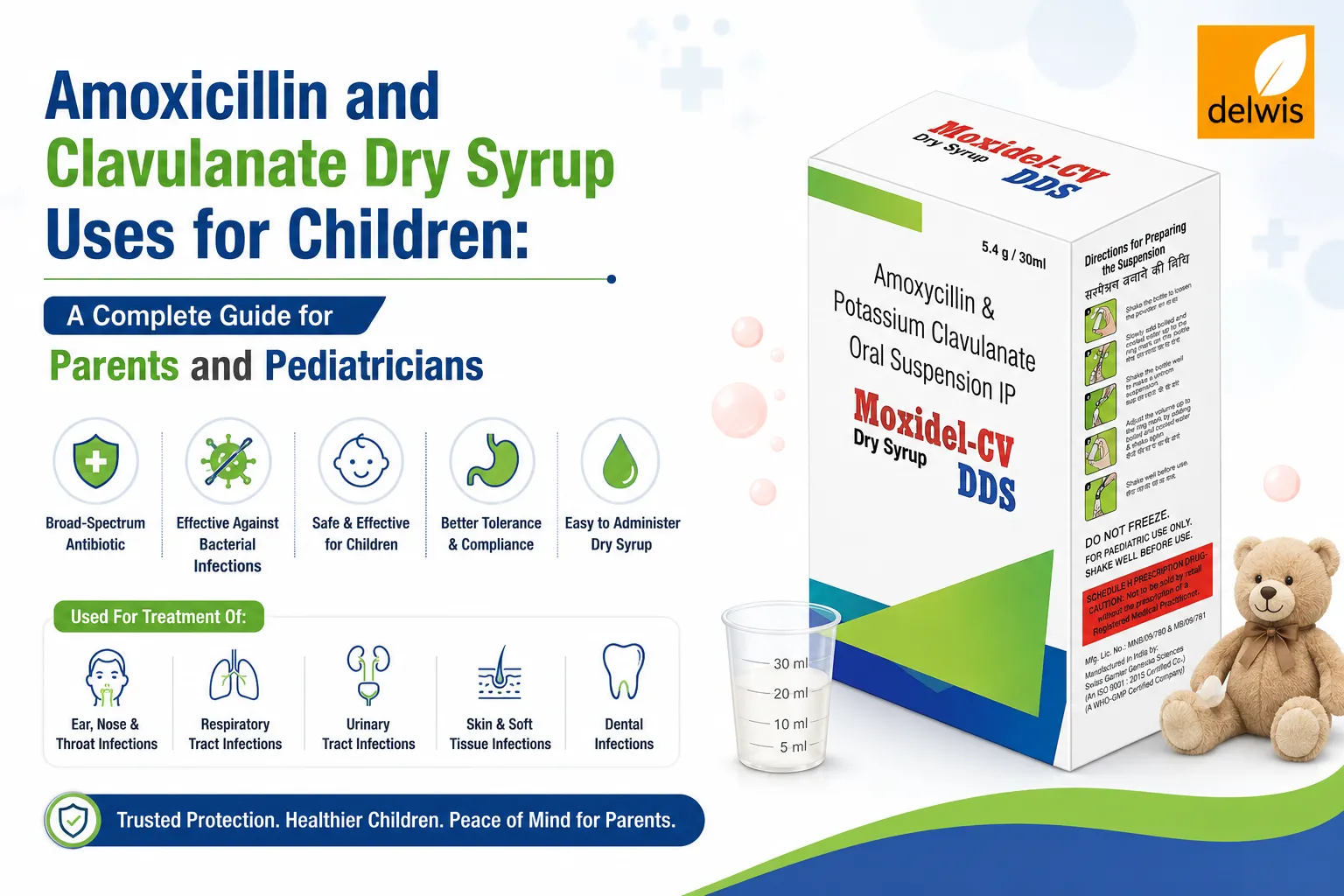
For the product profile, composition, and manufacturing details of this formulation, visit amoxycillin and potassium clavulanate oral suspension manufactured by Delwis Healthcare.
What Is Amoxicillin and Clavulanate Dry Syrup?
Amoxicillin and clavulanate dry syrup — also referred to as amoxicillin clavulanate dry syrup, amoxycillin clavulanic acid dry syrup, or DDS (Double Strength) dry syrup in the paediatric context — is a fixed-dose combination antibiotic formulation for children, available as a powder that is mixed with water before use to create an oral suspension.
The two active pharmaceutical ingredients are:
- Amoxycillin 400mg per 5ml — a broad-spectrum penicillin-class antibiotic that kills bacteria by disrupting their cell walls during active growth and division
- Potassium Clavulanate 57mg per 5ml — a beta-lactamase inhibitor that has no direct antibacterial activity but protects amoxicillin from being destroyed by a specific bacterial defence enzyme
Together, each 5ml dose of the reconstituted suspension delivers 457mg of total active ingredient — which is why this formulation is sometimes called the "457mg" or "double strength" paediatric dry syrup in clinical and pharmacy contexts. The 400mg amoxicillin component is the therapeutic workhorse; the 57mg clavulanate component is the shield that ensures amoxicillin can reach and kill bacteria that would otherwise resist it.
The "dry syrup" format — a powder that needs to be mixed with water before the first dose — exists for a specific pharmaceutical reason: amoxicillin and clavulanate are chemically unstable in liquid form over long periods, particularly at India's ambient temperatures. As a dry powder, the formulation remains stable for up to 24 months. Once mixed with water (reconstituted), the resulting suspension stays effective for 7 days when kept refrigerated.
Why Add Clavulanate? The Resistance Problem Explained for Parents
To understand why clavulanate is added to amoxicillin, parents need to understand one of the most important — and increasingly common — problems in treating children's bacterial infections: antibiotic resistance.
Bacteria are not passive. Over decades of antibiotic use, many common bacterial species have developed a defence mechanism against penicillin-class antibiotics like amoxicillin. They produce enzymes called beta-lactamases — proteins that chemically break apart the part of the amoxicillin molecule responsible for its antibacterial action, called the beta-lactam ring. Once that ring is broken, amoxicillin is inactivated before it can reach the bacteria — and the infection persists.
The three bacteria most commonly responsible for children's ear, throat, and sinus infections in India — Haemophilus influenzae, Moraxella catarrhalis, and certain strains of Staphylococcus aureus — are among the most frequent producers of beta-lactamase enzymes. This means that in many children, particularly those who have had antibiotic courses before, plain amoxicillin simply cannot work — not because the dose is wrong, but because the bacteria have developed the chemistry to destroy it.
Clavulanate solves this by binding irreversibly to the beta-lactamase enzyme itself, permanently switching it off. With the bacterial defence disarmed, amoxicillin can reach its target and do its job. Think of it this way: amoxicillin is the key, clavulanate is the mechanism that takes the lock off the door — allowing the key to finally work.
This is why amoxicillin and clavulanate dry syrup is not simply "stronger amoxicillin" — it is a combination that restores amoxicillin's effectiveness against bacteria that have evolved to resist it.
Amoxicillin and Clavulanate Dry Syrup Uses for Children — Condition by Condition
1. Ear Infections (Acute Otitis Media) — The Most Common Reason It Is Prescribed
Acute otitis media — an infection of the middle ear — is the single most frequently diagnosed bacterial infection in children in India, and the most common reason a paediatric antibiotic is prescribed. It is caused predominantly by three bacteria: Streptococcus pneumoniae, Haemophilus influenzae, and Moraxella catarrhalis. Two of these (H. influenzae and M. catarrhalis) are frequent beta-lactamase producers — meaning plain amoxicillin fails against them at a significant and growing rate.
Amoxicillin clavulanate at the 457mg high-dose formulation is specifically recommended in Indian and international paediatric guidelines as the antibiotic of choice for:
- Children under 2 years with ear infection (where the risk of resistant organisms is highest)
- Children of any age with severe or bilateral ear infections
- Children who have had an ear infection in the last month or have recently received antibiotics
- Children whose ear infection has not responded to plain amoxicillin within 48–72 hours
Parents should know that improvement in ear pain and fever typically begins within 24–48 hours of starting the syrup. If there is no improvement after 72 hours, or symptoms worsen, the paediatrician should be contacted.
2. Throat and Tonsil Infections (Tonsillitis and Pharyngitis)
Recurrent tonsillitis and treatment-resistant throat infections in children are a significant and frustrating clinical pattern that many Indian parents know well. The primary bacterial cause of tonsillitis is Streptococcus pyogenes (Group A Streptococcus), which is generally susceptible to plain amoxicillin. However, in children with recurrent tonsillitis, a secondary phenomenon occurs in tonsillar tissue: beta-lactamase-producing Staphylococcus aureus colonises the tonsillar crypts and produces beta-lactamase in the local tissue environment — which then destroys amoxicillin before it reaches the streptococcal pathogen it's meant to kill.
This is why some children have recurrent tonsillitis despite multiple courses of standard amoxicillin: the amoxicillin is being deactivated in the tonsil before it can work. The clavulanate component in amoxicillin and clavulanate dry syrup neutralises this local beta-lactamase activity — allowing amoxicillin to work against the streptococcal infection as intended.
3. Chest Infections — Community-Acquired Pneumonia and Bronchitis
Community-acquired pneumonia in children under five is one of India's most significant causes of childhood illness and hospitalisation. The most common bacterial pathogens — Streptococcus pneumoniae and Haemophilus influenzae — are both covered by amoxicillin-clavulanate, with clavulanate protecting against beta-lactamase-producing H. influenzae strains that are frequently implicated in paediatric lower respiratory tract infections.
The high-dose 457mg formulation achieves adequate lung tissue concentrations to exceed the minimum inhibitory concentration of intermediate-resistance pneumococcal strains — which have increased in Indian paediatric populations alongside rising antibiotic use. For outpatient management of mild-to-moderate community-acquired pneumonia in children, amoxicillin-clavulanate dry syrup is a first-line recommendation in Indian paediatric infectious disease guidelines.
Parents should note that a cough associated with bacterial pneumonia typically takes longer to resolve than the fever — fever usually breaks within 48–72 hours on treatment, while productive cough may persist for 1–2 weeks after the bacterial infection has been cleared. Completing the full antibiotic course is critical.
4. Sinusitis (Acute Bacterial Rhinosinusitis)
Sinusitis in children often follows a persistent or worsening upper respiratory viral infection — when bacteria colonise the fluid-filled sinuses that cannot drain properly due to the inflammation of the viral illness. The pathogens involved are the same as in ear infection: S. pneumoniae, H. influenzae, and M. catarrhalis. The clinical clue that sinusitis has become bacterial (rather than remaining viral) is persistence of nasal symptoms and facial pain beyond 10 days, or a secondary worsening after an initial improvement.
Amoxicillin and clavulanate is recommended over plain amoxicillin for sinusitis in children where beta-lactamase-producing organisms are suspected — particularly in children with previous antibiotic exposure or recurrent sinus infections.
5. Urinary Tract Infections (UTI) in Children
Urinary tract infections in children — including cystitis (bladder infection) and pyelonephritis (kidney infection) — are caused most commonly by Escherichia coli, Klebsiella pneumoniae, and Proteus mirabilis. Among these, beta-lactamase-producing E. coli strains (particularly in children with previous UTIs and antibiotic exposure) are increasingly prevalent in India.
Where urine culture identifies a beta-lactamase-producing organism, or where the child has had a prior UTI treated with standard antibiotics, amoxicillin-clavulanate is a clinically rational oral antibiotic choice for the ambulatory management of uncomplicated UTI in children — pending or in the absence of culture sensitivity data. Paediatric nephrologists and urologists may prescribe it as empirical therapy in children at higher risk of resistant uropathogens.
6. Skin and Soft Tissue Infections
Skin infections in children — including impetigo (crusty, spreading skin sores), infected insect bites, infected eczema patches, and early-stage cellulitis — are caused predominantly by Staphylococcus aureus and Streptococcus pyogenes. Community-acquired S. aureus in India has a significant rate of beta-lactamase production, meaning plain amoxicillin frequently fails for skin infections when the causative organism is Staphylococcus.
Amoxicillin-clavulanate dry syrup provides reliable oral antibiotic coverage for most non-MRSA (methicillin-susceptible) community-acquired staphylococcal and streptococcal skin infections in children — and is preferred over plain amoxicillin when skin infection has not responded to a prior antibiotic course.
How to Reconstitute Amoxicillin Clavulanate Dry Syrup — Step by Step
This is the step that causes the most confusion for parents — and where mistakes can compromise the quality and dose accuracy of every dose the child receives. Follow these steps carefully:
Step 1 — Gather what you need The glass bottle containing the dry powder and the separate small vial of Water for Injection (WFI) are both in the pack. Do not use tap water, filtered water, or boiled-and-cooled water as a substitute — only the provided WFI.
Step 2 — Add the full WFI volume Open the WFI vial and pour the entire contents into the dry powder glass bottle. Do not measure — pour everything in the vial. The WFI quantity is pre-calculated to achieve the correct 400mg amoxicillin + 57mg clavulanate per 5ml concentration.
Step 3 — Close and shake vigorously Cap the glass bottle firmly and shake it vigorously — not gently — for at least 30 seconds. The powder should completely dissolve into a uniform, smooth, pinkish-cream liquid suspension. If any powder remains stuck at the bottom, continue shaking until fully dispersed.
Step 4 — Check before giving each dose The suspension settles on standing — this is normal. Before measuring and giving each dose, always shake the bottle firmly again to re-suspend the powder evenly. Failure to shake before each dose results in the first doses being dilute and the last doses being concentrated — meaning your child is not getting consistent antibiotic coverage throughout the course.
Step 5 — Measure doses accurately Use only the measuring syringe or measuring spoon provided or supplied by your pharmacist. Household teaspoons are not accurate and can deliver under- or over-doses. For infants and toddlers, a 1ml or 2.5ml oral syringe allows the most accurate small-volume dosing.
Step 6 — Store in the refrigerator after reconstitution Once mixed, store the glass bottle in the refrigerator (2–8°C) — not in the freezer. The reconstituted suspension remains effective for 7 days from the day of mixing. Write the date of mixing and the discard date on the bottle label so you don't accidentally use it beyond day 7.
Dosage — A Guide for Parents and Prescribers
Dosage is always calculated by the paediatrician based on the child's current body weight, the type and severity of infection, and local resistance patterns. The standard dosing frameworks are:
Standard dose: 25–45 mg/kg/day of the amoxicillin component, given in two divided doses (twice daily — every 12 hours), for 5–7 days.
High dose (for ear infections and severe infections): 80–90 mg/kg/day of the amoxicillin component in two divided doses, for 10 days — specifically recommended for otitis media in children under 2 years, in areas with high resistant pneumococcal prevalence, and where previous treatment has failed.
Since this formulation delivers 400mg amoxicillin per 5ml, the volume per dose for a given weight is straightforward to calculate — but this must always be done and confirmed by the prescribing paediatrician. Never adjust or estimate the dose yourself based on comparisons with previous antibiotic courses.
Quick reference for common weight ranges (standard dose — always confirm with your paediatrician):
Child's Weight | Typical Dose Volume (Per Dose) | Frequency |
|---|
6–8 kg | 3.5–5 ml | Twice daily |
9–12 kg | 5–7 ml | Twice daily |
13–16 kg | 7–9 ml | Twice daily |
17–20 kg | 9–11 ml | Twice daily |
This table is indicative only. Always follow the specific dose volume prescribed by your child's paediatrician.
Before or After Food? Timing Matters
Give amoxicillin clavulanate syrup at the beginning of a meal or with food.
This is not merely a suggestion — it has two specific clinical reasons:
Reason 1 — Reduces gastrointestinal side effects: The most common side effects of this antibiotic combination in children are loose stools or diarrhoea and nausea — both primarily caused by the clavulanate component irritating the GI lining. Taking the syrup at the start of a meal significantly reduces this irritation by ensuring food is present to buffer the GI effects of the antibiotic.
Reason 2 — Improves amoxicillin absorption: Food — particularly a meal containing some fat — slows gastric emptying, which increases the time amoxicillin spends in the small intestine where it is absorbed. This improves overall bioavailability and ensures the child gets the full therapeutic benefit of each dose.
If your child vomits within 30 minutes of a dose, contact your paediatrician about whether to re-administer the dose. If vomiting occurs more than 30 minutes after the dose, the antibiotic has generally been sufficiently absorbed and a repeat dose is not required.
Side Effects in Children — What Parents Should Know and Watch For
Amoxicillin clavulanate dry syrup is generally well tolerated in children, but the clavulanate component makes it more likely to cause gastrointestinal side effects than plain amoxicillin:
Common (may affect up to 1 in 10 children):
- Loose stools or diarrhoea — The most frequently reported side effect. Usually mild and resolves on its own without stopping the antibiotic. Giving the syrup with food (as described above) reduces frequency and severity significantly. Diarrhoea occurring during or after antibiotic use is almost always mild antibiotic-associated diarrhoea — not an allergic reaction and not a reason to stop treatment without paediatric advice.
- Nausea and stomach discomfort — More common when given on an empty stomach. Giving with food usually resolves this.
- Skin rash — A mild, non-itchy rash occasionally occurs in children taking amoxicillin. This is usually an amoxicillin-specific (non-allergic) rash rather than a true penicillin allergy — but should always be reported to your paediatrician, who will assess whether it is a drug rash or an allergic reaction requiring the antibiotic to be stopped.
Less common but requiring prompt medical attention:
- Hives (urticaria) — Raised, itchy wheals on the skin appearing within minutes to hours of a dose may indicate a true allergic reaction. Stop the dose and contact your paediatrician immediately.
- Swelling of the lips, tongue, or throat (angioedema) — A rare but serious allergic reaction. This requires emergency medical attention.
- Severe or bloody diarrhoea — Rare but may indicate a Clostridioides difficile secondary infection. Contact your paediatrician if your child develops persistent watery or bloody diarrhoea during or after the antibiotic course.
- Yellowing of skin or eyes (jaundice) — A very rare side effect of clavulanate. If noticed, discontinue and contact your doctor immediately.
Managing diarrhoea during treatment: Ensure the child stays well hydrated with oral rehydration solution (ORS) or water, continue breastfeeding if applicable, and avoid high-sugar drinks and fruit juices which can worsen osmotic diarrhoea. Probiotic supplementation alongside antibiotics is widely used in Indian paediatric practice and may reduce antibiotic-associated diarrhoea — discuss with your paediatrician.
Who Should Not Take This Syrup? Precautions to Know
Penicillin allergy: Children with a confirmed allergy to any penicillin antibiotic (amoxicillin, ampicillin, flucloxacillin) should not receive amoxicillin-clavulanate. Always disclose any prior allergic reactions to antibiotics to the prescribing paediatrician before starting this medicine.
Previous clavulanate-related liver reaction: A small number of patients develop liver enzyme elevation or jaundice with clavulanate. Any child who has had a hepatic reaction to amoxicillin-clavulanate previously should not receive it again.
Mononucleosis (glandular fever): Children with confirmed or suspected Epstein-Barr virus (glandular fever) infection should not receive amoxicillin — it produces a widespread, characteristic rash in these patients that is frequently mistaken for a drug allergy.
Infants under 3 months: Use requires specific paediatric supervision with careful weight-based dose calculation and monitoring.
Conclusion
Amoxicillin and clavulanate dry syrup for children represents one of the most important advances in paediatric antibiotic prescribing — transforming a first-generation antibiotic that bacteria had learned to defeat into a reliable, broad-spectrum treatment for the most common bacterial infections in children by addressing the resistance mechanism directly. For parents, understanding why this combination is prescribed, how to prepare and give it correctly, and what to watch for in terms of side effects makes a meaningful difference to treatment outcomes. For paediatricians, this guide serves as a comprehensive reference for the clinical indications, dosage framework, and patient counselling points that support confident, complete antibiotic courses in the children they treat.
For the complete product profile, composition details, and manufacturing quality standards behind this formulation, explore the amoxycillin and potassium clavulanate oral suspension by Delwis Healthcare. To explore the full pediatrics range of oral liquid formulations and dry syrups manufactured at our WHO-GMP certified Ahmedabad facility, visit the Delwis Healthcare paediatrics portfolio.
Frequently Asked Questions
Q: What is amoxicillin and clavulanate dry syrup used for in children?
It is used for bacterial infections in children where beta-lactamase-producing resistant bacteria are involved — most commonly ear infections (acute otitis media), throat and tonsil infections (tonsillitis), chest infections (community-acquired pneumonia, bronchitis), sinusitis, urinary tract infections, and skin infections. It is prescribed when plain amoxicillin has failed or when resistant bacteria are expected.
Q: What does "dry syrup" mean?
Dry syrup refers to the formulation format — a powder that must be mixed (reconstituted) with water before it can be administered as a liquid suspension to a child. The dry powder format ensures the antibiotic remains chemically stable for up to 24 months. Once mixed with water, it must be used within 7 days and stored in the refrigerator.
Q: Why does my child have diarrhoea after starting this syrup?
Loose stools and diarrhoea are the most common side effects, caused primarily by the clavulanate component affecting the gut lining and gut bacteria. This is usually mild, self-limiting, and not a reason to stop the antibiotic without paediatric advice. Always give the syrup with food at the start of a meal, keep your child well hydrated, and consult your paediatrician if the diarrhoea is severe, bloody, or accompanied by high fever.
Q: How do I know if my child is allergic to this antibiotic?
True penicillin allergy is rare but important to identify. Signs include hives (raised, itchy skin welts), swelling of the face, lips, or throat, difficulty breathing, or a widespread rash appearing within minutes to an hour of the dose. Mild non-itchy rashes can also occur with amoxicillin in children without glandular fever — these are usually not true allergic reactions but must be assessed by a paediatrician. When in doubt, stop the dose and seek medical advice promptly.
Q: Is amoxicillin clavulanate dry syrup safe for babies under 1 year?
Yes, it can be used in infants and even neonates under paediatric supervision, with doses calculated precisely by body weight. For very young infants, the paediatrician should confirm the specific dosage and monitor the child's response. Never estimate or self-adjust dosing in infants.
Q: My child spit out some of the syrup. Should I give another dose?
If a significant portion of the dose is spat out immediately (within a few seconds), you can attempt to give the dose again calmly — but do not force it or give a double dose. If your child consistently refuses the syrup, inform your paediatrician. The syrup can be mixed with a small amount of juice or sweetened water (ask your pharmacist), but should not be mixed in advance or in a large volume of liquid.
Q: Should the syrup be refrigerated?
Yes — after reconstitution (mixing with water), the suspension must be stored in the refrigerator at 2–8°C. Do not freeze. The dry powder bottle (before mixing) should be stored below 25°C, protected from light and moisture. Always check the expiry date on the outer box before reconstituting.
Q: What is the difference between this syrup and Augmentin DS?
Augmentin DS is a brand name for the same combination — amoxicillin 400mg + clavulanate 57mg per 5ml (457mg DDS). The active ingredients, formulation, and therapeutic effect are identical. Different pharmaceutical manufacturers produce this combination under various brand names in India.
This guide is written for informational and educational purposes only. It does not constitute medical advice or a substitute for professional paediatric assessment and prescribing. All dosing decisions and antibiotic courses for children must be directed by a qualified paediatrician or physician based on individual clinical evaluation.