Skin infections and inflammatory skin conditions can cause redness, itching, swelling, irritation, tenderness, scaling, or discharge. Because many dermatological conditions can produce similar symptoms, choosing an appropriate topical treatment requires identifying the underlying cause rather than simply selecting a cream based on its strength.
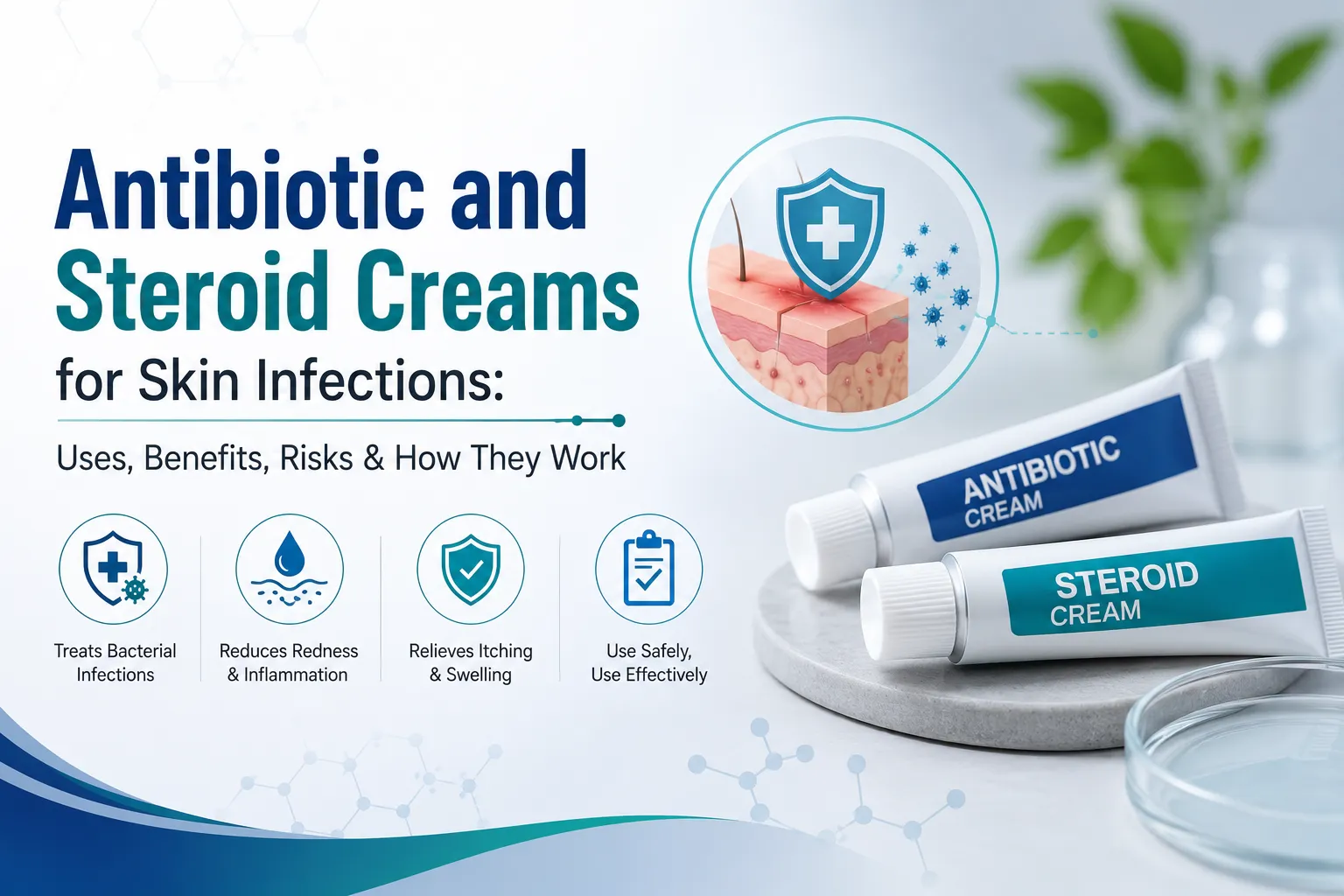
Antibiotic and steroid creams combine two different therapeutic approaches: an antibiotic that acts against susceptible bacteria and a corticosteroid that reduces inflammation. Such combinations may be useful in selected dermatological conditions when bacterial infection and significant inflammation occur together.
However, these products are not appropriate for every skin rash or infection. In particular, corticosteroids can mask or worsen certain fungal and viral infections when used without an appropriate diagnosis.
This guide explains how topical antibiotics and corticosteroids work, when combination creams may be considered, their potential benefits and risks, and important considerations for patients, dermatologists, pharmaceutical companies, and healthcare businesses.
Quick Answer: What Are Antibiotic and Steroid Creams Used For?
Antibiotic and steroid creams may be prescribed for selected inflammatory skin conditions where a susceptible bacterial infection is also present or suspected.
The antibiotic component targets susceptible bacteria, while the corticosteroid helps reduce inflammation such as redness, swelling, and itching.
They should not be routinely used for:
- Unexplained skin rashes
- Uncomplicated fungal infections
- Viral skin infections
- Long-term self-treatment of chronic skin problems
- Every itchy or red skin lesion
The most appropriate treatment depends on the underlying diagnosis and should be selected according to professional medical advice and the specific product's approved indications.
For pharmaceutical companies evaluating topical combination products, an experienced Fusidic Acid and Mometasone Cream Manufacturer can be an important partner for formulation, quality-controlled production, filling, packaging, and commercial supply.
What Are Antibiotic and Steroid Creams?
Antibiotic and steroid creams contain two different categories of active pharmaceutical ingredients.
Topical antibiotic
A topical antibiotic is intended to act against susceptible bacteria that may be responsible for a localized bacterial skin infection.
Examples include:
- Fusidic acid
- Mupirocin
- Neomycin
- Other topical antibiotics depending on the formulation and indication
Topical corticosteroid
A corticosteroid reduces inflammatory activity in the skin. Depending on the specific corticosteroid and its potency, it may help control:
- Redness
- Swelling
- Itching
- Irritation
- Inflammatory discomfort
A combination product therefore attempts to address bacterial infection and inflammation at the same time when both are clinically relevant.
That does not mean every bacterial infection requires a steroid, or that every inflamed skin condition requires an antibiotic.
How Do Antibiotic and Corticosteroid Creams Work?
The two components have different mechanisms of action.
How Does a Topical Antibiotic Work?
Topical antibiotics interfere with bacterial processes that are essential for growth or survival.
For example, fusidic acid interferes with bacterial protein synthesis by affecting elongation factor G, an important component of bacterial protein production.
Mupirocin works through a different mechanism and inhibits bacterial protein synthesis by interfering with isoleucyl-tRNA synthetase.
The choice of topical antibiotic depends on factors such as the suspected organism, susceptibility, clinical presentation, treatment site, and applicable treatment guidance.
How Does a Topical Corticosteroid Work?
Topical corticosteroids reduce inflammation by modifying inflammatory processes within the skin.
Depending on the corticosteroid and formulation, they can reduce:
- Redness
- Itching
- Swelling
- Irritation
- Inflammatory symptoms
However, topical corticosteroids vary in potency. Their appropriate use therefore depends on the specific medicine, concentration, application site, patient's age, treatment duration, and clinical diagnosis.
When Can an Antibiotic-Steroid Combination Be Helpful?
A combination may be considered when a bacterial infection and significant inflammation are present together and both components are appropriate for the diagnosed condition.
A healthcare professional may consider factors such as:
- Whether bacterial infection is actually present.
- Whether the suspected bacteria are susceptible to the antibiotic.
- Whether inflammation is significant enough to justify a corticosteroid.
- Where the product will be applied.
- How long treatment should continue.
- The patient's age and medical history.
- The approved indication of the specific formulation.
The combination should therefore be considered a targeted treatment option, not a general-purpose cream for redness, itching, or irritation.
Antibiotic Cream vs Steroid Cream: What's the Difference?
The primary difference is their therapeutic purpose.
Feature | Topical Antibiotic | Topical Corticosteroid |
Primary purpose | Treat susceptible bacterial infection | Reduce inflammation |
Acts against bacteria | Yes | No |
Reduces inflammation | Not its primary role | Yes |
Treats fungal infections | No | No |
Treats viral infections | No | No |
Main role | Bacterial infection | Inflammatory skin disease |
Combination use | Selected clinical situations | Selected clinical situations |
A cream that reduces redness or itching does not necessarily treat the underlying cause of the condition.
Can Steroid Creams Make Skin Infections Worse?
Yes, in certain circumstances.
Corticosteroids suppress local inflammation. If an infection is present but the diagnosis has not been established, reducing visible inflammation may make the infection more difficult to recognize.
In some cases, inappropriate corticosteroid use can allow certain infections to persist or worsen.
This is particularly relevant to fungal and viral skin infections.
For this reason, steroid-containing topical medicines should be used only when the diagnosis and treatment rationale are appropriate.
If a rash spreads, changes appearance, becomes painful, or does not improve as expected, medical reassessment is preferable to simply using a stronger or different steroid-containing cream.
Are Antibiotic and Steroid Creams Suitable for Fungal Infections?
Generally, antibiotic-steroid combinations are not routine treatments for uncomplicated fungal infections.
Fungal infections require an appropriate antifungal medicine.
Using a corticosteroid-containing product on an undiagnosed fungal infection can temporarily reduce redness and itching while allowing the underlying fungal infection to persist.
This can make the infection more difficult to recognize and potentially delay appropriate treatment.
For readers researching topical antifungal options, our related guide on Luliconazole vs ketoconazole vs clotrimazole provides a separate comparison of commonly used antifungal medicines.
What Is the Role of Fusidic Acid in Topical Skin Treatment?
Fusidic acid is a topical antibiotic used against susceptible bacteria. It is particularly associated with treatment of certain staphylococcal skin infections.
Its antibacterial activity results from interference with bacterial protein synthesis.
However, antimicrobial resistance is an important consideration. Unnecessary or prolonged use of topical antibiotics can contribute to selection of resistant bacteria.
Therefore, fusidic acid-containing products should be used according to appropriate medical advice and the approved information for the particular formulation.
For a more detailed discussion of the specific antibiotic-corticosteroid combination, readers can also refer to our complete guide to fusidic acid and mometasone cream uses.
This creates a useful distinction between the two articles: this guide discusses antibiotic-steroid combinations broadly, while the linked article focuses specifically on the individual combination and its uses.
What Is the Role of Mometasone?
Mometasone is a topical corticosteroid used to reduce inflammation associated with selected dermatological conditions.
Depending on the formulation and approved indication, it can help reduce symptoms such as:
- Redness
- Itching
- Swelling
- Inflammation
Mometasone-containing products should be used according to the relevant product information and professional advice.
Particular care may be necessary when topical corticosteroids are used on sensitive areas, large areas of skin, broken skin, or for extended periods.
When Should an Antibiotic-Steroid Combination Be Avoided?
These products should not automatically be used whenever the skin is red, swollen, or itchy.
A healthcare professional may need to reconsider combination treatment when:
- A fungal infection is suspected.
- A viral infection is suspected.
- The diagnosis is uncertain.
- There is no evidence of bacterial infection.
- The condition is improving without an antibiotic requirement.
- Prolonged corticosteroid exposure could create additional risk.
- The affected area is particularly sensitive.
- The infection repeatedly returns.
Correct diagnosis is especially important because several dermatological diseases can produce similar visible symptoms.
Common Side Effects of Topical Antibiotic and Steroid Creams
Side effects vary depending on the active ingredients, formulation, treatment area, duration, and individual sensitivity.
Potential local effects include:
- Burning
- Stinging
- Irritation
- Redness
- Itching
- Dryness
With inappropriate or prolonged corticosteroid use, additional effects may occur, including:
- Skin thinning
- Stretch marks
- Changes in pigmentation
- Visible small blood vessels
- Increased susceptibility to local infection
The risk depends on factors such as corticosteroid potency, treatment duration, application site, amount used, and whether the area is covered.
Patients should seek medical advice if they develop significant irritation, worsening symptoms, or an unexpected reaction.
How Should These Creams Be Used Safely?
Safe use starts with following the instructions for the specific product prescribed or recommended by a healthcare professional.
Apply only to the recommended area
Avoid applying the product to other areas unless instructed.
Wash your hands
Wash hands before and after application unless the hands themselves are the treatment area.
Follow the recommended duration
Do not continue treatment indefinitely simply because symptoms have not completely disappeared.
Avoid unnecessary occlusion
Covering the treated area can increase corticosteroid absorption and should generally only be done when specifically advised.
Keep away from the eyes
Unless specifically formulated and prescribed for ocular use, topical skin preparations should not be placed in the eyes.
Reassess persistent symptoms
If the condition does not improve, the diagnosis may need to be reviewed rather than simply extending treatment.
When Should You See a Dermatologist?
Professional medical assessment is particularly important when:
- The rash is spreading rapidly.
- There is significant pain or swelling.
- Pus or extensive discharge is present.
- Fever or systemic symptoms occur.
- The area around the eye is affected.
- The condition repeatedly returns.
- Symptoms fail to improve.
- The diagnosis is uncertain.
- A child has a significant or persistent skin infection.
- A patient has medical factors that increase infection risk.
A dermatologist can determine whether the condition is bacterial, fungal, viral, inflammatory, allergic, or another dermatological disorder.
Antibiotic Resistance and Responsible Use
Antibiotic resistance is an important consideration for both oral and topical antimicrobial medicines.
Repeated or unnecessary antibiotic exposure can contribute to selection of resistant organisms.
Responsible use includes:
- Using antibiotics only when clinically appropriate.
- Following professional treatment instructions.
- Avoiding unnecessary repeated courses.
- Reassessing treatment failure.
- Considering antimicrobial susceptibility and local resistance patterns where appropriate.
A combination cream containing an antibiotic should therefore not be viewed as a general treatment for every irritated or inflamed area of skin.
Antibiotic and Steroid Creams vs Antifungal Treatments
Understanding the difference between bacterial and fungal infections is important.
Bacterial infection
A suitable topical antibiotic may be considered for an appropriate localized bacterial infection.
Fungal infection
An appropriate antifungal medicine is generally required.
Inflammatory skin disease
A topical corticosteroid may be considered when clinically appropriate.
Bacterial infection with substantial inflammation
In selected situations, an antibiotic-corticosteroid combination may be considered.
Viral infection
Antibiotic-steroid combinations are not routine antiviral treatments.
The central principle is:
Identify and treat the underlying cause rather than simply suppressing visible symptoms.
For pharmaceutical businesses working across dermatology, topical dosage forms can include creams, gels, ointments, and powders. Delwis Healthcare's Cream Manufacturing category provides a relevant starting point for companies evaluating commercial cream production.
Related Topical Antifungal Products
Antibiotic-steroid products and antifungal products have different therapeutic roles.
For example, Delwis Healthcare's portfolio includes a Luliconazole Cream Manufacturer page for businesses evaluating a topical antifungal product.
The company also has a Clotrimazole Dusting Powder manufacturing page, which is relevant to topical antifungal powder formulations.
For educational information specifically about clotrimazole dusting powder, see the related Clotrimazole Dusting Powder Uses guide.
These links should be viewed as related topical dosage-form resources rather than interchangeable treatments. The appropriate medicine depends on the underlying condition and product indication.
For Pharmaceutical Companies: What Matters in Topical Combination Cream Manufacturing?
For pharmaceutical companies, distributors, and healthcare brands, manufacturing a topical combination cream requires more than simply combining two active ingredients.
Important manufacturing considerations include:
Raw material quality
Active pharmaceutical ingredients and excipients should meet established specifications and quality requirements.
Formulation uniformity
The manufacturing process should achieve consistent distribution of the active ingredients throughout the finished formulation.
Physical characteristics
Depending on the formulation, attributes such as:
- Appearance
- Texture
- Viscosity
- pH
- Consistency
- Homogeneity
may be important quality characteristics.
Assay and finished-product testing
Appropriate testing helps verify that active ingredients meet applicable specifications.
Microbiological quality
Topical products require appropriate microbiological controls to maintain product quality and patient safety.
Stability
Stability studies help establish how the formulation performs throughout its intended shelf life under defined storage conditions.
Filling and packaging
Suitable tubes, containers, closures, and filling processes help maintain product integrity and consistent presentation.
Why Formulation Quality Matters in Topical Products
Topical pharmaceutical products need to provide consistent performance from batch to batch.
A well-controlled cream formulation should have appropriate:
- Spreadability
- Consistency
- Homogeneity
- Stability
- Packaging compatibility
- Active-ingredient distribution
Manufacturing variables such as mixing, homogenization, temperature, addition sequence, holding time, and filling conditions can influence the final product.
For B2B pharmaceutical companies, this makes the manufacturer's quality systems, process controls, testing capabilities, documentation, and production infrastructure important factors during supplier evaluation.
Choosing a Third-Party or CMO Manufacturing Partner
Pharmaceutical companies considering topical combination products should evaluate potential manufacturing partners based on more than production capacity.
Important criteria include:
- GMP compliance
- Quality assurance systems
- Quality control capabilities
- Raw material qualification
- Validated manufacturing processes
- Formulation development capabilities
- Stability-testing support
- Filling and packaging capabilities
- Batch documentation
- Regulatory support
- Production scalability
- Supply reliability
A qualified CMO or pharma third-party manufacturer can provide manufacturing infrastructure and technical capabilities while pharmaceutical companies focus on commercialization, distribution, brand development, and market expansion.
Key Takeaways
- Topical antibiotics target susceptible bacteria, while corticosteroids reduce inflammation.
- Antibiotic-steroid combinations may have a role in selected conditions where bacterial infection and significant inflammation occur together.
- They are not general-purpose treatments for every itchy, red, or irritated rash.
- Corticosteroids can mask or worsen certain fungal and viral infections when used incorrectly.
- Fungal infections generally require an appropriate antifungal treatment rather than an antibiotic-steroid combination.
- Responsible antibiotic use is important because unnecessary exposure can contribute to antimicrobial resistance.
- Treatment should consider the diagnosis, affected area, patient factors, treatment duration, and approved product information.
- For pharmaceutical businesses, formulation consistency, GMP systems, testing, stability, filling, packaging, documentation, and scalable production are important when selecting a manufacturing partner.
Conclusion
Antibiotic and corticosteroid creams have a role in managing selected dermatological conditions, but they should be used for the appropriate indication and for an appropriate duration.
The antibiotic component addresses susceptible bacterial organisms, while the corticosteroid helps control inflammation. Combining the two can therefore be useful in carefully selected cases, but the combination should not be considered a universal treatment for skin infections.
For patients, obtaining an appropriate diagnosis before using a combination cream is one of the most important steps. For pharmaceutical companies, selecting a manufacturing partner requires consideration of formulation expertise, manufacturing controls, quality testing, stability, filling, packaging, regulatory support, and production scalability.
For B2B pharmaceutical companies evaluating topical dermatology products, Delwis Healthcare provides manufacturing capabilities across relevant dosage forms. Explore Cream Manufacturing for broader capabilities or review the Fusidic Acid and Mometasone Cream Manufacturer page for the specific product category.
Frequently Asked Questions
What are antibiotic and steroid creams used for?
They may be prescribed for selected skin conditions where a susceptible bacterial infection occurs alongside significant inflammation. They are not suitable for every skin rash or infection.
Can antibiotic and steroid creams treat fungal infections?
They are not routine treatments for uncomplicated fungal infections. An appropriate antifungal medicine is generally required when a fungal infection has been diagnosed.
Can steroid creams make infections worse?
Yes. Corticosteroids can suppress inflammation and may mask or aggravate certain infections when used inappropriately.
Is fusidic acid an antibiotic?
Yes. Fusidic acid is a topical antibiotic that acts against susceptible bacteria by interfering with bacterial protein synthesis.
What does mometasone do in a combination cream?
Mometasone is a corticosteroid that reduces inflammation and symptoms such as redness and itching when used for appropriate dermatological conditions.
Are antibiotic-steroid creams safe for long-term use?
They are not generally intended for unrestricted long-term use. Duration depends on the specific product, indication, corticosteroid potency, application site, and medical advice.
Can I use an antibiotic-steroid cream for any itchy rash?
No. Itching can result from fungal infections, eczema, allergies, irritation, and other conditions. The underlying cause should be established before choosing treatment.
What should I do if the skin infection does not improve?
Consult a healthcare professional. Persistent symptoms may indicate an incorrect diagnosis, resistant organism, reinfection, treatment intolerance, or another dermatological condition.
Medical disclaimer: This article is intended for educational purposes and does not replace professional medical diagnosis or treatment. The appropriate topical medicine depends on the diagnosis, affected area, severity, patient factors, and approved product information.